Longo Umile Giuseppe, Matarese Maria, Arcangeli Valeria, Alciati Viviana, Candela Vincenzo, Facchinetti Gabriella, Marchetti Anna, De Marinis Maria Grazia, Denaro Vincenzo
Department of Orthopedic and Trauma Surgery, Campus Bio-Medico University, Via Alvaro del Portillo, 200, 00128 Trigoria, Rome, Italy.
Research Unit Nursing Science, Campus Bio-Medico di Roma University, 00128 Rome, Italy.
J Clin Med. 2020 May 16;9(5):1497. doi: 10.3390/jcm9051497.
Caregivers represent the core of patients' care in hospital structures, in the process of care and self-care after discharge. We aim to identify the factors that affect the strain of caring for orthopedic patients and how these factors are related to the quality of life of caregivers. We also want to evaluate the role of caregivers in orthopedic disease, focusing attention on the patient-caregiver dyad.
A comprehensive search on PubMed, Cochrane, CINAHL and Embase databases was conducted. This review was reported following PRISMA statement guidance. Studies were selected, according to inclusion and exclusion criteria, about patient-caregiver dyads. For quality assessment, we used the MINORS and the Cochrane Risk of BIAS assessment tool.
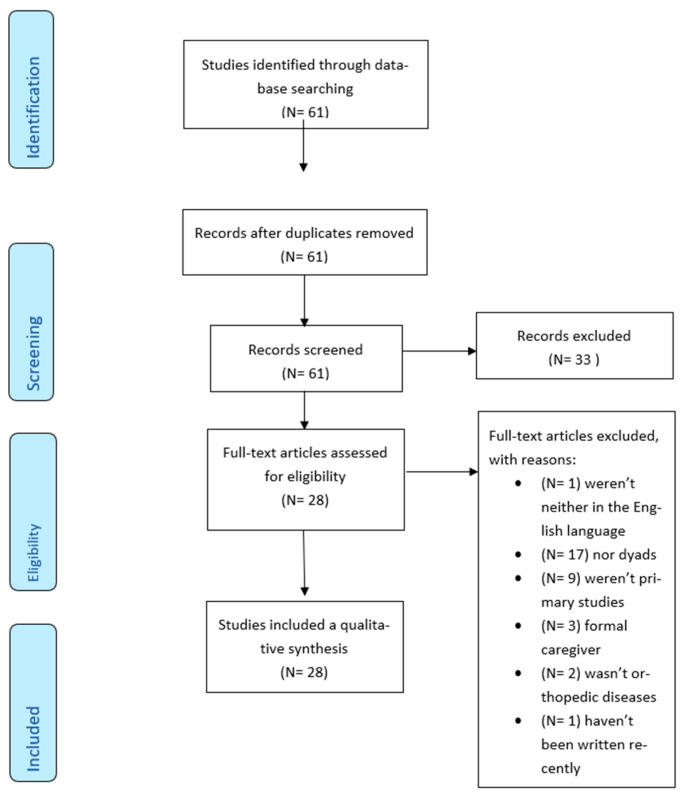
28 studies were included in the systematic review; in these studies, 3034 dyads were analyzed. Caregivers were not always able to bear the difficulties of care. An improvement in strain was observed after behavioral interventions from health-care team members; Conclusions: The role of the caregiver can lead to a deterioration of physical, cognitive and mental conditions. The use of behavioral interventions increased quality of life, reducing the strain in caregivers of orthopedic patients. For this reason, it is important to consider the impact that orthopedic disease has on the strain of the caregiver and to address this topic.
在医院结构中以及出院后的护理和自我护理过程中,护理人员是患者护理的核心。我们旨在确定影响骨科患者护理压力的因素,以及这些因素与护理人员生活质量的关系。我们还想评估护理人员在骨科疾病中的作用,重点关注患者 - 护理人员二元组。
对PubMed、Cochrane、CINAHL和Embase数据库进行了全面检索。本综述按照PRISMA声明指南进行报告。根据纳入和排除标准,选择了关于患者 - 护理人员二元组的研究。对于质量评估,我们使用了MINORS和Cochrane偏倚风险评估工具。
系统评价纳入了28项研究;在这些研究中,分析了3034个二元组。护理人员并非总能承受护理的困难。在医疗团队成员进行行为干预后,压力得到了改善。结论:护理人员的角色可能导致身体、认知和心理状况的恶化。行为干预的使用提高了生活质量,减轻了骨科患者护理人员的压力。因此,重要的是要考虑骨科疾病对护理人员压力的影响,并解决这一问题。