Department of Genetics and Molecular Pathology, SA Pathology, Adelaide, SA, Australia.
Centre for Cancer Biology, SA Pathology and University of South Australia, Adelaide, SA, Australia.
Blood. 2020 Jul 2;136(1):24-35. doi: 10.1182/blood.2019000937.
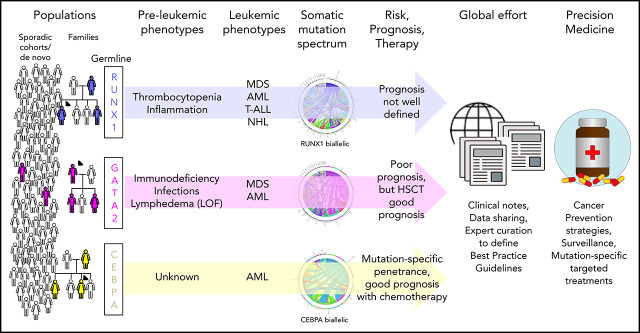
Recognition that germline mutations can predispose individuals to blood cancers, often presenting as secondary leukemias, has largely been driven in the last 20 years by studies of families with inherited mutations in the myeloid transcription factors (TFs) RUNX1, GATA2, and CEBPA. As a result, in 2016, classification of myeloid neoplasms with germline predisposition for each of these and other genes was added to the World Health Organization guidelines. The incidence of germline mutation carriers in the general population or in various clinically presenting patient groups remains poorly defined for reasons including that somatic mutations in these genes are common in blood cancers, and our ability to distinguish germline (inherited or de novo) and somatic mutations is often limited by the laboratory analyses. Knowledge of the regulation of these TFs and their mutant alleles, their interaction with other genes and proteins and the environment, and how these alter the clinical presentation of patients and their leukemias is also incomplete. Outstanding questions that remain for patients with these germline mutations or their treating clinicians include: What is the natural course of the disease? What other symptoms may I develop and when? Can you predict them? Can I prevent them? and What is the best treatment? The resolution of many of the remaining clinical and biological questions and effective evidence-based treatment of patients with these inherited mutations will depend on worldwide partnerships among patients, clinicians, diagnosticians, and researchers to aggregate sufficient longitudinal clinical and laboratory data and integrate these data with model systems.
人们认识到种系突变可使个体易患血液癌症,通常表现为继发性白血病,这在过去 20 年中主要得益于对具有髓系转录因子(TF)RUNX1、GATA2 和 CEBPA 遗传突变的家族进行的研究。因此,在 2016 年,世界卫生组织指南中增加了具有种系易感性的这些和其他基因的髓系肿瘤分类。由于某些原因,包括这些基因的体细胞突变在血液癌症中很常见,并且我们区分种系(遗传或从头发生)和体细胞突变的能力通常受到实验室分析的限制,因此在普通人群或各种临床表现的患者群体中种系突变携带者的发生率仍未得到很好的定义。这些 TF 及其突变等位基因的调控、它们与其他基因和蛋白质及环境的相互作用以及这些如何改变患者及其白血病的临床表现等方面的知识也不完整。对于具有这些种系突变的患者或为其治疗的临床医生,仍存在许多悬而未决的问题,包括:疾病的自然病程如何?我可能会出现哪些其他症状,何时出现?能否预测?能否预防?以及最佳治疗方法是什么?解决许多剩余的临床和生物学问题并为具有这些遗传突变的患者提供有效的循证治疗,将取决于患者、临床医生、诊断医生和研究人员之间的全球合作关系,以汇集足够的纵向临床和实验室数据,并将这些数据与模型系统相结合。