Sehlmeyer Kirsten, Ruwisch Jannik, Roldan Nuria, Lopez-Rodriguez Elena
Institute of Functional and Applied Anatomy, Hannover Medical School, Hanover, Germany.
Biomedical Research in Endstage and Obstructive Lung Disease Hannover, Member of the German Centre for Lung Research, Hanover, Germany.
Front Physiol. 2020 May 5;11:386. doi: 10.3389/fphys.2020.00386. eCollection 2020.
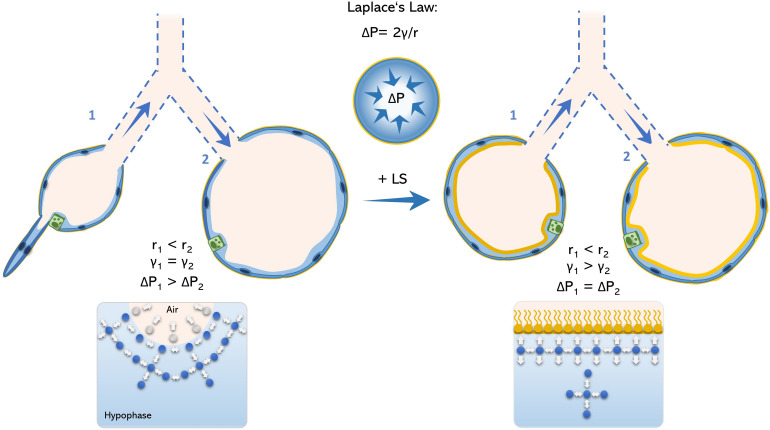
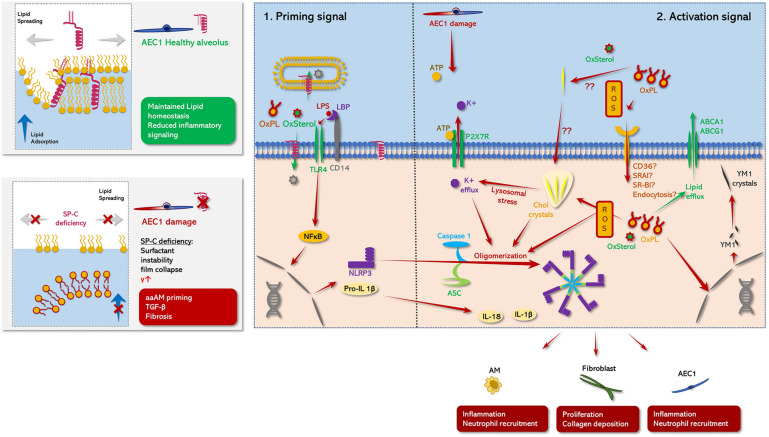
Surfactant protein C (SP-C) is an important player in enhancing the interfacial adsorption of lung surfactant lipid films to the alveolar air-liquid interface. Doing so, surface tension drops down enough to stabilize alveoli and the lung, reducing the work of breathing. In addition, it has been shown that SP-C counteracts the deleterious effect of high amounts of cholesterol in the surfactant lipid films. On its side, cholesterol is a well-known modulator of the biophysical properties of biological membranes and it has been proven that it activates the inflammasome pathways in the lung. Even though the molecular mechanism is not known, there are evidences suggesting that these two molecules may interplay with each other in order to keep the proper function of the lung. This review focuses in the role of SP-C and cholesterol in the development of lung fibrosis and the potential pathways in which impairment of both molecules leads to aberrant lung repair, and therefore impaired alveolar dynamics. From molecular to cellular mechanisms to evidences in animal models and human diseases. The evidences revised here highlight a potential SP-C/cholesterol axis as target for the treatment of lung fibrosis.
表面活性蛋白C(SP-C)在增强肺表面活性物质脂质膜向肺泡气液界面的界面吸附中起着重要作用。通过这样做,表面张力下降到足以稳定肺泡和肺,减少呼吸功。此外,已经表明SP-C可抵消表面活性物质脂质膜中大量胆固醇的有害作用。就胆固醇而言,它是生物膜生物物理特性的众所周知的调节剂,并且已经证明它可激活肺中的炎性小体途径。尽管分子机制尚不清楚,但有证据表明这两种分子可能相互作用以维持肺的正常功能。本综述重点关注SP-C和胆固醇在肺纤维化发展中的作用以及这两种分子的损伤导致异常肺修复从而导致肺泡动力学受损的潜在途径。从分子机制到细胞机制,再到动物模型和人类疾病中的证据。此处修订的证据突出了潜在的SP-C/胆固醇轴作为治疗肺纤维化的靶点。