López-Cabrera Rocío, Arenas Alicia, Medina Francisco J, Euwema Martin, Munduate Lourdes
Department of Social Psychology, University of Seville, Seville, Spain.
Occupational & Organizational Psychology and Professional Learning, Katholieke Universiteit Leuven, Leuven, Belgium.
Front Psychol. 2020 May 4;11:556. doi: 10.3389/fpsyg.2020.00556. eCollection 2020.
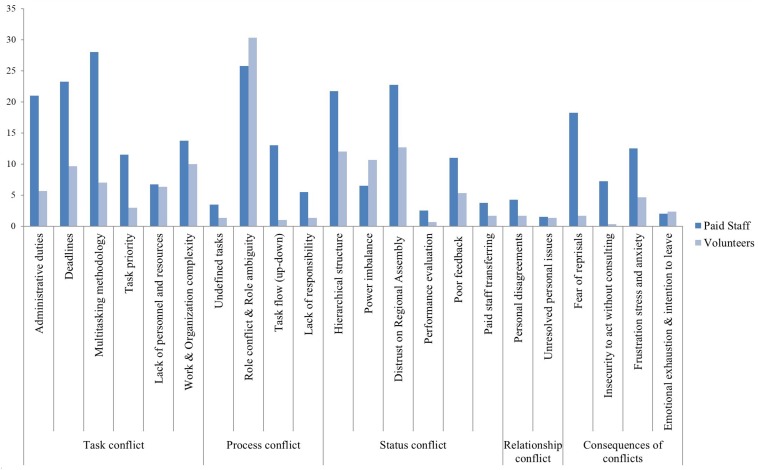
Non-profit organizations (NPOs) are quite complex in terms of organizational structure, diversity at the workplace, as well as motivational mechanisms and value rationality. Nevertheless, from the perspective of organizational psychology, the systematic analysis of this context is scarce in the literature, particularly regarding conflicts. This qualitative study analyzes types, prevalence, and consequences of conflicts in a large NPO considering as theoretical framework several consolidated organizational psychology theories: conflict theory, social comparison theory, and equity theory. Conflicts were analyzed taking into account volunteers' perspective, who have been the consistent protagonist in NPO research, but also considering paid staff's perspective as one of the main stakeholders in these organizations, whose relative power has increased in the past decade due to the professionalization of the NPO's sector. Results confirmed the existence of four types of conflicts: task, process, status, and relationship conflicts. Relationship conflict is the least reported type, revealing the protection factor that values and engagement with a social aim have on this organizational context. The most relevant finding is the strong difference between paid staff and volunteers in conflict perceptions, showing paid staff, overall, higher levels of conflicts than volunteers. Findings also show stronger negative consequences for paid staff compared to volunteers. Theoretical and practical implications are discussed.
非营利组织(NPO)在组织结构、工作场所的多样性以及激励机制和价值合理性方面相当复杂。然而,从组织心理学的角度来看,文献中对这一背景的系统分析很少,尤其是关于冲突的分析。本定性研究以冲突理论、社会比较理论和公平理论等几种成熟的组织心理学理论为理论框架,分析了一个大型非营利组织中冲突的类型、普遍性和后果。在分析冲突时,既考虑了志愿者的观点(志愿者一直是NPO研究中的主要角色),也考虑了带薪员工的观点(带薪员工是这些组织的主要利益相关者之一,由于NPO部门的专业化,其相对权力在过去十年中有所增加)。结果证实存在四种类型的冲突:任务冲突、过程冲突、地位冲突和关系冲突。关系冲突是报告最少的类型,这揭示了价值观和对社会目标的参与对这种组织环境的保护作用。最相关的发现是带薪员工和志愿者在冲突认知上存在很大差异,总体而言,带薪员工的冲突水平高于志愿者。研究结果还表明,与志愿者相比,带薪员工受到的负面影响更大。本文讨论了理论和实践意义。