Krysiak Yaşar, Marler Bernd, Barton Bastian, Plana-Ruiz Sergi, Gies Hermann, Neder Reinhard B, Kolb Ute
Institute of Inorganic Chemistry and Analytical Chemistry, Johannes Gutenberg University, Duesbergweg 10-14, Mainz D-55128, Germany.
Department of Materials and Geoscience, Technische Universität Darmstadt, Petersenstrasse 23, Darmstadt D-64287, Germany.
IUCrJ. 2020 Apr 21;7(Pt 3):522-534. doi: 10.1107/S2052252520003991. eCollection 2020 May 1.
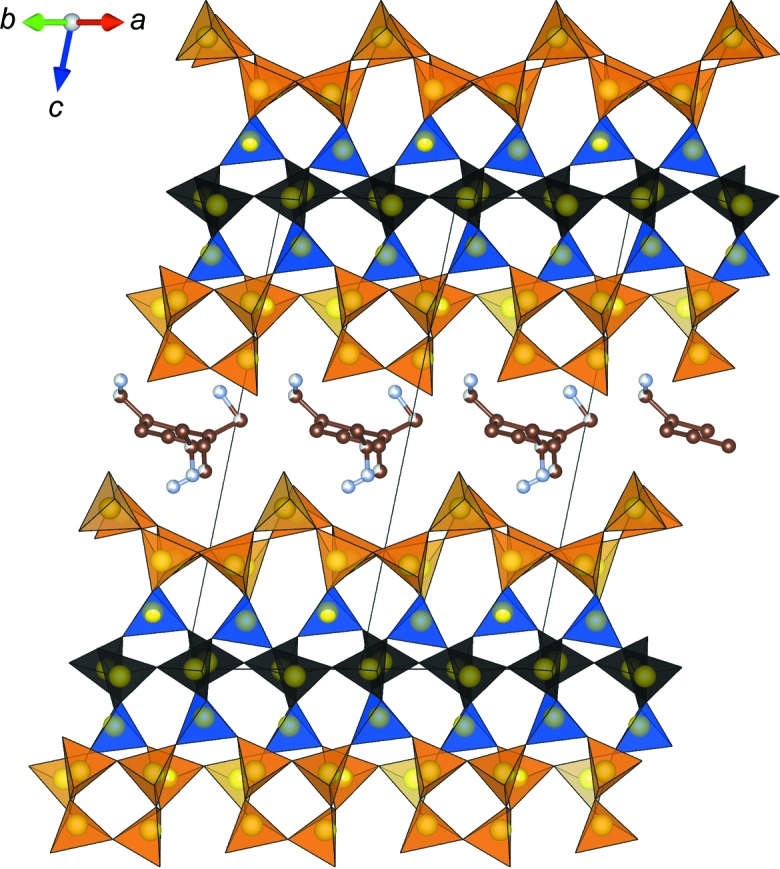
This study made use of a recently developed combination of advanced methods to reveal the atomic structure of a disordered nanocrystalline zeolite using exit wave reconstruction, automated diffraction tomography, disorder modelling and diffraction pattern simulation. By applying these methods, it was possible to determine the so far unknown structures of the hydrous layer silicate RUB-6 and the related zeolite-like material RUB-5. The structures of RUB-5 and RUB-6 contain the same dense layer-like building units (LLBUs). In the case of RUB-5, these building units are interconnected via additional SiO tetrahedra, giving rise to a framework structure with a 2D pore system consisting of intersecting 8-ring channels. In contrast, RUB-6 contains these LLBUs as separate silicate layers terminated by silanol/sil-oxy groups. Both RUB-6 and RUB-5 show stacking disorder with intergrowths of different polymorphs. The unique structure of RUB-6, together with the possibility for an interlayer expansion reaction to form RUB-5, make it a promising candidate for interlayer expansion with various metal sources to include catalytically active reaction centres.
本研究采用了最近开发的先进方法组合,通过出射波重建、自动衍射断层扫描、无序建模和衍射图案模拟来揭示无序纳米晶沸石的原子结构。通过应用这些方法,得以确定水合层状硅酸盐RUB-6和相关类沸石材料RUB-5迄今未知的结构。RUB-5和RUB-6的结构包含相同的致密层状构建单元(LLBUs)。在RUB-5的情况下,这些构建单元通过额外的SiO四面体相互连接,形成具有由相交的8元环通道组成的二维孔系统的骨架结构。相比之下,RUB-6包含这些LLBUs作为由硅醇/硅氧基封端的独立硅酸盐层。RUB-6和RUB-5都表现出不同多晶型相互生长的堆积无序。RUB-6的独特结构,以及通过层间膨胀反应形成RUB-5的可能性,使其成为与各种金属源进行层间膨胀以纳入催化活性反应中心的有前途的候选物。