Moesslacher Julia, Battisti Verena, Delang Leen, Neyts Johan, Abdelnabi Rana, Pürstinger Gerhard, Urban Ernst, Langer Thierry
University of Innsbruck, Department of Pharmacy, Innrain 80/82, 6020 Innsbruck, Austria.
University of Vienna, Department of Pharmaceutical Chemistry, Althanstraße 14, A-1090 Vienna, Austria.
ACS Med Chem Lett. 2020 Mar 5;11(5):906-912. doi: 10.1021/acsmedchemlett.9b00662. eCollection 2020 May 14.
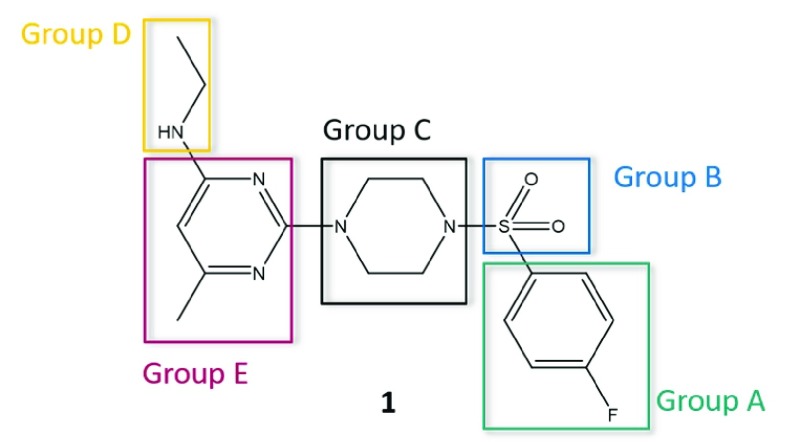
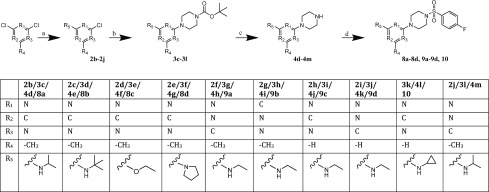
The chikungunya virus (CHIKV) is a mosquito-transmitted alphavirus, and it is the causative agent of chikungunya fever (CHIKF). Although it has re-emerged as an epidemic threat, so far there are neither vaccines nor pharmacotherapy available to prevent or treat an infection. Herein, we describe the synthesis and structure-activity relationship studies of a class of novel small molecule inhibitors against CHIKV and the discovery of a new potent inhibitor (compound ). The starting point of the optimization process was -ethyl-6-methyl-2-(4-(4-fluorophenylsulfonyl)piperazine-1-yl)pyrimidine-4-amine () with an EC of 8.68 μM, a CC of 122 μM, and therefore a resulting selectivity index (SI) of 14.2. The optimized compound , however, displays a much lower micromolar antiviral activity (EC value of 3.95 μM), considerably better cytotoxic liability (CC value of 260 μM) and consequently an improved SI of greater than 61. Therefore, we report the identification of a promising novel compound class that has the potential for further development of antiviral drugs against the CHIKV.
基孔肯雅病毒(CHIKV)是一种由蚊子传播的甲病毒,是基孔肯雅热(CHIKF)的病原体。尽管它已再次成为一种流行威胁,但迄今为止,尚无可用的疫苗或药物疗法来预防或治疗感染。在此,我们描述了一类针对CHIKV的新型小分子抑制剂的合成及构效关系研究,并发现了一种新的强效抑制剂(化合物 )。优化过程的起始点是 -乙基-6-甲基-2-(4-(4-氟苯基磺酰基)哌嗪-1-基)嘧啶-4-胺(),其半数有效浓度(EC)为8.68 μM,半数细胞毒性浓度(CC)为122 μM,因此产生的选择性指数(SI)为14.2。然而,优化后的化合物 显示出低得多的微摩尔抗病毒活性(EC值为3.95 μM)、相当好的细胞毒性耐受性(CC值为260 μM),因此SI提高到大于61。因此,我们报告鉴定出一类有前景的新型化合物,其具有进一步开发抗CHIKV抗病毒药物的潜力。