Belleau Emily L, Ehret Lauren E, Hanson Jessica L, Brasel Karen J, Larson Christine L, deRoon-Cassini Terri A
McLean Hospital, Center for Depression, Anxiety and Stress Research, Belmont, MA, USA.
Harvard Medical School, Boston, MA, USA.
Neurobiol Stress. 2020 Apr 1;12:100217. doi: 10.1016/j.ynstr.2020.100217. eCollection 2020 May.
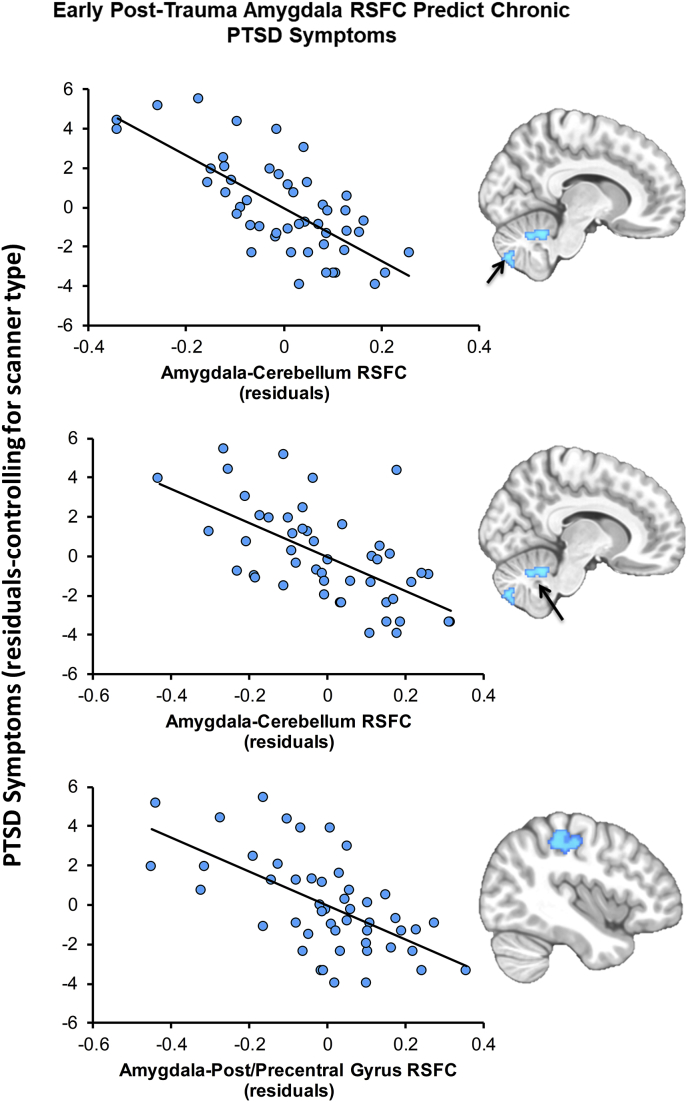
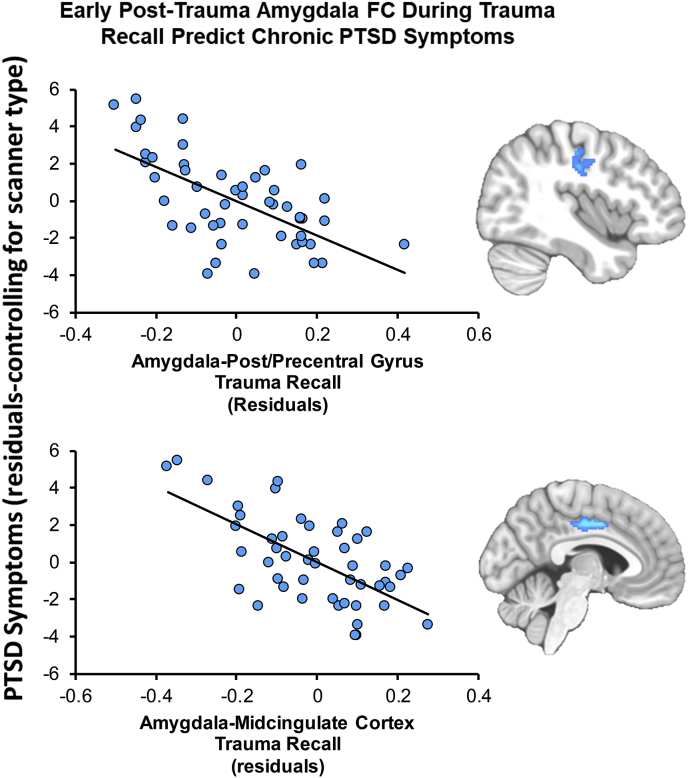
Understanding neural mechanisms that confer risk for posttraumatic stress disorder (PTSD) is critical for earlier intervention, yet longitudinal work has been sparse. The amygdala is part of a core network consistently implicated in PTSD symptomology. Most neural models of PTSD have focused on the amygdala's interactions with the dorsal anterior cingulate cortex, ventromedial prefrontal cortex, and hippocampus. However, an increasing number of studies have linked PTSD symptoms to aberrations in amygdala functional connections with other brain regions involved in emotional information processing, self-referential processing, somatosensory processing, visual processing, and motor control. In the current study, trauma-exposed individuals ( = 54) recruited from the emergency department completed a resting state fMRI scan as well as a script-driven trauma recall fMRI task scan two-weeks post-trauma along with demographic, PTSD, and other clinical symptom questionnaires two-weeks and six-months post-trauma. We examined whether amygdala-whole brain functional connectivity (FC) during rest and task could predict six-month post-trauma PTSD symptoms. More negative amygdala-cerebellum and amygdala-postcentral gyrus FC during rest as well as more negative amygdala-postcentral gyrus and amygdala-midcingulate cortex during recall of the trauma memory predicted six-month post-trauma PTSD after controlling for scanner type. Follow-up multiple regression sensitivity analyses controlling for several other relevant predictors of PTSD symptoms, revealed that amygdala-cerebellum FC during rest and amygdala-postcentral gyrus FC during trauma recall were particularly robust predictors of six-month PTSD symptoms. The results extend cross-sectional studies implicating abnormal FC of the amygdala with other brain regions involved in somatosensory processing, motor control, and emotional information processing in PTSD, to the prospective prediction of risk for chronic PTSD. This work may contribute to earlier identification of at-risk individuals and elucidate potential intervention targets.
了解导致创伤后应激障碍(PTSD)风险的神经机制对于早期干预至关重要,但纵向研究一直很少。杏仁核是一个核心网络的一部分,该网络一直与PTSD症状学有关。大多数PTSD神经模型都集中在杏仁核与背侧前扣带回皮质、腹内侧前额叶皮质和海马体的相互作用上。然而,越来越多的研究将PTSD症状与杏仁核与其他参与情绪信息处理、自我参照处理、体感处理、视觉处理和运动控制的脑区之间的功能连接异常联系起来。在本研究中,从急诊科招募的54名受过创伤的个体在创伤后两周完成了静息态功能磁共振成像扫描以及脚本驱动的创伤回忆功能磁共振成像任务扫描,并在创伤后两周和六个月完成了人口统计学、PTSD及其他临床症状问卷。我们研究了静息和任务期间杏仁核与全脑的功能连接(FC)是否能够预测创伤后六个月的PTSD症状。在控制扫描仪类型后,静息时杏仁核与小脑以及杏仁核与中央后回的FC更负,以及在回忆创伤记忆时杏仁核与中央后回和杏仁核与扣带中部皮质的FC更负,可预测创伤后六个月的PTSD。后续的多元回归敏感性分析控制了PTSD症状的其他几个相关预测因素,结果显示静息时杏仁核与小脑的FC以及创伤回忆时杏仁核与中央后回的FC是创伤后六个月PTSD症状特别有力的预测因素。这些结果将涉及杏仁核与其他参与PTSD体感处理、运动控制和情绪信息处理的脑区功能连接异常的横断面研究扩展到了慢性PTSD风险的前瞻性预测。这项工作可能有助于更早地识别高危个体并阐明潜在的干预靶点。