Department of Neurology, the Second Affiliated Hospital of Chongqing Medical University, Chongqing, China.
CNS Neurosci Ther. 2020 Aug;26(8):851-861. doi: 10.1111/cns.13391. Epub 2020 May 21.
A large amount of literature has indicated that excitatory synaptic transmission plays a crucial role in epilepsy, but the detailed pathogenesis still needs to be clarified.
In the present study, we used samples from patients with temporal lobe epilepsy, pentylenetetrazole-kindled mice, and Mg -free-induced epileptic cultured hippocampal neurons to detect the expression pattern of STK24. Then, the whole-cell recording was carried out after STK24 overexpression in the Mg -free-induced epileptic cultured hippocampal neurons. In addition, coimmunoprecipitation was performed to detect the association between endogenous STK24 and main subunits of NMDARs and AMPARs in the hippocampus of PTZ-kindled mice.
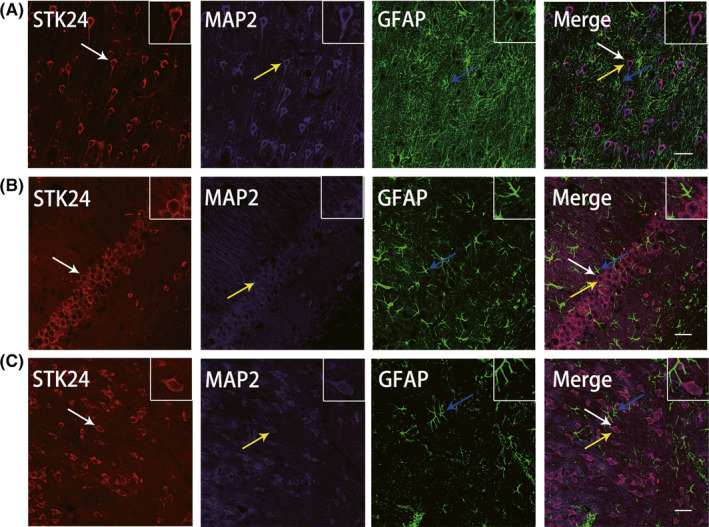
Here, we reported that STK24 was specifically located in epileptic neurons of human and pentylenetetrazole-kindled mice. Meanwhile, the expression of STK24 was significantly down-regulated in these samples which are mentioned above. Besides, we found that the amplitude of miniature excitatory postsynaptic currents was increased in STK24 overexpressed epileptic hippocampal cultured neurons, which means the excitatory synaptic transmission was changed. Moreover, the coimmunoprecipitation, which further supported the previous experiment, indicated an association between STK24 and the subunits of the NMDA receptor.
These findings expand our understanding of how STK24 involved in the excitatory synaptic transmission in epilepsy and lay a foundation for exploring the possibility of STK24 as a drug target.
大量文献表明,兴奋性突触传递在癫痫中起着至关重要的作用,但详细的发病机制仍需阐明。
在本研究中,我们使用来自颞叶癫痫患者、戊四氮点燃小鼠和镁缺乏诱导的癫痫培养海马神经元的样本,检测 STK24 的表达模式。然后,在镁缺乏诱导的癫痫培养海马神经元中转染 STK24 后进行全细胞记录。此外,通过免疫共沉淀检测 PTZ 点燃小鼠海马中内源性 STK24 与 NMDA 受体和 AMPAR 主要亚基之间的关联。
在这里,我们报告 STK24 特异性定位于人类和戊四氮点燃小鼠的癫痫神经元中。同时,在这些样本中,STK24 的表达明显下调。此外,我们发现 STK24 过表达的癫痫海马培养神经元中小型兴奋性突触后电流的幅度增加,这意味着兴奋性突触传递发生了变化。此外,免疫共沉淀进一步支持了之前的实验,表明 STK24 与 NMDA 受体亚基之间存在关联。
这些发现扩展了我们对 STK24 如何参与癫痫中兴奋性突触传递的理解,并为探索 STK24 作为药物靶点的可能性奠定了基础。