Centre for Research in Media and Communication, Faculty of Social Sciences and Humanities, Universiti Kebangsaan Malaysia, Bangi, Selangor, Malaysia.
School of Human Development and Technocommunication, Universiti Malaysia Perlis, Arau, Perlis, Malaysia.
PLoS One. 2020 May 21;15(5):e0233668. doi: 10.1371/journal.pone.0233668. eCollection 2020.
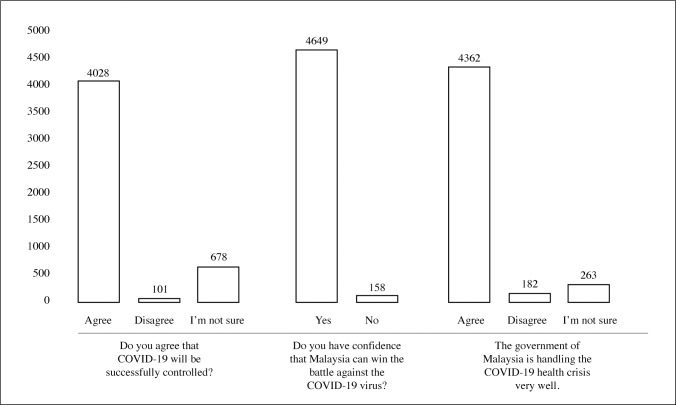
In an effort to mitigate the outbreak of COVID-19, many countries have imposed drastic lockdown, movement control or shelter in place orders on their residents. The effectiveness of these mitigation measures is highly dependent on cooperation and compliance of all members of society. The knowledge, attitudes and practices people hold toward the disease play an integral role in determining a society's readiness to accept behavioural change measures from health authorities. The aim of this study was to determine the knowledge levels, attitudes and practices toward COVID-19 among the Malaysian public. A cross-sectional online survey of 4,850 Malaysian residents was conducted between 27th March and 3rd April 2020. The survey instrument consisted of demographic characteristics, 13 items on knowledge, 3 items on attitudes and 3 items on practices, modified from a previously published questionnaire on COVID-19. Descriptive statistics, chi-square tests, t-tests and one-way analysis of variance (ANOVA) were conducted. The overall correct rate of the knowledge questionnaire was 80.5%. Most participants held positive attitudes toward the successful control of COVID-19 (83.1%), the ability of Malaysia to conquer the disease (95.9%) and the way the Malaysian government was handling the crisis (89.9%). Most participants were also taking precautions such as avoiding crowds (83.4%) and practising proper hand hygiene (87.8%) in the week before the movement control order started. However, the wearing of face masks was less common (51.2%). This survey is among the first to assess knowledge, attitudes and practice in response to the COVID-19 pandemic in Malaysia. The results highlight the importance of consistent messaging from health authorities and the government as well as the need for tailored health education programs to improve levels of knowledge, attitudes and practices.
为了减轻 COVID-19 的爆发,许多国家对居民实施了严格的封锁、行动管制或就地避难令。这些缓解措施的有效性高度依赖于社会各界的合作和遵守。人们对疾病的了解、态度和做法在很大程度上决定了一个社会对卫生当局采取行为改变措施的准备程度。本研究旨在确定马来西亚公众对 COVID-19 的知识水平、态度和做法。2020 年 3 月 27 日至 4 月 3 日期间,对 4850 名马来西亚居民进行了横断面在线调查。调查工具包括人口统计学特征、13 项关于知识、3 项关于态度和 3 项关于实践的问题,改编自之前发表的关于 COVID-19 的问卷。进行了描述性统计、卡方检验、t 检验和单因素方差分析(ANOVA)。知识问卷的总体正确率为 80.5%。大多数参与者对 COVID-19 的成功控制(83.1%)、马来西亚战胜该疾病的能力(95.9%)以及马来西亚政府处理危机的方式(89.9%)持积极态度。大多数参与者在行动管制令开始前一周也采取了预防措施,如避免人群(83.4%)和正确的手部卫生(87.8%)。然而,戴口罩的情况较少见(51.2%)。这项调查是评估马来西亚对 COVID-19 大流行的知识、态度和实践的首批调查之一。结果强调了卫生当局和政府持续传递信息的重要性,以及需要制定有针对性的健康教育计划来提高知识、态度和实践水平。