• 文献检索
  • 文档翻译
  • 深度研究
  • 学术资讯
  • Suppr Zotero 插件Zotero 插件
  • 邀请有礼
  • 套餐&价格
  • 历史记录
应用&插件
Suppr Zotero 插件Zotero 插件浏览器插件Mac 客户端Windows 客户端微信小程序
定价
高级版会员购买积分包购买API积分包
服务
文献检索文档翻译深度研究API 文档MCP 服务
关于我们
关于 Suppr公司介绍联系我们用户协议隐私条款
关注我们

Suppr 超能文献

核心技术专利:CN118964589B侵权必究
粤ICP备2023148730 号-1Suppr @ 2026

文献检索

告别复杂PubMed语法,用中文像聊天一样搜索,搜遍4000万医学文献。AI智能推荐,让科研检索更轻松。

立即免费搜索

文件翻译

保留排版,准确专业,支持PDF/Word/PPT等文件格式,支持 12+语言互译。

免费翻译文档

深度研究

AI帮你快速写综述,25分钟生成高质量综述,智能提取关键信息,辅助科研写作。

立即免费体验

实施清洁诊所方法可提高危地马拉高地西部地区卫生设施的水、环境卫生和个人卫生质量。

Implementing the Clean Clinic Approach Improves Water, Sanitation, and Hygiene Quality in Health Facilities in the Western Highlands of Guatemala.

机构信息

Save the Children, Washington, DC, USA.

出版信息

Glob Health Sci Pract. 2020 Jun 30;8(2):256-269. doi: 10.9745/GHSP-D-19-00413.

DOI:10.9745/GHSP-D-19-00413
PMID:32439715
原文链接:https://pmc.ncbi.nlm.nih.gov/articles/PMC7326526/
Abstract

BACKGROUND

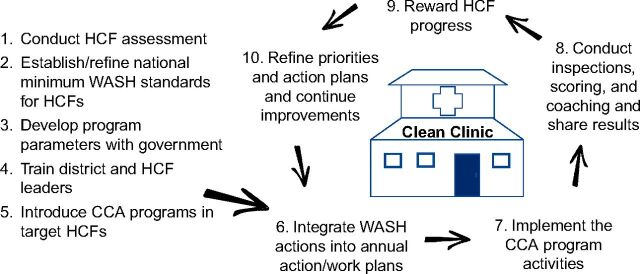
Water, sanitation, and hygiene (WASH) services are cornerstones to providing safe health care services and improving patient satisfaction and care seeking. The Clean Clinic Approach (CCA) uses a 10-step process to support health care facilities (HCFs) in making incremental, effective cleanliness and infection prevention and control (IPC) improvements, without relying on external investments. We piloted the CCA in Guatemala and assessed the extent to which it contributed to quality improvements in WASH for IPC.

METHODS

After developing an assessment tool tailored to the Guatemalan context, we assessed 11 HCFs in 8 technical areas and scored the facilities on 79 criteria with a total of 100 points. We conducted a baseline assessment (September to October 2018), second assessment (January 2019), and final assessment (February to March 2019).

RESULTS

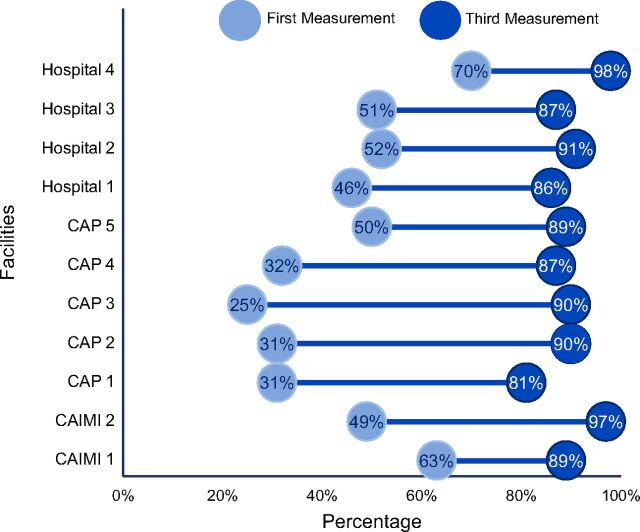
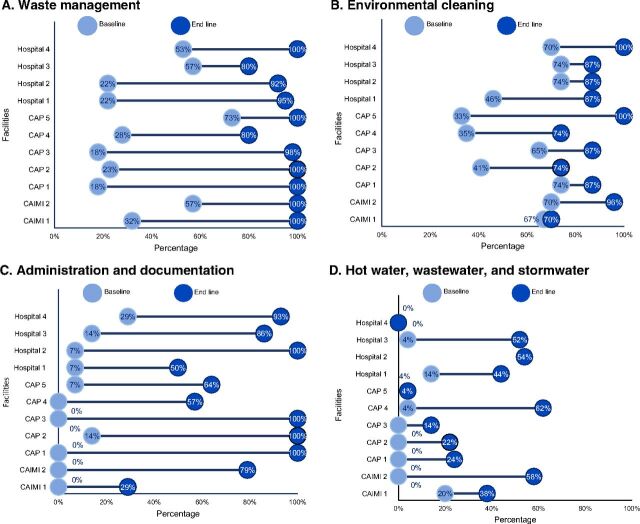
The 11 HCFs improved their average emergency/general ward scores from 41 points at baseline to 87 points at end line, based on a 100-point scale. For delivery wards, the scores increased from 50 to 91 points and for postnatal wards from 46 to 90 points.

CONCLUSIONS

The CCA process and tools facilitated a systematic way for HCFs to identify, prioritize, make, and measure WASH quality of care improvements. Training facility staff was fundamental to improving quality standards, and involving medical and administration staff in joint analysis, coordination, and planning sessions was key to integration and teamwork. Further work is needed to increase involvement of local government and community members and to further adapt the process and tools.

摘要

背景

水、环境卫生和个人卫生(WASH)服务是提供安全医疗服务、提高患者满意度和促进患者寻求医疗服务的基石。清洁诊所方法(CCA)采用 10 步流程,支持医疗机构(HCFs)逐步进行有效的清洁和感染预防与控制(IPC)改进,而无需依赖外部投资。我们在危地马拉试行 CCA,并评估其在促进 WASH 为 IPC 服务质量改进方面的程度。

方法

在为危地马拉环境量身定制评估工具后,我们评估了 8 个技术领域的 11 个 HCF,并根据总共 100 分的 79 项标准对这些设施进行了评分。我们进行了基线评估(2018 年 9 月至 10 月)、第二次评估(2019 年 1 月)和最终评估(2019 年 2 月至 3 月)。

结果

11 个 HCF 将其平均急诊/普通病房评分从基线时的 41 分提高到终点时的 87 分,采用 100 分制。分娩病房的分数从 50 分提高到 91 分,产后病房从 46 分提高到 90 分。

结论

CCA 流程和工具为 HCF 确定、优先考虑、实施和衡量 WASH 护理质量改进提供了一种系统的方法。培训设施工作人员对于提高质量标准至关重要,让医疗和行政人员参与联合分析、协调和规划会议是整合和团队合作的关键。需要进一步努力增加地方政府和社区成员的参与,并进一步调整流程和工具。
https://cdn.ncbi.nlm.nih.gov/pmc/blobs/0dd5/7326526/c26aacd97fd3/GH-GHSP200013F007.jpg
https://cdn.ncbi.nlm.nih.gov/pmc/blobs/0dd5/7326526/9fbe4b7c16aa/GH-GHSP200013F001.jpg
https://cdn.ncbi.nlm.nih.gov/pmc/blobs/0dd5/7326526/3bc389c585a3/GH-GHSP200013F002.jpg
https://cdn.ncbi.nlm.nih.gov/pmc/blobs/0dd5/7326526/7993df1aea3a/GH-GHSP200013F003.jpg
https://cdn.ncbi.nlm.nih.gov/pmc/blobs/0dd5/7326526/fd9b97eed896/GH-GHSP200013F004.jpg
https://cdn.ncbi.nlm.nih.gov/pmc/blobs/0dd5/7326526/f896784f2543/GH-GHSP200013F006.jpg
https://cdn.ncbi.nlm.nih.gov/pmc/blobs/0dd5/7326526/803e0861a51c/GH-GHSP200013F005.jpg
https://cdn.ncbi.nlm.nih.gov/pmc/blobs/0dd5/7326526/c26aacd97fd3/GH-GHSP200013F007.jpg
https://cdn.ncbi.nlm.nih.gov/pmc/blobs/0dd5/7326526/9fbe4b7c16aa/GH-GHSP200013F001.jpg
https://cdn.ncbi.nlm.nih.gov/pmc/blobs/0dd5/7326526/3bc389c585a3/GH-GHSP200013F002.jpg
https://cdn.ncbi.nlm.nih.gov/pmc/blobs/0dd5/7326526/7993df1aea3a/GH-GHSP200013F003.jpg
https://cdn.ncbi.nlm.nih.gov/pmc/blobs/0dd5/7326526/fd9b97eed896/GH-GHSP200013F004.jpg
https://cdn.ncbi.nlm.nih.gov/pmc/blobs/0dd5/7326526/f896784f2543/GH-GHSP200013F006.jpg
https://cdn.ncbi.nlm.nih.gov/pmc/blobs/0dd5/7326526/803e0861a51c/GH-GHSP200013F005.jpg
https://cdn.ncbi.nlm.nih.gov/pmc/blobs/0dd5/7326526/c26aacd97fd3/GH-GHSP200013F007.jpg

相似文献

1
Implementing the Clean Clinic Approach Improves Water, Sanitation, and Hygiene Quality in Health Facilities in the Western Highlands of Guatemala.实施清洁诊所方法可提高危地马拉高地西部地区卫生设施的水、环境卫生和个人卫生质量。
Glob Health Sci Pract. 2020 Jun 30;8(2):256-269. doi: 10.9745/GHSP-D-19-00413.
2
Water, sanitation and hygiene infrastructure and quality in rural healthcare facilities in Rwanda.卢旺达农村医疗设施中的水、环境卫生与个人卫生基础设施及质量
BMC Health Serv Res. 2017 Aug 3;17(1):517. doi: 10.1186/s12913-017-2460-4.
3
Healthcare provider satisfaction with environmental conditions in rural healthcare facilities of 14 low- and middle-income countries.医疗服务提供者对 14 个中低收入国家农村医疗设施环境条件的满意度。
Int J Hyg Environ Health. 2021 Jul;236:113802. doi: 10.1016/j.ijheh.2021.113802. Epub 2021 Jul 7.
4
Integration of IPC/WASH critical conditions into quality of care and quality improvement tools and processes: Bangladesh case study.将 IPC/WASH 关键条件融入到护理质量和质量改进工具及流程中:孟加拉国案例研究。
Antimicrob Resist Infect Control. 2024 Sep 11;13(1):100. doi: 10.1186/s13756-024-01455-9.
5
Assessment of water, sanitation and hygiene service availability in healthcare facilities in the greater Kampala metropolitan area, Uganda.乌干达坎帕拉大都市区医疗设施供水、环境卫生和个人卫生服务供应情况评估。
BMC Public Health. 2020 Nov 23;20(1):1767. doi: 10.1186/s12889-020-09895-9.
6
Using the Water and Sanitation for Health Facility Improvement Tool (WASH FIT) in Zimbabwe: A Cross-Sectional Study of Water, Sanitation and Hygiene Services in 50 COVID-19 Isolation Facilities.津巴布韦使用水和环境卫生设施促进健康工具(WASH FIT):50 个 COVID-19 隔离设施的水、环境卫生和个人卫生服务横断面研究。
Int J Environ Res Public Health. 2021 May 25;18(11):5641. doi: 10.3390/ijerph18115641.
7
Estimating the cost of interventions to improve water, sanitation and hygiene in healthcare facilities across India.估算改善印度医疗卫生机构水、环境卫生和个人卫生的干预措施成本。
BMJ Glob Health. 2020 Dec;5(12). doi: 10.1136/bmjgh-2020-003045.
8
Assessment of water, sanitation and hygiene in HCFs: which tool to follow?医疗机构中的水、环境卫生和个人卫生评估:应该遵循哪种工具?
Rev Environ Health. 2019 Dec 18;34(4):435-440. doi: 10.1515/reveh-2019-0001.
9
Water, Sanitation, and Hygiene in Rural Health-Care Facilities: A Cross-Sectional Study in Ethiopia, Kenya, Mozambique, Rwanda, Uganda, and Zambia.农村医疗机构中的水、环境卫生与个人卫生:埃塞俄比亚、肯尼亚、莫桑比克、卢旺达、乌干达和赞比亚的横断面研究
Am J Trop Med Hyg. 2017 Oct;97(4):1033-1042. doi: 10.4269/ajtmh.17-0208. Epub 2017 Aug 18.
10
Extending the use of the World Health Organisations'  water sanitation and hygiene assessment tool for surveys in hospitals - from WASH-FIT to WASH-FAST.将世界卫生组织的水卫生和环境卫生评估工具用于医院调查的扩展使用 - 从 WASH-FIT 到 WASH-FAST。
PLoS One. 2019 Dec 16;14(12):e0226548. doi: 10.1371/journal.pone.0226548. eCollection 2019.

引用本文的文献

1
Does WASH FIT Improve Water, Sanitation, and Hygiene and Related Health Impacts in Healthcare Facilities? A Systematic Review.水、卫生设施和个人卫生综合干预措施(WASH FIT)是否能改善医疗机构的水、卫生设施和个人卫生状况以及相关健康影响?一项系统综述。
Int J Environ Res Public Health. 2025 Apr 30;22(5):708. doi: 10.3390/ijerph22050708.
2
Does WASH FIT improve water, sanitation, and hygiene and related health impacts in healthcare facilities? A systematic review.水、卫生和个人卫生综合干预措施(WASH FIT)是否能改善医疗机构的水、环境卫生和个人卫生状况以及相关的健康影响?一项系统评价。
medRxiv. 2024 Apr 6:2024.04.05.24305396. doi: 10.1101/2024.04.05.24305396.
3

本文引用的文献

1
What is the impact of water sanitation and hygiene in healthcare facilities on care seeking behaviour and patient satisfaction? A systematic review of the evidence from low-income and middle-income countries.医疗设施中的水卫生与卫生状况对就医行为和患者满意度有何影响?对低收入和中等收入国家证据的系统评价。
BMJ Glob Health. 2018 May 9;3(3):e000648. doi: 10.1136/bmjgh-2017-000648. eCollection 2018.
2
Environmental conditions in health care facilities in low- and middle-income countries: Coverage and inequalities.中低收入国家医疗卫生机构环境条件:覆盖范围和不平等。
Int J Hyg Environ Health. 2018 Apr;221(3):409-422. doi: 10.1016/j.ijheh.2018.01.004. Epub 2018 Jan 11.
3
Access to and challenges in water, sanitation, and hygiene in healthcare facilities during the early phase of the COVID-19 pandemic in Ethiopia: A mixed-methods evaluation.
埃塞俄比亚 COVID-19 大流行早期医疗保健设施中获得水、环境卫生和个人卫生服务的机会和面临的挑战:混合方法评估。
PLoS One. 2022 May 13;17(5):e0268272. doi: 10.1371/journal.pone.0268272. eCollection 2022.
Understanding the mechanisms and drivers of antimicrobial resistance.
理解抗菌药物耐药性的机制和驱动因素。
Lancet. 2016 Jan 9;387(10014):176-87. doi: 10.1016/S0140-6736(15)00473-0. Epub 2015 Nov 18.
4
SQUIRE 2.0 (Standards for QUality Improvement Reporting Excellence): revised publication guidelines from a detailed consensus process.SQUIRE 2.0(卓越质量改进报告标准):通过详细的共识过程制定的修订版出版指南。
BMJ Qual Saf. 2016 Dec;25(12):986-992. doi: 10.1136/bmjqs-2015-004411. Epub 2015 Sep 14.
5
Burden of endemic health-care-associated infection in developing countries: systematic review and meta-analysis.发展中国家地方性卫生保健相关感染的负担:系统评价和荟萃分析。
Lancet. 2011 Jan 15;377(9761):228-41. doi: 10.1016/S0140-6736(10)61458-4. Epub 2010 Dec 9.
6
Basics of quality improvement in health care.医疗保健质量改进基础
Mayo Clin Proc. 2007 Jun;82(6):735-9. doi: 10.4065/82.6.735.
7
[Maternal mortality in Guatemala: differences between hospital and non-hospital deaths].
Salud Publica Mex. 2006 May-Jun;48(3):183-92. doi: 10.1590/s0036-36342006000300002.
8
Hospital infection prevention and control: a model for improving the quality of hospital care in low- and middle-income countries.医院感染预防与控制:提高低收入和中等收入国家医院护理质量的模式
Infect Control Hosp Epidemiol. 1998 Feb;19(2):125-35. doi: 10.1086/647780.