Mahgoub Marwa Yahia, Elnady Basant Mohamed, Abdelkader Haytham Sayed, Abdelhalem Raghdaa Abdelkhaleq, Hassan Waleed Ahmed
Rheumatology, Rehabilitation and Physical Medicine Department, Benha University, Benha, Egypt.
Neuropsychiatry Department, Benha University, Benha, Egypt.
Open Access Rheumatol. 2020 May 5;12:55-63. doi: 10.2147/OARRR.S252748. eCollection 2020.
Knee osteoarthritis (OA) is a painful condition with peripheral and central pain transmission. Fibromyalgia (FM) is the role model of central sensitization of pain perception.
To assess the frequency of FM in knee OA patients and evaluate the impact of FM on mental health and the quality of life in knee OA patients.
A total of 121 female patients were recruited and divided into 3 groups: group I of 59 patients with knee OA only, group II of 32 patients with knee OA and FM, and group III of 30 FM patients. Patients underwent history taking, examination, investigations, and radiological evaluation of both knees. The assessment of visual analog scale (VAS), Pittsburgh Sleep Quality Index (PSQI), Pain Anxiety Symptom Scale Short Form 20 (PASS20), Beck Depression Inventory (BDI-II), and PCASEE questionnaire were done for all patients. Lequesne index of knee OA and radiological Kellgren and Lawrence score severity were done for all OA patients. Fibromyalgia Impact Questionnaire (FIQ) was assessed for all FM patients.
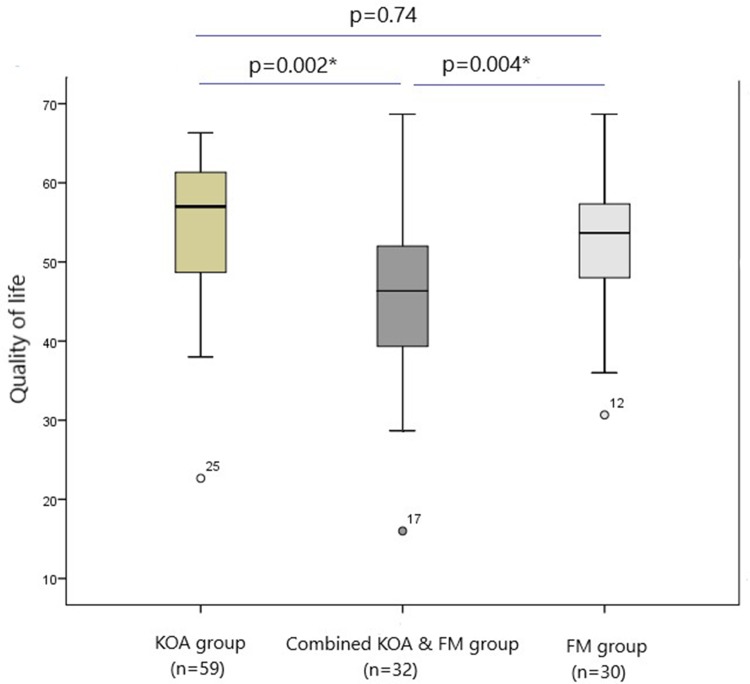
FM was diagnosed in 35.5% of knee OA patients. Group II patients had higher VAS, PASS-20, PSQI, and lower quality of life than either groups I and III, elevated Lequesne index score than group I, significant correlation between VAS and BMI (p=0.002), Lequesne index score (p<0.001), PASS20 (p=0.006), BDI-II score (p=0.002), and FIQ (P<0.001), and a negative correlation was found between VAS and physical (p<0.001), anxiety (p=0.046), and social (p=0.026) QoL parameters. Univariable regression analysis showed a higher age, VAS, PSQI, PASS20, and FIQ were associated with lower QoL in group II. A higher PASS20 was the only predictor of lower QoL in multivariable analysis.
Fibromyalgia coexists frequently in knee OA patients and has implications on their mental health, functional activity, and quality of life.
膝关节骨关节炎(OA)是一种伴有外周和中枢性疼痛传递的疼痛性疾病。纤维肌痛(FM)是疼痛感知中枢敏化的典型范例。
评估膝关节OA患者中FM的发生率,并评价FM对膝关节OA患者心理健康和生活质量的影响。
共招募121例女性患者,分为3组:I组59例仅患有膝关节OA的患者,II组32例患有膝关节OA和FM的患者,III组30例FM患者。患者接受病史采集、检查、各项检查以及双膝关节的影像学评估。对所有患者进行视觉模拟量表(VAS)、匹兹堡睡眠质量指数(PSQI)、疼痛焦虑症状量表简表20(PASS20)、贝克抑郁量表(BDI-II)和PCASEE问卷评估。对所有OA患者进行膝关节OA的Lequesne指数以及影像学Kellgren和Lawrence评分以评估严重程度。对所有FM患者进行纤维肌痛影响问卷(FIQ)评估。
35.5%的膝关节OA患者被诊断为FM。II组患者的VAS、PASS-20、PSQI评分更高,生活质量低于I组和III组,Lequesne指数评分高于I组,VAS与BMI(p = 0.002)、Lequesne指数评分(p < 0.001)、PASS20(p = 0.006)、BDI-II评分(p = 0.002)和FIQ(P < 0.001)之间存在显著相关性,并且VAS与身体(p < 0.001)、焦虑(p = 0.046)和社会(p = 0.026)生活质量参数之间存在负相关性。单因素回归分析显示,II组中年龄较大、VAS、PSQI、PASS20和FIQ与较低的生活质量相关。在多因素分析中,较高的PASS20是生活质量较低的唯一预测因素。
纤维肌痛在膝关节OA患者中经常并存,并且对其心理健康、功能活动和生活质量有影响。