Snyder Adam J, LeBlanc Aaron R H, Jun Chen, Bevitt Joseph J, Reisz Robert R
Department of Biology, University of Toronto Mississauga, Mississauga, Ontario, Canada.
Department of Biological Sciences, University of Alberta, Edmonton, Alberta, Canada.
PeerJ. 2020 May 13;8:e9168. doi: 10.7717/peerj.9168. eCollection 2020.
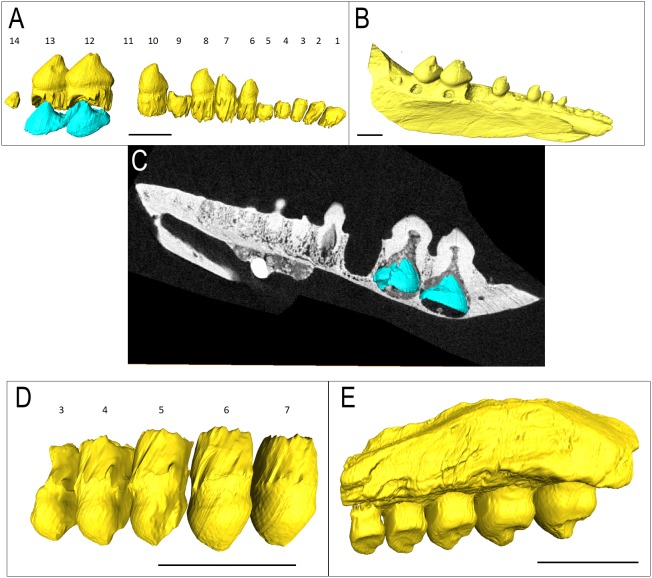
Permian bolosaurid parareptiles are well-known for having complex tooth crowns and complete tooth rows in the jaws, in contrast to the comparatively simple teeth and frequent replacement gaps in all other Paleozoic amniotes. Analysis of the specialized dentition of the bolosaurid parareptiles from North America and from Russia, utilizing a combination of histological and tomographic data, reveals unusual patterns of tooth development and replacement. The data confirm that bolosaurid teeth have thecodont implantation with deep roots, the oldest known such example among amniotes, and independently evolved among much younger archosauromorphs (including dinosaurs and crocodilians) and among synapsids (including mammals). High-resolution CT scans were able to detect the density boundary between the alveolar bone and the jawbone, as confirmed by histology, and revealed the location and size of developing replacement teeth in the pulp cavity of functional teeth. Evidence provided by the paratype dentary of indicates that replacement teeth are present along the whole tooth row at slightly different stages of development, with the ontogenetically more developed teeth anteriorly, suggesting that tooth replacement was highly synchronized. CT data also show tooth replacement is directly related to the presence of lingual pits in the jaw, and that migration of tooth buds occurs initially close to these resorption pits to a position immediately below the functional tooth within its pulp cavity. The size and complex shape of the replacement teeth in the holotype of indicate that the replacement teeth can develop within the pulp cavity to an advanced stage while the previous generation remains functional for an extended time, reminiscent of the condition seen in other amniotes with occluding dentitions, including mammals.
二叠纪的博洛蜥类副爬行动物以其复杂的齿冠和完整的齿列而闻名,这与所有其他古生代羊膜动物相对简单的牙齿和频繁的换牙间隙形成对比。利用组织学和断层扫描数据相结合的方法,对来自北美和俄罗斯的博洛蜥类副爬行动物的特殊齿系进行分析,揭示了牙齿发育和替换的异常模式。数据证实,博洛蜥类牙齿具有槽生植入方式且牙根很深,这是羊膜动物中已知最早的此类例子,并且在更年轻的主龙形类(包括恐龙和鳄鱼)以及合弓类(包括哺乳动物)中独立演化。高分辨率CT扫描能够检测到牙槽骨和颌骨之间的密度边界,这一点得到了组织学的证实,并且揭示了功能性牙齿牙髓腔中正在发育的替换牙的位置和大小。副模齿骨提供的证据表明,替换牙在整个齿列中处于不同的发育阶段,个体发育上更发达的牙齿位于前方,这表明牙齿替换高度同步。CT数据还显示,牙齿替换与颌骨舌侧凹坑的存在直接相关,并且牙胚的迁移最初发生在靠近这些吸收凹坑的位置,然后移动到功能性牙齿牙髓腔内其正下方的位置。模式标本中替换牙的大小和复杂形状表明,替换牙可以在牙髓腔内发育到晚期,而前一代牙齿在较长时间内仍保持功能,这让人联想到其他具有咬合齿列的羊膜动物(包括哺乳动物)的情况。