BC Cancer, University of British Columbia, Kelowna, Canada.
MD Anderson Cancer Center, University of Texas, Houston, United States.
Radiother Oncol. 2020 Aug;149:64-69. doi: 10.1016/j.radonc.2020.04.038. Epub 2020 Apr 27.
To identify a PSA threshold value at an intermediate follow-up time after low dose rate (LDR) prostate brachytherapy associated with cure, defined as long-term (10-15 year) freedom from prostate cancer.
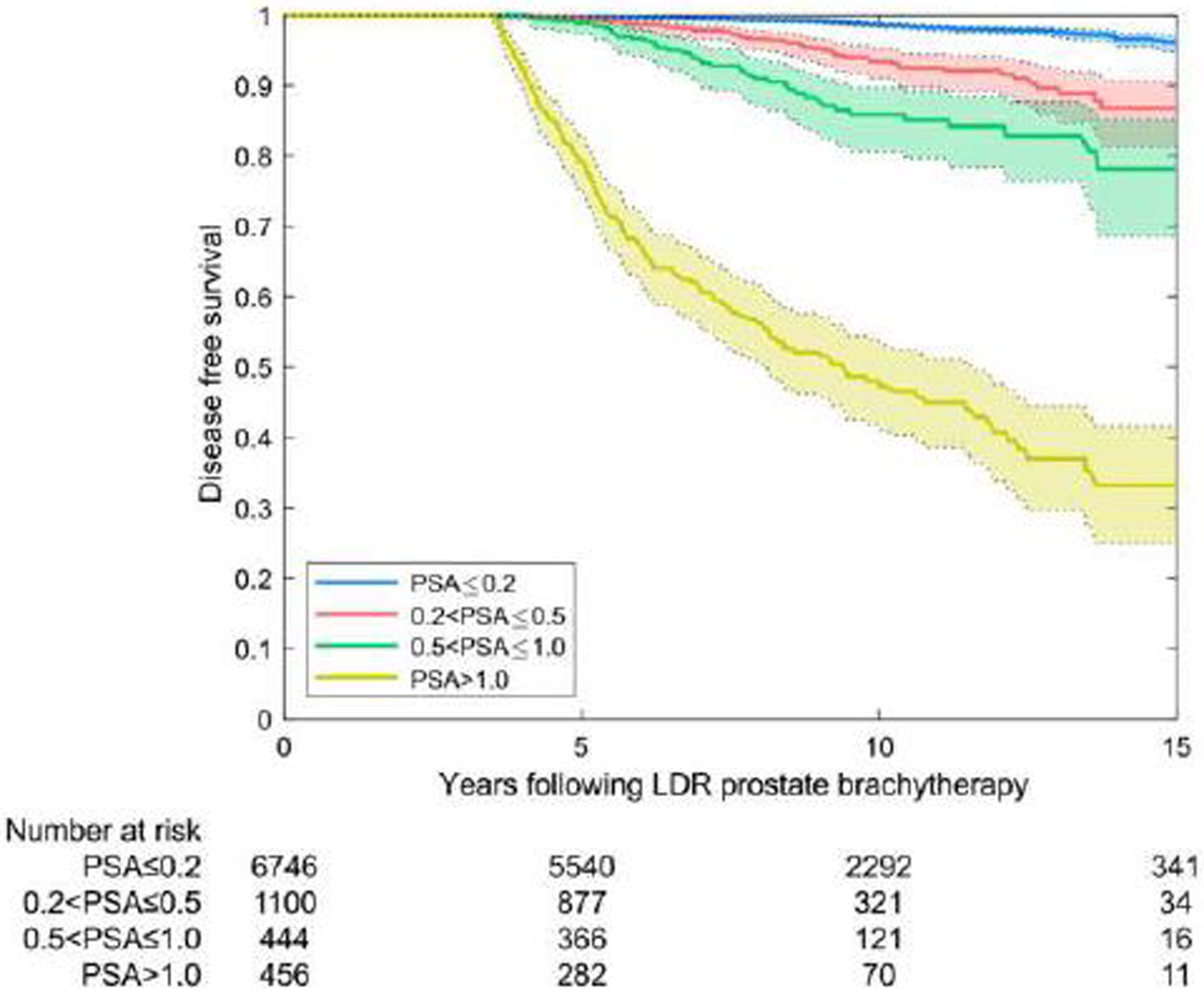
Data from 7 institutions for 14,220 patients with localized prostate cancer treated with LDR brachytherapy, either alone (8552) or with external beam radiotherapy (n = 1175), androgen deprivation (n = 3165), or both (n = 1328), were analyzed. Risk distribution was 42.4% favorable, 49.2% intermediate, and 8.4% high-risk. Patients with clinical failure before 3.5 years were excluded. Kaplan-Meier analysis was used with clinical failure (local, distant, regional or biochemical triggering salvage) as an endpoint for each of four PSA categories: PSA ≤ 0.2, >0.2 to ≤0.5, >0.5 to ≤1.0, and >1.0 ng/mL. PSA levels at 4 years (±6 months) in 8746 patients without clinical failure were correlated with disease status at 10-15 years.
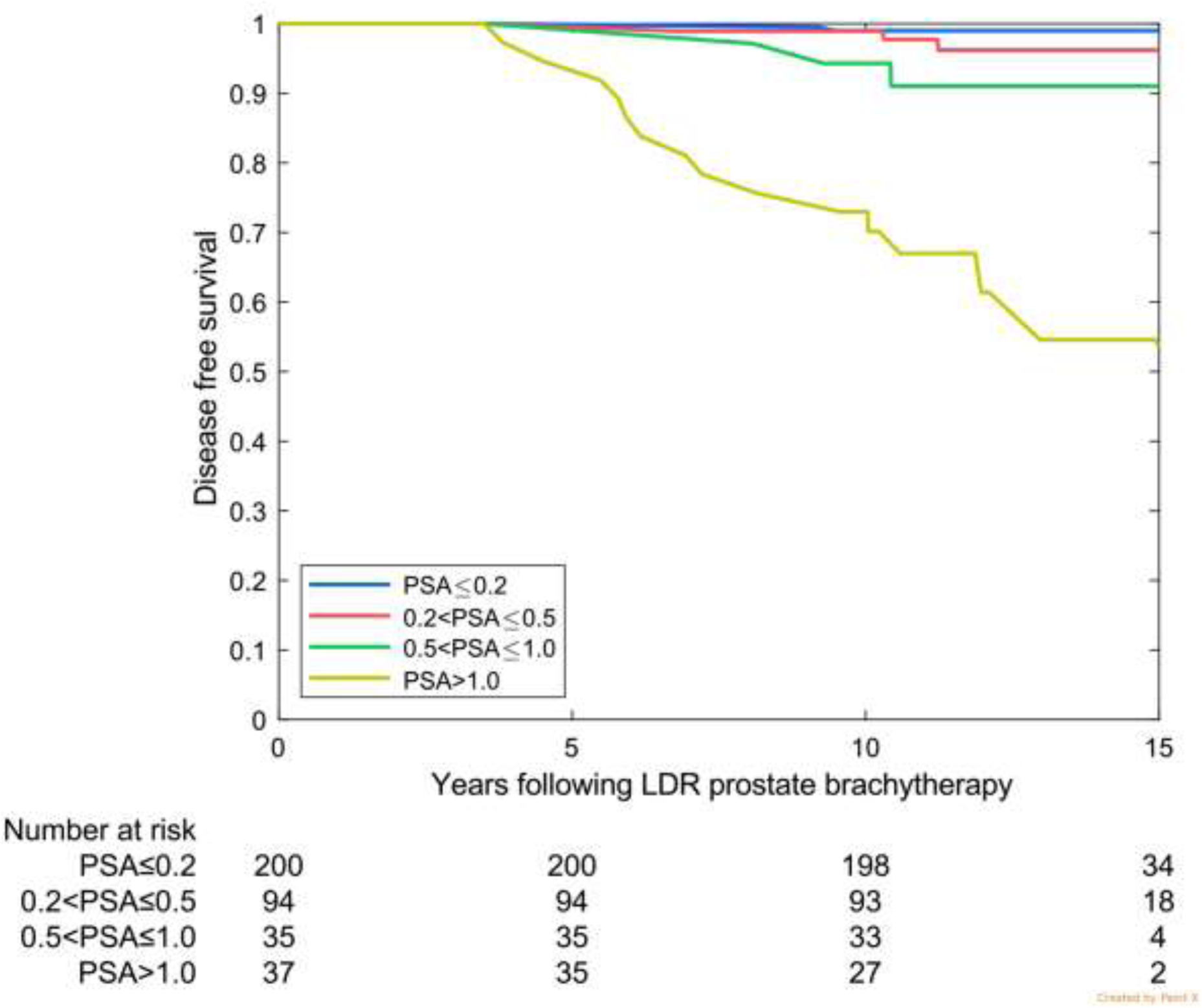
For the 77.1% of patients with 4-year PSA ≤ 0.2, the freedom-from-recurrence (FFR) rates were 98.7% (95% CI 98.3-99.0) at 10 years and 96.1% (95% CI 94.8-97.2) at 15 years. Three independent validation cohorts confirmed 97-99% 10-year FFR rates with 4-year PSA ≤ 0.2. Successive PSA categories were associated with diminished disease-free rates at 10 and 15 years. PSA category was strongly associated with treatment success (p < 0.0005).
Since 98.7% of patients with PSA ≤ 0.2 ng/mL at 4 years after LDR prostate brachytherapy were disease-free beyond 10 years, we suggest adopting this biochemical definition of cure for patients with ≥4 years' follow-up after LDR brachytherapy.
在低剂量率(LDR)前列腺近距离放射治疗后,确定与治愈相关的 PSA 阈值,治愈定义为长期(10-15 年)无前列腺癌。
对来自 7 家机构的 14220 例接受 LDR 近距离放射治疗的局限性前列腺癌患者的数据进行分析,其中单纯治疗(8552 例)、联合外照射放疗(n=1175)、雄激素剥夺治疗(n=3165)或联合治疗(n=1328)。风险分布为 42.4%为低危、49.2%为中危、8.4%为高危。排除 3.5 年内发生临床失败的患者。采用 Kaplan-Meier 分析,以临床失败(局部、远处、区域或生化引发的挽救性治疗)为每个 PSA 四个类别(PSA≤0.2ng/ml、0.2ng/ml<PSA≤0.5ng/ml、0.5ng/ml<PSA≤1.0ng/ml 和 PSA>1.0ng/ml)的终点。在无临床失败的 8746 例患者中,比较 4 年时(±6 个月)的 PSA 值与 10-15 年时的疾病状态。
在 4 年 PSA≤0.2ng/ml 的 77.1%患者中,10 年时无复发生存率(FFR)为 98.7%(95%CI 98.3-99.0),15 年时为 96.1%(95%CI 94.8-97.2)。3 个独立的验证队列证实了 4 年 PSA≤0.2ng/ml 的患者 10 年时 97-99%的 FFR 率。连续的 PSA 类别与 10 年和 15 年时无疾病生存率降低相关。PSA 类别与治疗成功率密切相关(p<0.0005)。
在 LDR 前列腺近距离放射治疗后 4 年 PSA≤0.2ng/ml 的患者中,98.7%在 10 年后无疾病,我们建议对 LDR 近距离放射治疗后随访时间≥4 年的患者采用这种生化治愈定义。