Department of Oral and Maxillofacial Diseases, University of Helsinki and Helsinki University Hospital, PO Box 63, 00014, Helsinki, Finland.
Department of Oral and Maxillofacial Surgery, Faculty of Dentistry, Tanta University, El-Gaish, Tanta Qism 2, Tanta, Gharbia Governorate, Egypt.
Tissue Eng Regen Med. 2020 Aug;17(4):477-493. doi: 10.1007/s13770-020-00259-3. Epub 2020 May 24.
Insufficient vascularization hampers bone tissue engineering strategies for reconstructing large bone defects. Delivery of prolyl-hydroxylase inhibitors (PHIs) is an interesting approach to upregulate vascular endothelial growth factor (VEGF) by mimicking hypoxic stabilization of hypoxia-inducible factor-1alpha (HIF-1α). This study assessed two PHIs: dimethyloxalylglycine (DMOG) and baicalein for their effects on human adipose tissue-derived mesenchymal stem/stromal cells (AT-MSCs).
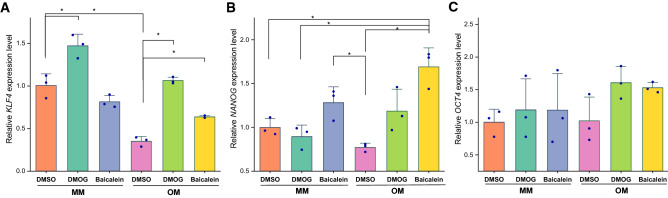
Isolated AT-MSCs were characterized and treated with PHIs to assess the cellular proliferation response. Immunostaining and western-blots served to verify the HIF-1α stabilization response. The optimized concentrations for long-term treatment were tested for their effects on the cell cycle, apoptosis, cytokine secretion, and osteogenic differentiation of AT-MSCs. Gene expression levels were evaluated for alkaline phosphatase (ALPL), bone morphogenetic protein 2 (BMP2), runt-related transcription factor 2 (RUNX2), vascular endothelial growth factor A (VEGFA), secreted phosphoprotein 1 (SPP1), and collagen type I alpha 1 (COL1A1). In addition, stemness-related genes Kruppel-like factor 4 (KLF4), Nanog homeobox (NANOG), and octamer-binding transcription factor 4 (OCT4) were assessed.
PHIs stabilized HIF-1α in a dose-dependent manner and showed evident dose- and time dependent antiproliferative effects. With doses maintaining proliferation, DMOG and baicalein diminished the effect of osteogenic induction on the expression of RUNX2, ALPL, and COL1A1, and suppressed the formation of mineralized matrix. Suppressed osteogenic response of AT-MSCs was accompanied by an upregulation of stemness-related genes.
PHIs significantly reduced the osteogenic differentiation of AT-MSCs and rather upregulated stemness-related genes. PHIs proangiogenic potential should be weighed against their longterm direct inhibitory effects on the osteogenic differentiation of AT-MSCs.
血管生成不足阻碍了用于重建大骨缺损的骨组织工程策略。通过模拟缺氧诱导因子-1α(HIF-1α)的低氧稳定来递送脯氨酰-羟化酶抑制剂(PHI)是上调血管内皮生长因子(VEGF)的一种有趣方法。本研究评估了两种 PHI:二甲基草酰甘氨酸(DMOG)和黄芩素对人脂肪组织来源的间充质干细胞/基质细胞(AT-MSCs)的作用。
分离的 AT-MSCs 进行特征鉴定,并使用 PHI 处理以评估细胞增殖反应。免疫染色和 Western 印迹用于验证 HIF-1α稳定反应。优化的长期处理浓度用于测试其对 AT-MSCs 细胞周期、凋亡、细胞因子分泌和成骨分化的影响。碱性磷酸酶(ALPL)、骨形态发生蛋白 2(BMP2)、 runt 相关转录因子 2(RUNX2)、血管内皮生长因子 A(VEGFA)、分泌磷蛋白 1(SPP1)和胶原 I 型 alpha 1(COL1A1)的基因表达水平进行了评估。此外,还评估了干细胞相关基因 Kruppel 样因子 4(KLF4)、Nanog 同源盒(NANOG)和八聚体结合转录因子 4(OCT4)。
PHI 以剂量依赖性方式稳定 HIF-1α,并表现出明显的剂量和时间依赖性抗增殖作用。在维持增殖的剂量下,DMOG 和黄芩素减弱了成骨诱导对 RUNX2、ALPL 和 COL1A1 表达的影响,并抑制了矿化基质的形成。AT-MSCs 的成骨反应受到抑制,同时伴随着干细胞相关基因的上调。
PHI 显著降低了 AT-MSCs 的成骨分化,而更多地上调了干细胞相关基因。PHI 的促血管生成潜力与其对 AT-MSCs 成骨分化的长期直接抑制作用应权衡利弊。