Hip Department, IRCCS Istituto Ortopedico Galeazzi, Via Riccardo Galeazzi 4, 20161, Milan, Italy.
Laboratory of Experimental Biochemistry, IRCCS Istituto Ortopedico Galeazzi, Milan, Italy.
Int Orthop. 2020 Aug;44(8):1591-1598. doi: 10.1007/s00264-020-04590-1. Epub 2020 May 24.
The COVID-19 pandemic is importantly affecting the orthopaedic practice all over the world with Northern Italy being the first European area that faced the worst scenario. In this study, the changes in clinical practice occurred in an orthopaedic center in Milan are described.
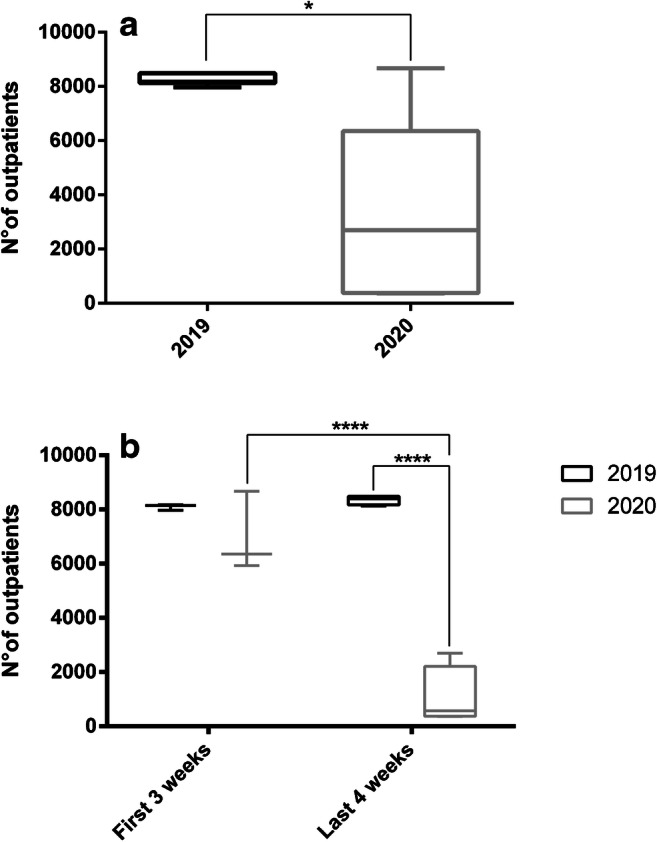
Number and type of admissions, outpatients cancelled and preserved, emergency room, and intensive care unit activities have been analyzed in the timeframe of seven weeks since the beginning of the pandemic (from February 24th to April 10th) and compared with the same period in 2019.
The planned surgical admissions declined from 2172 in 2019 to 664 in 2020 (69.42%, p < 0.0001), while emergencies increased from 158 to 268 (69.62%). The rehabilitation admissions declined from 414 to 69 (83.33%). The overall admission decreased by 63.52%, the trend showed a drop in the last weeks. Surgery performed in the COVID-19 operating room increased by 16.7% in the last week. Seven deaths occurred (0.7% of all orthopaedics and trauma admissions) compared with four (0.1%) which happened in the same period in 2019 (p = 0.004). Six of these patients were suffering from COVID-19. A total of 23,580 outpatients (93.8%) were cancelled. Emergency room consultations declined by 68.14% and 63.47% among white and green priority, respectively, while increased by 25% and 100% among yellow and red, respectively.
These numbers show the radical changed scenario in an orthopaedic center in Milan during COVID-19 pandemic. Elective surgery declined rapidly going close to zero, outpatient admissions were restricted to cases that cannot be postponed, while emergencies increased due to the role played by the hospital as referral orthopaedic centre during the pandemic. The still ongoing emergency will have important impacts on the overall orthopaedic healthcare management for the next months.
COVID-19 大流行正在全球范围内对矫形外科实践产生重要影响,意大利北部是第一个面临最严重情况的欧洲地区。本研究描述了米兰一家矫形外科中心在这一期间临床实践的变化。
分析了从大流行开始(2 月 24 日至 4 月 10 日)的七周内,住院、取消和保留的门诊、急诊室和重症监护病房的活动,并与 2019 年同期进行了比较。
计划手术入院从 2019 年的 2172 例降至 2020 年的 664 例(69.42%,p<0.0001),而急诊从 158 例增至 268 例(69.62%)。康复入院从 414 例降至 69 例(83.33%)。总入院人数减少了 63.52%,呈最后几周下降的趋势。在 COVID-19 手术室进行的手术在最后一周增加了 16.7%。共发生 7 例死亡(所有矫形和创伤入院的 0.7%),而 2019 年同期发生 4 例(0.1%)(p=0.004)。其中 6 例患有 COVID-19。共有 23580 名门诊患者(93.8%)被取消。急诊室咨询分别减少了 68.14%和 63.47%,而黄色和红色咨询分别增加了 25%和 100%。
这些数字显示了米兰一家矫形外科中心在 COVID-19 大流行期间的情况发生了重大变化。择期手术迅速下降至接近零,门诊入院限于不能推迟的病例,而由于医院在大流行期间作为转诊矫形中心的作用,急诊人数增加。持续进行的紧急情况将对未来几个月的整体矫形医疗保健管理产生重要影响。