Fu Zhen, Agudelo Paula, Wells Christina E
School of Agricultural, Forest, and Environmental Sciences , Clemson University , Clemson, SC, 29634 ; Department of Entomology , Washington State University , Pullman, WA, 99164.
School of Agricultural, Forest, and Environmental Sciences , Clemson University , Clemson, SC, 29634.
J Nematol. 2020;52:1-12. doi: 10.21307/jofnem-2020-047.
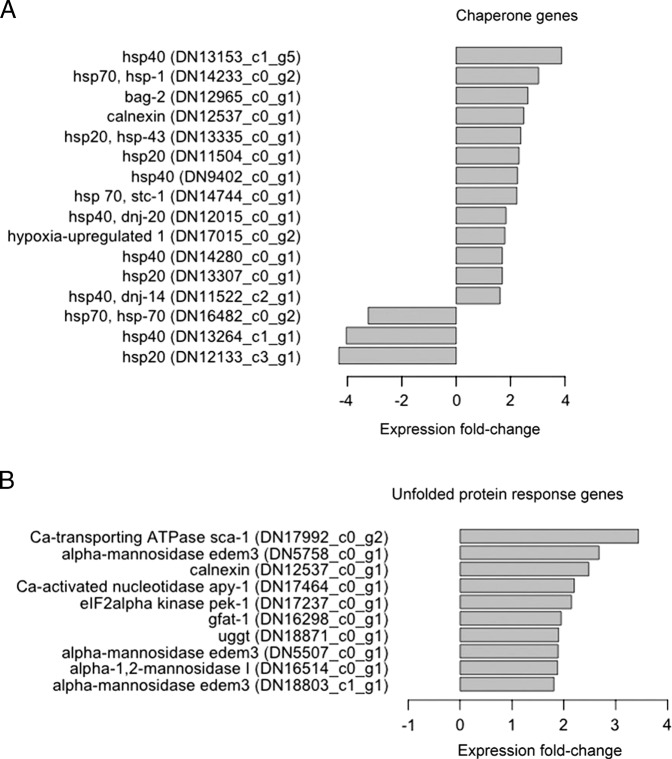
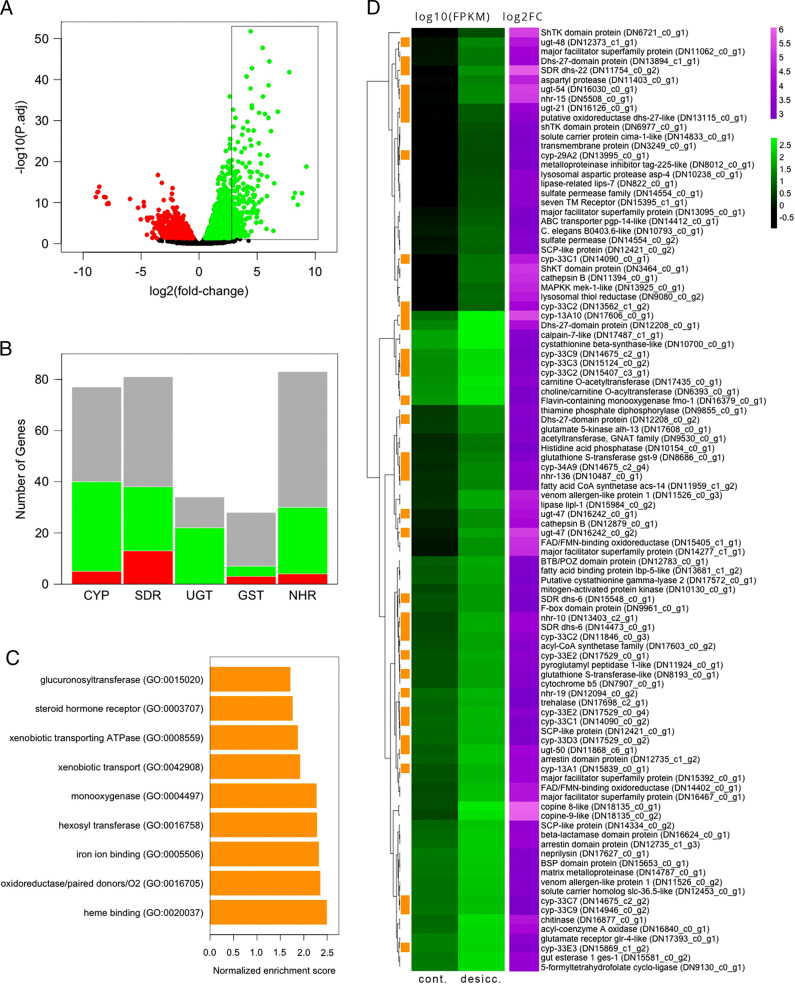
The foliar nematode () is a quarantined pest that infects a broad range of herbaceous and woody plants. Previous work has demonstrated its remarkable ability to survive rapid and extreme desiccation, although the specific molecular mechanisms underlying its anhydrobiotic response have not been characterized. The authors used RNA sequencing and transcriptome assembly to compare patterns of gene expression between hydrated and 24-hr desiccated nematodes. In total, 2,083 and 953 genes were significantly up- and downregulated, respectively, in desiccated nematodes. Of the 100 annotated genes with the largest positive fold-changes, more than one third encoded putative detoxification-related proteins. Genes encoding enzymes of Phase I and Phase II detoxification systems were among the most strongly upregulated in the transcriptome, including 35 cytochrome p450s, 23 short chain dehydrogenase/reductases, 5 glutathione-S-transferases, and 22 UDP-glucuronosyltransferases. Genes encoding heat shock proteins, unfolded protein response enzymes, and intrinsically disordered proteins were also upregulated. Anhydrobiosis in appears to involve both strategies to minimize protein misfolding and aggregation, and wholesale induction of the cellular detoxification machinery. These processes may be controlled in part through the activity of forkhead transcription factors similar to ' , a number of which were differentially expressed under desiccation. The foliar nematode () is a quarantined pest that infects a broad range of herbaceous and woody plants. Previous work has demonstrated its remarkable ability to survive rapid and extreme desiccation, although the specific molecular mechanisms underlying its anhydrobiotic response have not been characterized. The authors used RNA sequencing and transcriptome assembly to compare patterns of gene expression between hydrated and 24-hr desiccated nematodes. In total, 2,083 and 953 genes were significantly up- and downregulated, respectively, in desiccated nematodes. Of the 100 annotated genes with the largest positive fold-changes, more than one third encoded putative detoxification-related proteins. Genes encoding enzymes of Phase I and Phase II detoxification systems were among the most strongly upregulated in the transcriptome, including 35 cytochrome p450s, 23 short chain dehydrogenase/reductases, 5 glutathione-S-transferases, and 22 UDP-glucuronosyltransferases. Genes encoding heat shock proteins, unfolded protein response enzymes, and intrinsically disordered proteins were also upregulated. Anhydrobiosis in appears to involve both strategies to minimize protein misfolding and aggregation, and wholesale induction of the cellular detoxification machinery. These processes may be controlled in part through the activity of forkhead transcription factors similar to ’ , a number of which were differentially expressed under desiccation.
叶线虫()是一种检疫性害虫,可感染多种草本和木本植物。先前的研究表明,它具有在快速和极端干燥条件下生存的显著能力,尽管其隐生反应的具体分子机制尚未明确。作者使用RNA测序和转录组组装来比较水合状态和干燥24小时的线虫之间的基因表达模式。在干燥的线虫中,分别有2083个和953个基因显著上调和下调。在100个注释基因中,正向折叠变化最大的基因中,超过三分之一编码推定的解毒相关蛋白。编码I相和II相解毒系统酶的基因是转录组中上调最强的基因之一,包括35种细胞色素P450、23种短链脱氢酶/还原酶、5种谷胱甘肽-S-转移酶和22种UDP-葡萄糖醛酸基转移酶。编码热休克蛋白、未折叠蛋白反应酶和内在无序蛋白的基因也上调。叶线虫的隐生似乎涉及尽量减少蛋白质错误折叠和聚集的策略,以及细胞解毒机制的全面诱导。这些过程可能部分通过类似于‘ ’的叉头转录因子的活性来控制,其中一些在干燥条件下差异表达。叶线虫()是一种检疫性害虫,可感染多种草本和木本植物。先前的研究表明,它具有在快速和极端干燥条件下生存的显著能力,尽管其隐生反应的具体分子机制尚未明确。作者使用RNA测序和转录组组装来比较水合状态和干燥24小时的线虫之间 的基因表达模式。在干燥的线虫中,分别有2083个和953个基因显著上调和下调。在100个注释基因中,正向折叠变化最大的基因中,超过三分之一编码推定的解毒相关蛋白。编码I相和II相解毒系统酶的基因是转录组中上调最强的基因之一,包括35种细胞色素P450、23种短链脱氢酶/还原酶、5种谷胱甘肽-S-转移酶和22种UDP-葡萄糖醛酸基转移酶。编码热休克蛋白、未折叠蛋白反应酶和内在无序蛋白的基因也上调。叶线虫的隐生似乎涉及尽量减少蛋白质错误折叠和聚集的策略,以及细胞解毒机制的全面诱导。这些过程可能部分通过类似于‘ ’的叉头转录因子的活性来控制,其中一些在干燥条件下差异表达。