National Institute of Nursing Research, National Institutes of Health, 3 Center Drive, Building 3, Room 26E, Bethesda, MD, 20892, USA.
Henry M. Jackson Foundation for the Advancement of Military Medicine, 6720A Rockledge Dr, Bethesda, MD, 20817, USA.
BMC Neurol. 2020 May 25;20(1):209. doi: 10.1186/s12883-020-01760-x.
Concussion is the most common type of TBI, yet reliable objective measures related to these injuries and associated recovery processes remain elusive, especially in military personnel. The purpose of this study was to characterize the relationship between cytokines and recovery from acute brain injury in active duty service members. Inflammatory cytokines (IL-6, IL-10, and TNFα) were measured acutely in blood samples within 8 h following a medically diagnosed concussion and then 24 h later.
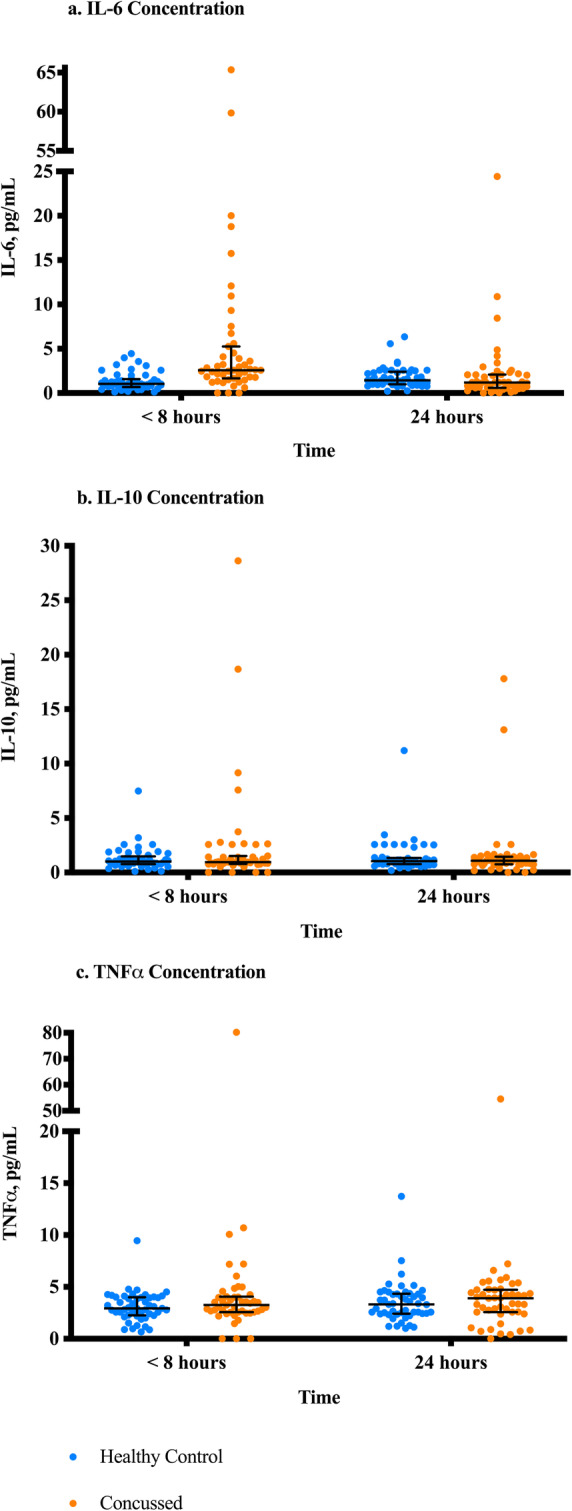
Participants (n = 94) were categorized into two groups: 1) military personnel who sustained provider-diagnosed concussion, without other major medical diagnosis (n = 45) and 2) healthy control participants in the same deployment environment who did not sustain concussion or other illness or injuries (n = 49). IL-6, IL-10, and TNFα concentrations were measured using an ultrasensitive single-molecule enzyme-linked immunosorbent assay. Differences in cytokine levels between concussed and healthy groups were evaluated at two time points (time point 1 ≤ 8 h after injury; time point 2 = 24 h following time point 1).
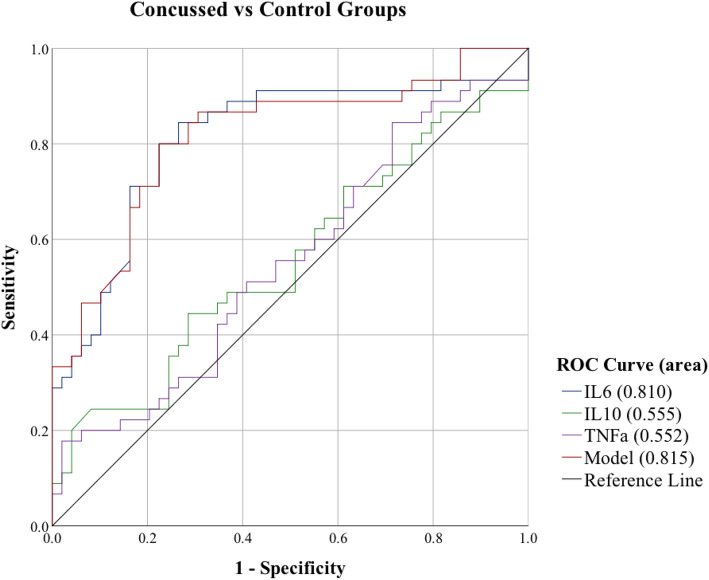
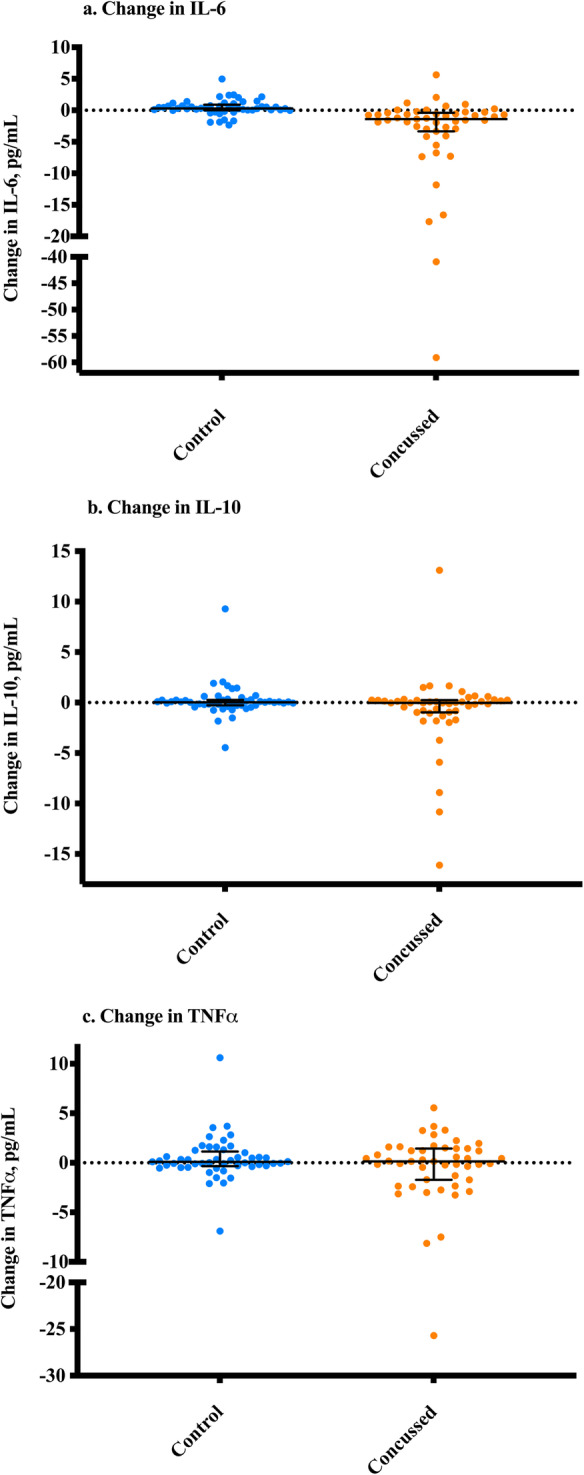
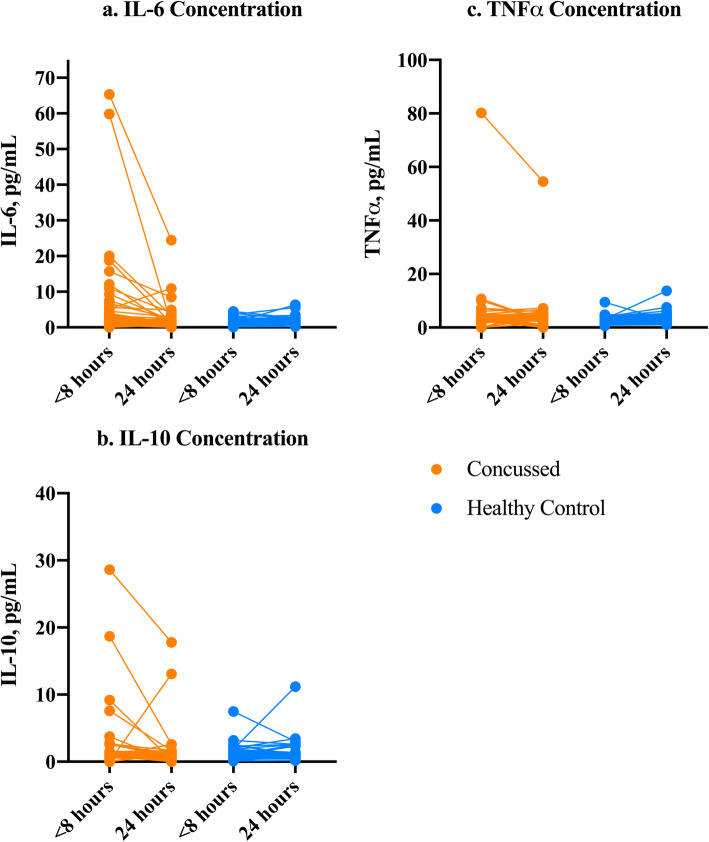
At time point 1, IL-6 median (IQR) concentrations were 2.62 (3.62) in the concussed group, which was greater compared to IL-6 in the healthy control group (1.03 (0.90); U = 420.00, z = - 5.12, p < 0.001). Compared to healthy controls, the concussed group did not differ at time point 1 in IL-10 or TNFα concentrations (p's > 0.05). At time point 2, no differences were detected between concussed and healthy controls for IL-6, IL-10, or TNFα (p's > 0.05). The median difference between time points 1 and 2 were compared between the concussed and healthy control groups for IL-6, IL-10, and TNFα. Change in IL-6 across time was greater for the concussed group than healthy control (- 1.54 (3.12); U = 315.00, z = - 5.96, p < 0.001), with no differences between groups in the change of IL-10 or TNFα (p's > 0.05).
Reported here is a significant elevation of IL-6 levels in concussed military personnel less than 8 h following injury. Future studies may examine acute and chronic neurological symptomology associated with inflammatory cytokine levels, distinguish individuals at high risk for developing neurological complications, and identify underlying biological pathways to mitigate inflammation and improve outcomes.
脑震荡是最常见的创伤性脑损伤(TBI)类型,但与这些损伤及相关恢复过程相关的可靠客观测量方法仍难以捉摸,尤其是在军事人员中。本研究的目的是描述现役军人急性脑损伤后细胞因子与恢复之间的关系。在接受医学诊断为脑震荡后 8 小时内和之后 24 小时内,急性采集血液样本,测量炎症细胞因子(IL-6、IL-10 和 TNFα)。
参与者(n=94)分为两组:1)有提供者诊断为脑震荡且无其他主要医疗诊断的现役军人(n=45);2)在同一部署环境中没有遭受脑震荡或其他疾病或损伤的健康对照参与者(n=49)。使用超敏单分子酶联免疫吸附测定法测量 IL-6、IL-10 和 TNFα 的浓度。在两个时间点评估脑震荡组和健康组之间细胞因子水平的差异(时间点 1≤损伤后 8 小时;时间点 2=时间点 1 后 24 小时)。
在时间点 1,脑震荡组的 IL-6 中位数(IQR)浓度为 2.62(3.62),高于健康对照组的 1.03(0.90);U=420.00,z=-5.12,p<0.001)。与健康对照组相比,脑震荡组在时间点 1 时 IL-10 或 TNFα 浓度没有差异(p>0.05)。在时间点 2,脑震荡组和健康对照组之间的 IL-6、IL-10 或 TNFα 浓度无差异(p>0.05)。比较脑震荡组和健康对照组在时间点 1 和 2 之间的 IL-6、IL-10 和 TNFα 的中位数差异。脑震荡组的 IL-6 变化大于健康对照组(-1.54(3.12);U=315.00,z=-5.96,p<0.001),IL-10 或 TNFα 两组之间无差异(p>0.05)。
本研究报告了脑震荡后不到 8 小时,现役军人的 IL-6 水平显著升高。未来的研究可能会检查与炎症细胞因子水平相关的急性和慢性神经症状,区分发生神经并发症风险高的个体,并确定减轻炎症和改善结果的潜在生物学途径。