Boone Erin C, Wang Wendy Y, Gaedigk Roger, Cherner Mariana, Bérard Anick, Leeder J Steven, Miller Neil A, Gaedigk Andrea
Division of Clinical Pharmacology, Toxicology and Therapeutic Innovation, Children's Mercy Kansas City, Kansas City, MO, United States.
School of Medicine, University of Missouri-Kansas City, Kansas City, MO, United States.
Front Pharmacol. 2020 May 8;11:486. doi: 10.3389/fphar.2020.00486. eCollection 2020.
The gene locus has been extensively studied over decades, yet a portion of variability in CYP2D6 activity cannot be explained by known sequence variations within the gene, copy number variation, or structural rearrangements. It was proposed that rs5758550, located 116 kb downstream of the gene locus, increases gene expression and thus contributes to variability in CYP2D6 activity. This finding has, however, not been validated. The purpose of the study was to address a major technological barrier, i.e., experimentally linking rs5758550, also referred to as the "enhancer" single-nucleotide polymorphism (SNP), to haplotypes >100 kb away. To overcome this challenge is essential to ultimately determine the contribution of the "enhancer" SNP to interindividual variability in CYP2D6 activity.
A large ethnically mixed population sample (n=3,162) was computationally phased to determine linkage between the "enhancer" SNP and haplotypes (or star alleles). To experimentally validate predicted linkages, DropPhase2D6, a digital droplet PCR (ddPCR)-based method was developed. 10X Genomics Linked-Reads were utilized as a proof of concept.
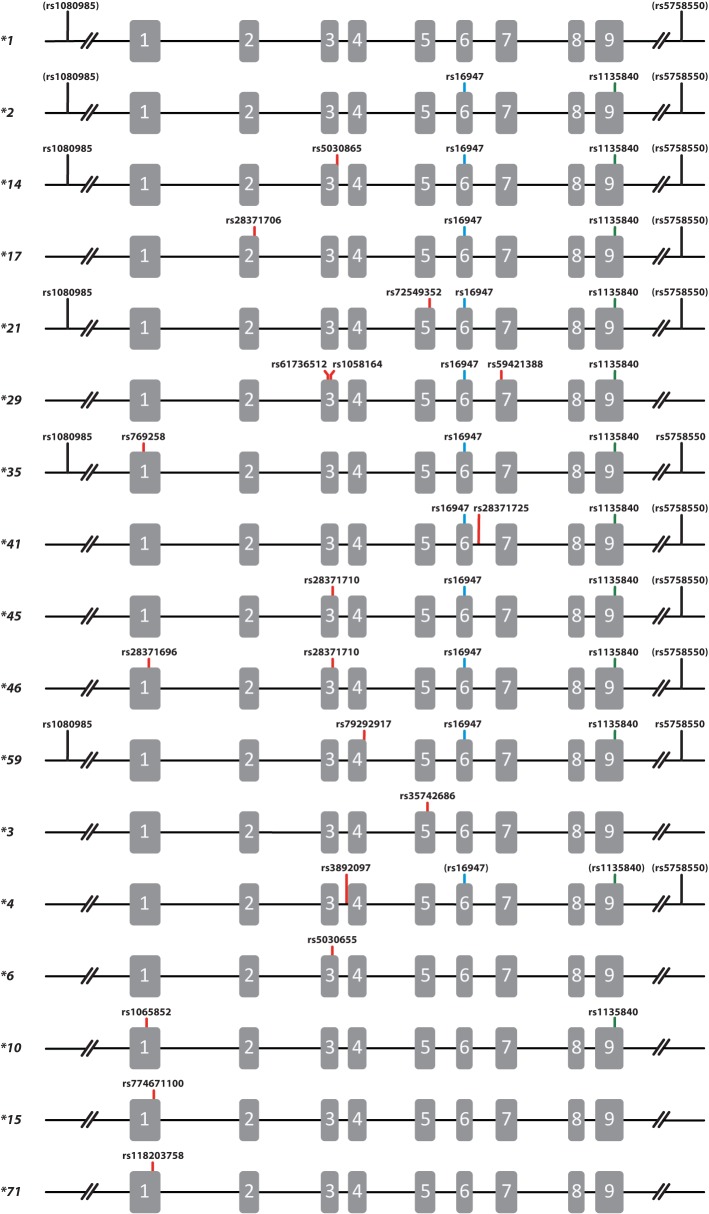
Phasing predicted that the "enhancer" SNP can occur on numerous haplotypes including , and and suggested that linkage is incomplete, i.e., a portion of these alleles do not have the "enhancer" SNP. Phasing also revealed differences among the European and African ancestry data sets regarding the proportion of alleles with and without the "enhancer" SNP. DropPhase2D6 was utilized to confirm or refute the predicted "enhancer" SNP location for individual samples, e.g., of n=3 samples genotyped as , rs5758550 was on the allele of two samples and on the allele of one sample. Our findings highlight that the location of the "enhancer" SNP must not be assigned by "default." Furthermore, linkage between the "enhancer" SNP and star allele haplotypes was confirmed with 10X Genomics technology.
Since the "enhancer" SNP can be present on a portion of normal, decreased, or no function alleles, the phase of the "enhancer" SNP must be considered when investigating the impact of the "enhancer" SNP on CYP2D6 activity.
几十年来,该基因座已得到广泛研究,但细胞色素P450 2D6(CYP2D6)活性的部分变异性无法通过该基因内已知的序列变异、拷贝数变异或结构重排来解释。有人提出,位于该基因座下游116 kb处的rs5758550可增加基因表达,从而导致CYP2D6活性的变异性。然而,这一发现尚未得到验证。本研究的目的是解决一个主要的技术障碍,即通过实验将rs5758550(也称为“增强子”单核苷酸多态性(SNP))与距离超过100 kb的单倍型联系起来。克服这一挑战对于最终确定“增强子”SNP对CYP2D6活性个体间变异性的贡献至关重要。
对一个大型种族混合人群样本(n = 3162)进行计算定相,以确定“增强子”SNP与单倍型(或星等位基因)之间的连锁关系。为了通过实验验证预测的连锁关系,开发了一种基于数字液滴PCR(ddPCR)的方法DropPhase2D6。利用10X基因组学连接读数作为概念验证。
定相预测“增强子”SNP可出现在包括、和等多种单倍型上,并表明连锁是不完全的,即这些等位基因中的一部分没有“增强子”SNP。定相还揭示了欧洲和非洲血统数据集之间在有和没有“增强子”SNP的等位基因比例方面的差异。DropPhase2D6用于确认或反驳个体样本中预测的“增强子”SNP位置,例如,在n = 3个基因分型为的样本中,rs5758550在两个样本的等位基因上,在一个样本的等位基因上。我们的研究结果强调,“增强子”SNP的位置不能“默认”确定。此外,10X基因组学技术证实了“增强子”SNP与星等位基因单倍型之间的连锁关系。
由于“增强子”SNP可存在于一部分正常、功能降低或无功能的等位基因上,因此在研究“增强子”SNP对CYP2D6活性的影响时,必须考虑“增强子”SNP的相位。