Department of Pediatrics and.
Department of Human Genetics, University of Michigan, Ann Arbor, MI.
Blood. 2020 Jul 30;136(5):533-541. doi: 10.1182/blood.2019004161.
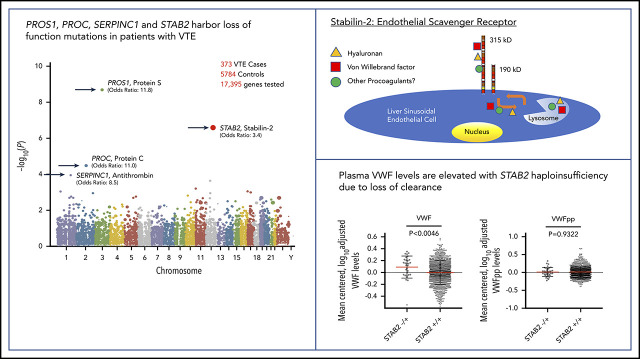
Deep vein thrombosis and pulmonary embolism, collectively defined as venous thromboembolism (VTE), are the third leading cause of cardiovascular death in the United States. Common genetic variants conferring increased varying degrees of VTE risk have been identified by genome-wide association studies (GWAS). Rare mutations in the anticoagulant genes PROC, PROS1 and SERPINC1 result in perinatal lethal thrombosis in homozygotes and markedly increased VTE risk in heterozygotes. However, currently described VTE variants account for an insufficient portion of risk to be routinely used for clinical decision making. To identify new rare VTE risk variants, we performed a whole-exome study of 393 individuals with unprovoked VTE and 6114 controls. This study identified 4 genes harboring an excess number of rare damaging variants in patients with VTE: PROS1, STAB2, PROC, and SERPINC1. At STAB2, 7.8% of VTE cases and 2.4% of controls had a qualifying rare variant. In cell culture, VTE-associated variants of STAB2 had a reduced surface expression compared with reference STAB2. Common variants in STAB2 have been previously associated with plasma von Willebrand factor and coagulation factor VIII levels in GWAS, suggesting that haploinsufficiency of stabilin-2 may increase VTE risk through elevated levels of these procoagulants. In an independent cohort, we found higher von Willebrand factor levels and equivalent propeptide levels in individuals with rare STAB2 variants compared with controls. Taken together, this study demonstrates the utility of gene-based collapsing analyses to identify loci harboring an excess of rare variants with functional connections to a complex thrombotic disease.
深静脉血栓形成和肺栓塞,统称为静脉血栓栓塞症(VTE),是美国心血管死亡的第三大主要原因。全基因组关联研究(GWAS)已经确定了具有不同程度 VTE 风险的常见遗传变异。PROC、PROS1 和 SERPINC1 抗凝基因中的罕见突变导致纯合子围产期致死性血栓形成,并使杂合子 VTE 风险显著增加。然而,目前描述的 VTE 变体所占风险比例不足,无法常规用于临床决策。为了确定新的罕见 VTE 风险变体,我们对 393 名无诱因 VTE 患者和 6114 名对照进行了全外显子组研究。这项研究确定了 4 个基因,这些基因在 VTE 患者中含有过多的罕见破坏性变体:PROS1、STAB2、PROC 和 SERPINC1。在 STAB2 中,7.8%的 VTE 病例和 2.4%的对照有一个合格的罕见变体。在细胞培养中,与参考 STAB2 相比,VTE 相关的 STAB2 变体的表面表达降低。STAB2 中的常见变体以前曾在 GWAS 中与血浆血管性血友病因子和凝血因子 VIII 水平相关,这表明稳定素-2 的单倍体不足可能通过这些促凝剂水平升高增加 VTE 风险。在一个独立的队列中,我们发现与对照组相比,携带罕见 STAB2 变体的个体的血管性血友病因子水平更高,前肽水平相当。总的来说,这项研究表明,基于基因的合并分析可用于识别具有与复杂血栓性疾病功能联系的罕见变体过多的基因座。