
基于世界卫生组织多模式手卫生改善策略的 5 年手部卫生干预的效果:一项中断时间序列研究。
The effect of a 5-year hand hygiene initiative based on the WHO multimodal hand hygiene improvement strategy: an interrupted time-series study.
机构信息
Department of Pediatrics, National Hospital Organization (NHO) Shimoshizu National Hospital, 934-5 Shikawatashi, Yotsukaido, 284-0003, Chiba, Japan.
Division of Infection Control, NHO Shimoshizu National Hospital, Yotsukaidou, Japan.
出版信息
Antimicrob Resist Infect Control. 2020 May 27;9(1):75. doi: 10.1186/s13756-020-00732-7.
BACKGROUND
A World Health Organization (WHO) guideline-based multimodal hand hygiene (HH) initiative was introduced hospital-wide to a nonteaching Japanese hospital for 5 years. The objective of this study was to assess the effect of this initiative in terms of changes in alcohol-based hand rub (ABHR) consumption and the Hand Hygiene Self-Assessment Framework (HHSAF) score.
METHODS
The consumption of monthly hospital-wide ABHR was calculated in L per 1000 patient days (PDs). The change in ABHR consumption was analysed by an interrupted time series analysis with a pre-implementation period of 36 months and an implementation period of 60 months. The correlation between annual ABHR consumption and the HHSAF score was estimated using Pearson's correlation coefficients.
RESULTS
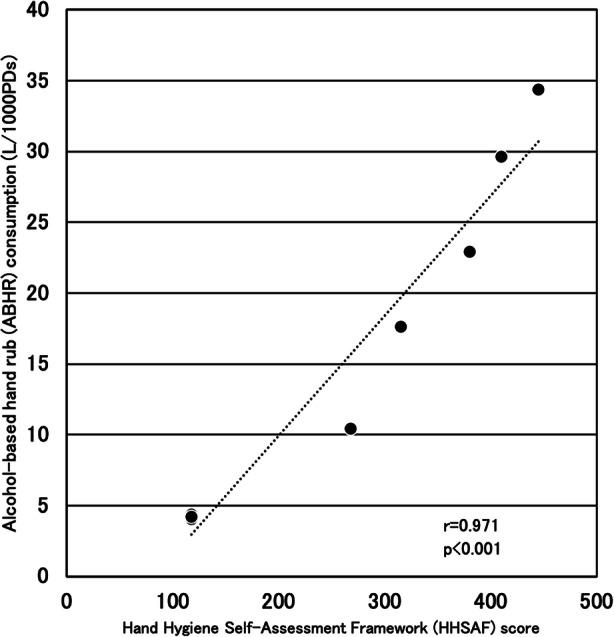
The annual ABHR consumption was 4.0 (L/1000 PDs) to 4.4 in the pre-implementation period and 10.4 to 34.4 in the implementation period. The HHSAF score was 117.5 (out of 500) in the pre-implementation period and 267.5 to 445 in the implementation period. A statistically significant increase in the monthly ABHR consumption (change in slope: + 0.479 L/1000 PDs, p < 0.01) was observed with the implementation of the initiative. Annual ABHR consumption was strongly correlated with the annual HHSAF score (r = 0.971, p < 0.01).
CONCLUSIONS
A 5-year WHO-based HH initiative significantly increased ABHR consumption. Our study suggested that the HHSAF assessment can be a good process measure to improve HH in a single facility, as ABHR consumption increased with the HHSAF score.
背景
一项基于世界卫生组织(WHO)指南的多模式手卫生(HH)倡议在五年内被引入一家非教学性的日本医院。本研究的目的是评估该倡议在酒精基手部搓揉剂(ABHR)消耗和手部卫生自我评估框架(HHSAF)得分方面的效果。
方法
每月在医院范围内计算 ABHR 的消耗量,以每 1000 个患者日(PDs)的升数表示。通过中断时间序列分析来分析 ABHR 消耗的变化,其中实施前时期为 36 个月,实施时期为 60 个月。使用 Pearson 相关系数估计年度 ABHR 消耗与 HHSAF 得分之间的相关性。
结果
实施前时期的年度 ABHR 消耗为 4.0(L/1000 PDs)至 4.4,实施时期为 10.4 至 34.4。实施前时期的 HHSAF 得分为 117.5(满分 500),实施时期为 267.5 至 445。随着倡议的实施,ABHR 消耗的月度增长呈统计学显著(斜率变化:+0.479 L/1000 PDs,p<0.01)。年度 ABHR 消耗与年度 HHSAF 得分呈强相关(r=0.971,p<0.01)。
结论
一项为期五年的基于 WHO 的 HH 倡议显著增加了 ABHR 的消耗。我们的研究表明,HHSAF 评估可以作为提高单个医疗机构 HH 的良好过程指标,因为 ABHR 消耗随 HHSAF 得分的增加而增加。

 Zotero 插件