Rinaldi Luca, Nevola Riccardo, Franci Gianluigi, Perrella Alessandro, Corvino Giusy, Marrone Aldo, Berretta Massimiliano, Morone Maria Vittoria, Galdiero Marilena, Giordano Mauro, Adinolfi Luigi Elio, Sasso Ferdinando Carlo
Department of Advanced Medical and Surgical Sciences, University of Campania "L. Vanvitelli", 80100 Naples, Italy.
Department of Medicine, Surgery, Dentistry, University of Salerno "Scuola Medica Salernitana", 84100 Salerno, Italy.
Cancers (Basel). 2020 May 26;12(6):1351. doi: 10.3390/cancers12061351.
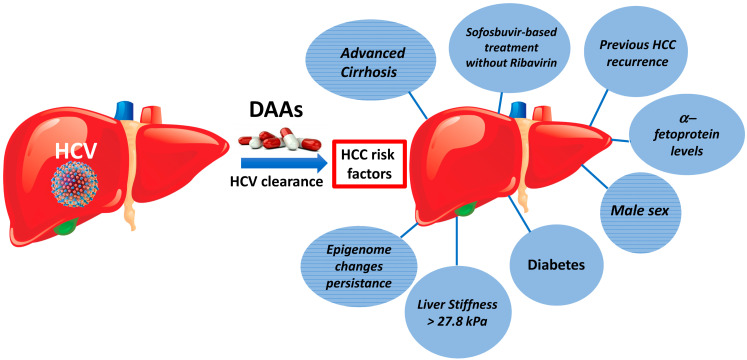
Direct-acting antivirals (DAAs) induce a rapid virologic response (SVR) in up to 99% of chronic hepatitis C patients. The role of SVR by DAAs on the incidence or recurrence of hepatocellular carcinoma (HCC) is still a matter of debate, although it is known that SVR does not eliminate the risk of HCC. In this review, we made an updated analysis of the literature data on the impact of SVR by DAAs on the risk of HCC as well as an assessment of risk factors and the role of epigenetics. Data showed that SVR has no impact on the occurrence of HCC in the short-medium term but reduces the risk of HCC in the medium-long term. A direct role of DAAs in the development of HCC has not been demonstrated, while the hypothesis of a reduction in immune surveillance in response to the rapid clearance of HCV and changes in the cytokine pattern influencing early carcinogenesis remains to be further elucidated. HCV induces epigenetic alterations such as modifications of the histone tail and DNA methylation, which are risk factors for HCC, and such changes are maintained after HCV clearance. Future epigenetic studies could lead to identify useful biomarkers and therapeutic targets. Cirrhosis has been identified as a risk factor for HCC, particularly if associated with high liver stiffness and α-fetoprotein values, diabetes and the male sex. Currently, considering the high number and health cost to follow subjects' post-HCV clearance by DAAs, it is mandatory to identify those at high risk of HCC to optimize management.
直接作用抗病毒药物(DAAs)可使高达99%的慢性丙型肝炎患者产生快速病毒学应答(SVR)。尽管已知SVR并不能消除肝细胞癌(HCC)的风险,但DAAs诱导的SVR对HCC发病率或复发的作用仍存在争议。在本综述中,我们对关于DAAs诱导的SVR对HCC风险影响的文献数据进行了更新分析,并评估了风险因素及表观遗传学的作用。数据显示,SVR在短期至中期对HCC的发生没有影响,但在中长期可降低HCC风险。尚未证实DAAs在HCC发生过程中具有直接作用,而关于因HCV快速清除导致免疫监视降低以及影响早期致癌作用的细胞因子模式改变的假说仍有待进一步阐明。HCV可诱导表观遗传改变,如组蛋白尾部修饰和DNA甲基化,这些都是HCC的风险因素,且在HCV清除后这些改变仍会持续存在。未来的表观遗传学研究可能会导致识别出有用的生物标志物和治疗靶点。肝硬化已被确定为HCC的一个风险因素,特别是与高肝硬度、甲胎蛋白值、糖尿病和男性性别相关时。目前,考虑到DAAs治疗后随访患者的数量众多及医疗成本,必须识别出HCC高风险患者以优化管理。