Zbiciak Artur, Kraśkiewicz Cezary, Sabouni-Zawadzka Anna Al, Pełczyński Jan, Dudziak Sławomir
Institute of Roads and Bridges, Faculty of Civil Engineering, Warsaw University of Technology, Al. Armii Ludowej 16, 00-637 Warsaw, Poland.
Institute of Building Engineering, Faculty of Civil Engineering, Warsaw University of Technology, Al. Armii Ludowej 16, 00-637 Warsaw, Poland.
Materials (Basel). 2020 May 26;13(11):2438. doi: 10.3390/ma13112438.
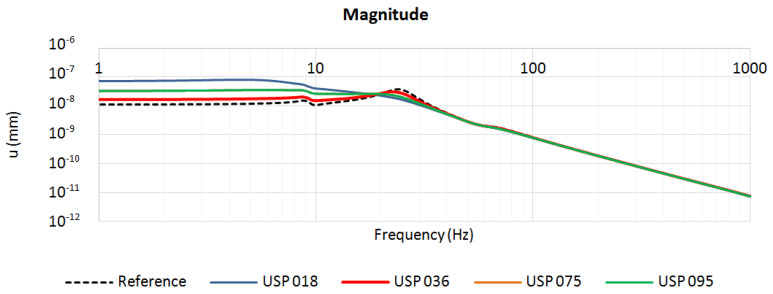
The present paper is dedicated to the analysis of under sleeper pads (USP), which are resilient elements used in ballasted track systems as vibration isolators. Four types of USP are considered. The authors present the results of laboratory tests, which are then used as input values for the finite element (FE) and mechanical model of the structure. A special focus is put on the description of an original four-degree-of-freedom (4DoF) mechanical model of the system that includes a fractional rheological model of USP. Using the proposed approaches, the dynamic characteristics of under sleeper pads are determined, and conclusions on vibration isolation effectiveness are drawn.
本文致力于分析轨枕垫板(USP),其作为隔振器用于有砟轨道系统的弹性元件。考虑了四种类型的轨枕垫板。作者展示了实验室测试结果,这些结果随后被用作结构有限元(FE)和力学模型的输入值。特别关注了该系统原始四自由度(4DoF)力学模型的描述,该模型包括轨枕垫板的分数流变模型。使用所提出的方法,确定了轨枕垫板的动态特性,并得出了关于隔振效果的结论。