Formoso-Rafferty Nora, Chavez Katherine Natalia, Ojeda Candela, Cervantes Isabel, Gutiérrez Juan Pablo
Departamento de Producción Agraria, E.T.S. Ingeniería Agronómica, Alimentaria y de Biosistemas, Universidad Politécnica de Madrid, C/Senda del Rey 18, 28040 Madrid, Spain.
Departamento de Producción Animal, Facultad de Veterinaria, Universidad Complutense de Madrid, Avda. Puerta de Hierro s/n, 28040 Madrid, Spain.
Animals (Basel). 2020 May 26;10(6):920. doi: 10.3390/ani10060920.
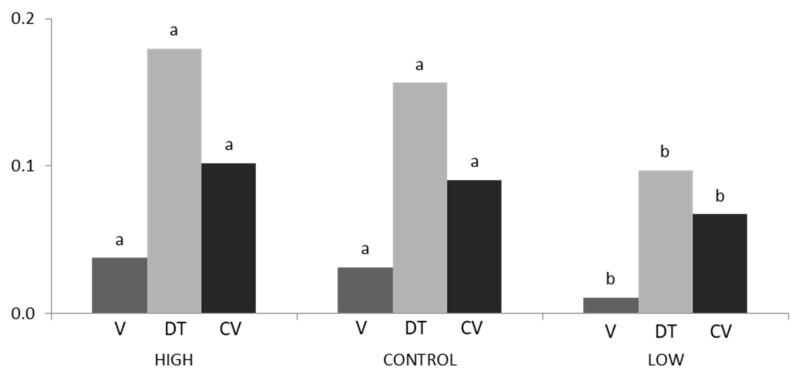
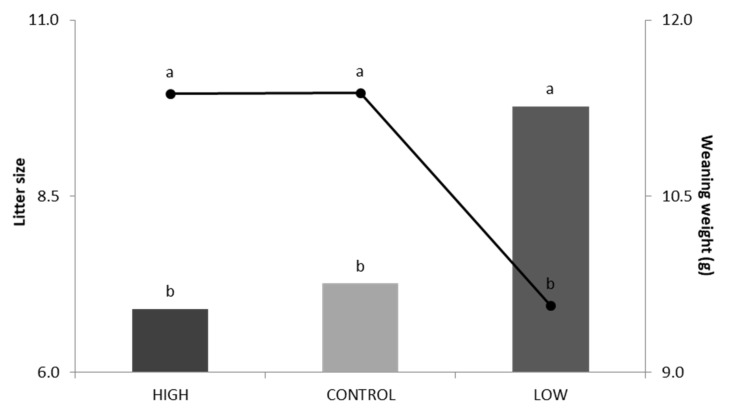
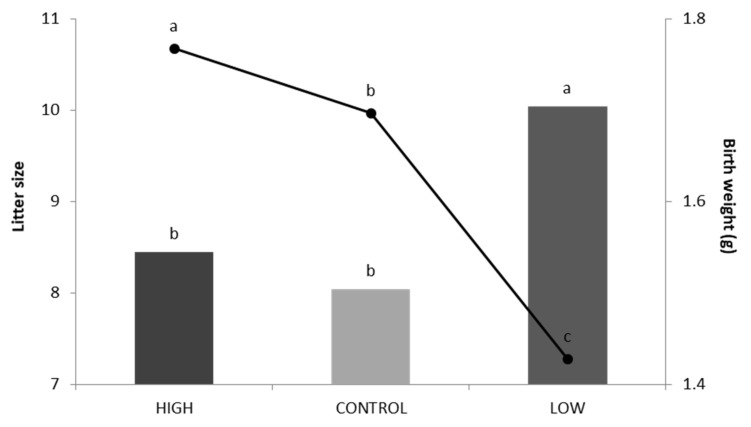
Birth weight (BW) in animal production is an economically important trait in prolific species. The laboratory mouse ( ) is used as an experimental animal because it is considered a suitable model for prolific species such as rabbits and pigs. Two mouse lines were divergently selected for birth weight variability with a third line of non-selected control population of the same origin as the animals starting the experiment. The objective of this study was, therefore, to compare and evaluate the differential response of each line. The animals were from the 17th generation of both low and high BW variability lines of the divergent selection experiment, including in addition animals from the control line. The dataset contained 389 records from 48 litters of the high line, 734 records from 73 litters of the low line, and 574 records from 71 litters of the control line. The studied traits were as follows: the BW, the BW variance, the BW standard deviation, the BW coefficient of variation within-litter, the weaning weight (WW), the litter size at birth and at weaning, the weight gain, and the preweaning survival. The model included the line effect jointly with the parturition number and its interaction, the linear and quadratic LS as covariates except for the LS trait itself when analyzing litter traits, as well as the pup sex when analyzing individual traits. The low line had a lower BW and WW, but a higher litter size, and greater robustness owing to a higher survival at weaning. As a model of livestock animals, the findings from this experiment led to a proposal of selection for pig production that would combine an increase in litter size with higher survival and welfare. Compared with the control line, a much higher response was observed in the low variability line than in the high line, making it extremely satisfactory given that homogeneity provides advantages in terms of animal welfare and robustness.
在动物生产中,出生体重(BW)是多产物种的一个重要经济性状。实验室小鼠被用作实验动物,因为它被认为是兔子和猪等多产物种的合适模型。针对出生体重变异性对两个小鼠品系进行了差异选择,并设立了第三个品系作为非选择对照群体,该对照群体与启动实验的动物来源相同。因此,本研究的目的是比较和评估每个品系的差异反应。这些动物来自差异选择实验中第17代的低出生体重变异性品系和高出生体重变异性品系,此外还包括对照品系的动物。数据集包含高品系48窝的389条记录、低品系73窝的734条记录以及对照品系71窝的574条记录。所研究的性状如下:出生体重、出生体重方差、出生体重标准差、窝内出生体重变异系数、断奶体重(WW)、出生时和断奶时的窝仔数、体重增加以及断奶前存活率。模型包括品系效应以及分娩次数及其交互作用,在分析窝仔性状时,除了窝仔数性状本身外,线性和二次产仔数作为协变量,在分析个体性状时还包括幼仔性别。低品系的出生体重和断奶体重较低,但窝仔数较高,并且由于断奶时存活率较高而具有更强的健壮性。作为家畜动物的模型,本实验的结果提出了一种用于猪生产的选择方案,该方案将增加窝仔数与提高存活率和福利相结合。与对照品系相比,低变异性品系的反应比高变异性品系高得多,鉴于同质性在动物福利和健壮性方面具有优势,这一结果非常令人满意。