Department of Healthcare Administration, Asia University, Taichung 41354, Taiwan.
South District Public Health Center, Taichung City Government, Taichung 402332, Taiwan.
Int J Environ Res Public Health. 2020 May 26;17(11):3777. doi: 10.3390/ijerph17113777.
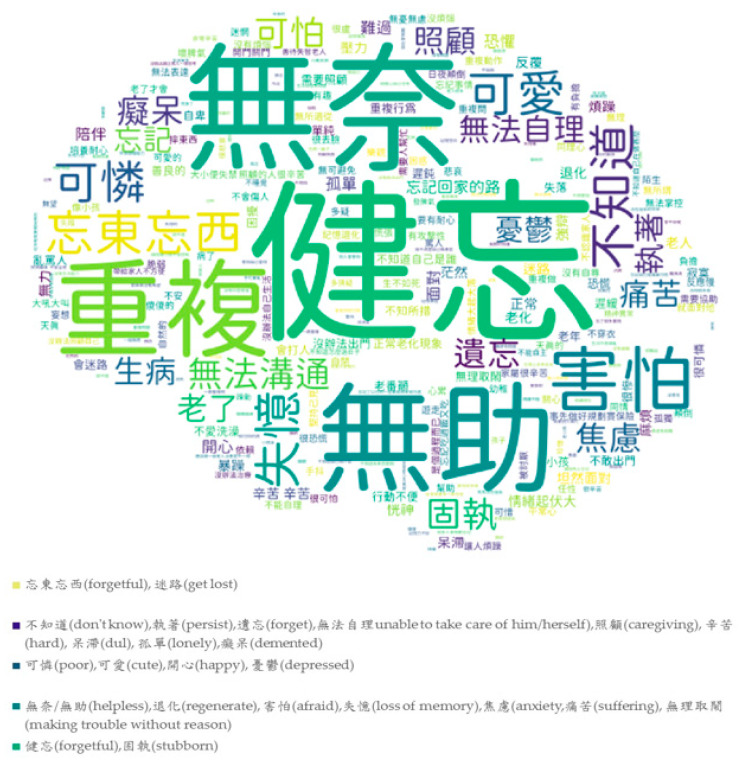
The purpose of this study was to examine the relationship between knowledge and attitudes towards dementia among adults. A cross-sectional online survey with purposive sampling was conducted in four district health centers in Taichung, Taiwan, in 2018. Knowledge was measured by the Taiwanese version of the Dementia Knowledge Assessment Scale. Attitudes towards people with dementia were measured by four kinds of feelings: discomfort, shame, avoidance, and fear. In total, 347 persons completed the questionnaire. Knowledge of dementia was modest. Higher education, a care-related background, chronic health conditions, experience caring for people with dementia, and knowledge of family history were related to higher knowledge of dementia. Attitudes towards people with dementia were grouped into four clusters: uncomfortable (22.2%), ashamed (2.6%), unfriendly (22.5%), and non-negative (52.7%). Knowledge of dementia was significantly related to the ashamed cluster but not to the other clusters. Lower education, a lack of caring experience, and a lack of knowledge of family history were related to uncomfortable feelings, and poorer financial satisfaction was related to uncomfortable, afraid, and avoidant feelings. The open-question expression of feelings towards dementia was more likely to be negative (55.3%). The public should be educated on knowledge of and friendly attitudes towards dementia.
本研究旨在探讨成年人对痴呆症的知识和态度之间的关系。2018 年,在台湾台中市的四个地区健康中心进行了一项横断面在线调查,采用了目的抽样法。知识通过台湾版的痴呆症知识评估量表来衡量。对痴呆症患者的态度通过四种感觉来衡量:不适、羞耻、回避和恐惧。共有 347 人完成了问卷。对痴呆症的了解程度适中。较高的教育程度、与护理相关的背景、慢性健康状况、照顾痴呆症患者的经验以及对家族史的了解与较高的痴呆症知识相关。对痴呆症患者的态度分为四个群体:不舒服(22.2%)、羞耻(2.6%)、不友好(22.5%)和非负面(52.7%)。对痴呆症的了解与羞耻群体显著相关,但与其他群体无关。较低的教育程度、缺乏护理经验和缺乏家族史与不适感有关,较差的经济满意度与不适感、恐惧和回避感有关。对痴呆症的开放性表达更有可能是负面的(55.3%)。应向公众宣传痴呆症的知识和友好态度。