Meza-Espinoza Juan Pablo, Sáinz González Enrique, León-León Christian J N, Arámbula-Meraz Eliakym, Contreras-Gutiérrez José Alfredo, García-Magallanes Noemí, Madueña-Molina Jesús, Luque-Ortega Fred, Cervín-Serrano Salvador, Picos-Cárdenas Verónica Judith
1Facultad de Medicina e Ingeniería en Sistemas Computacionales de Matamoros, Universidad Autónoma de Tamaulipas, Matamoros, Tamps., Mexico.
Servicio de Medicina Genética, Hospital General de Culiacán, Culiacán, Sin., Mexico.
Mol Cytogenet. 2020 May 19;13:17. doi: 10.1186/s13039-020-00484-4. eCollection 2020.
Concomitant trisomy 2q3 and monosomy 4q3 have been rarely reported. Pure trisomy 2q3 has been associated with microcephaly, hypertelorism, low-set ears, micrognathia, visceral abnormalities, and growth retardation. Monosomy 4q3 includes a wide variety of dysmorphic features such an abnormal skull shape, hypertelorism, Pierre Robin sequence, short nose with abnormal bridge, fifth finger clinodactyly, congenital heart, and genitourinary defects, in addition to intellectual disability, developmental delay, and hypotonia, but more distal deletions involving 4q34-qter may result in milder phenotypes. Here, we present a child with a mild dysmorphic syndrome, resulted of a duplication 2q34-qter and a deletion 4q35.2-qter inherited of his father.
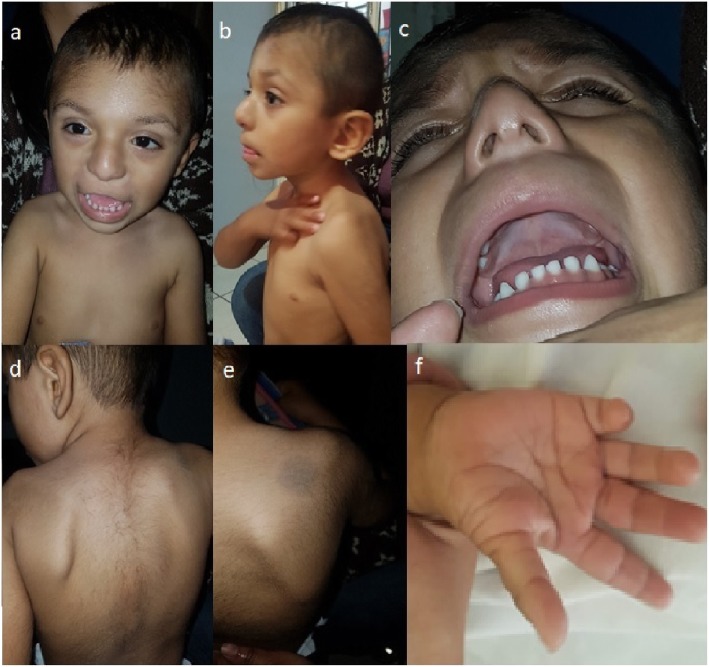
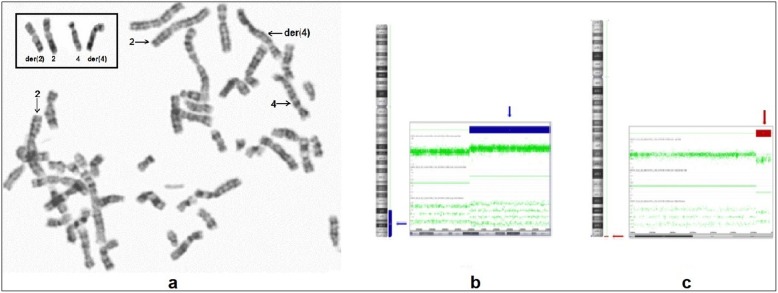
We report a child, who at birth presented hypotonia, dysmorphism, and bilateral cryptorchidism. At 2 years and 9 month of age he showed brachycephaly, narrow forehead, bilateral frontoparietal hypertrichosis, down slanting palpebral fissures, sparse eyebrows, sparse short eyelashes, hypertelorism, depressed nasal root, broad nasal bridge, bulbous nasal tip, prominent colummela, broad nasal ala, smooth filtrum, high arched palate, thin upper lips, and ears rotated backwards. He also showed telethelia, hypertrichosis from dorsal to the sacral region, hands with clinodactyly and hypoplasia of the terminal phalanx of the fifth finger, and broad thumbs, broad first toes, and right cryptorchidism. A chromosomal study revealed a karyotype 46,XY,der(4)t(2;4)(q34;q35.2), while an array comparative genomic hybridization showed a 31.12 Mb duplication of the chromosome 2q34-q37.3 and a 1.49 Mb deletion in the chromosome 4q35.2.
To our knowledge, only four families with translocation t(2;4) have been reported, two of them involving t(2q;4q), but the breakpoints involved in our patient have not been previously observed. The genomic imbalance in this patient was a duplication of 318 genes of the region 2q34-q37.3 and a deletion of 7 genes of 4q35.2. We discuss difficulty to assign specific congenital abnormalities to these duplicated/deleted regions and include some cases with terminal deletions of 4q with normal or just mildly detectable phenotypic effects.
2q3三体和4q3单体并存的情况鲜有报道。单纯的2q3三体与小头畸形、眼距过宽、低位耳、小颌畸形、内脏异常及生长发育迟缓有关。4q3单体包括多种畸形特征,如颅骨形状异常、眼距过宽、皮埃尔·罗宾序列、鼻梁异常的短鼻、第五指屈曲指、先天性心脏病和泌尿生殖系统缺陷,此外还有智力残疾、发育迟缓及肌张力减退,但涉及4q34 - qter的更远端缺失可能导致较轻的表型。在此,我们报告一名患有轻度畸形综合征的儿童,其2q34 - qter重复和4q35.2 - qter缺失遗传自他的父亲。
我们报告一名儿童,出生时表现为肌张力减退、畸形和双侧隐睾。在2岁9个月时,他出现短头畸形、前额狭窄、双侧额顶部多毛、睑裂向下倾斜、眉毛稀疏、睫毛稀疏短小、眼距过宽、鼻根凹陷、鼻梁宽阔、鼻尖球状、鼻小柱突出、鼻翼宽阔、鼻堤平滑、高拱腭、上唇薄以及耳朵向后旋转。他还表现为乳头间距增宽、从背部到骶部区域多毛、双手有屈曲指且第五指末节指骨发育不全、拇指宽阔、第一趾宽阔以及右侧隐睾。染色体研究显示核型为46,XY,der(4)t(2;4)(q34;q35.2),而阵列比较基因组杂交显示2号染色体q34 - q37.3区域有31.12 Mb的重复以及4号染色体q35.2区域有1.49 Mb的缺失。
据我们所知,仅报道过四个患有t(2;4)易位的家族,其中两个涉及t(2q;4q),但我们患者所涉及的断点此前尚未被观察到。该患者的基因组失衡为2q34 - q37.3区域318个基因的重复以及4q35.2区域7个基因的缺失。我们讨论了将特定先天性异常归因于这些重复/缺失区域的困难,并纳入了一些4q末端缺失但表型正常或仅轻微可检测的病例。