Department of Emergency, West China Second University Hospital, Sichuan University, Chengdu, Sichuan 610000, P.R. China.
Laboratory of Molecular Translational Medicine, Center for Translational Medicine, Key Laboratory of Birth Defects and Related Diseases of Women and Children (Sichuan University), Ministry of Education, West China Second University Hospital, Sichuan University, Chengdu, Sichuan 610000, P.R. China.
Int J Mol Med. 2020 Aug;46(2):561-570. doi: 10.3892/ijmm.2020.4610. Epub 2020 May 19.
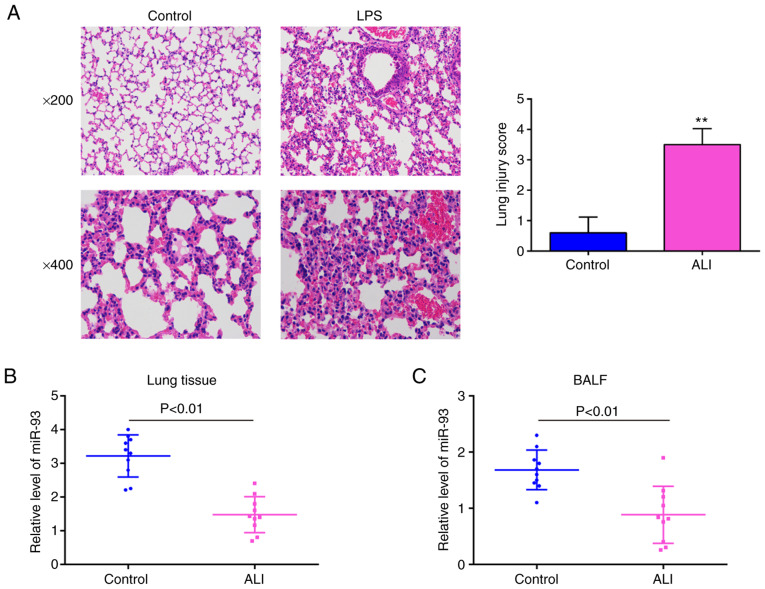
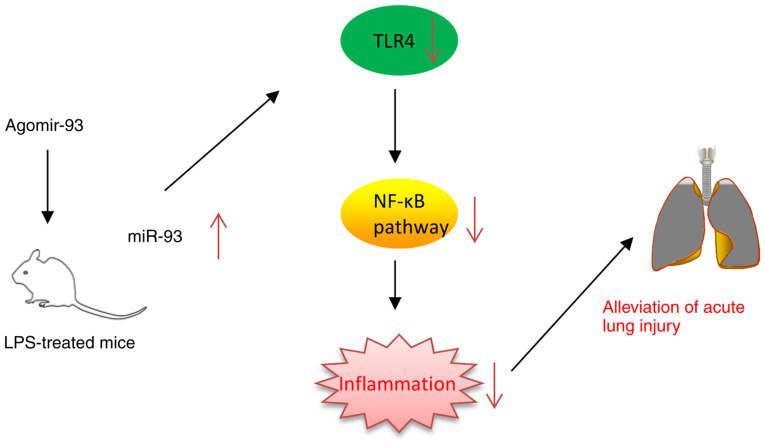
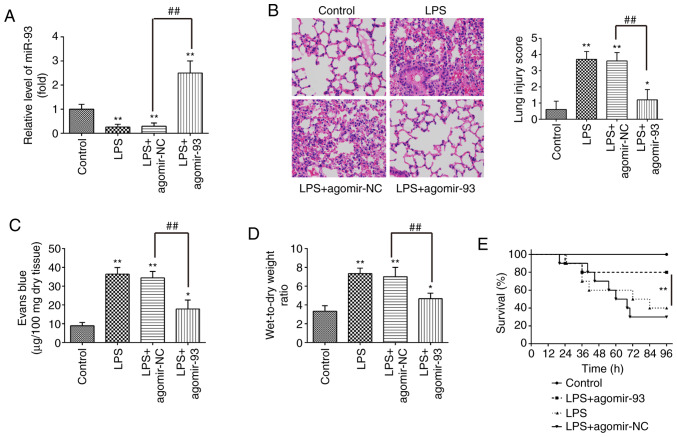
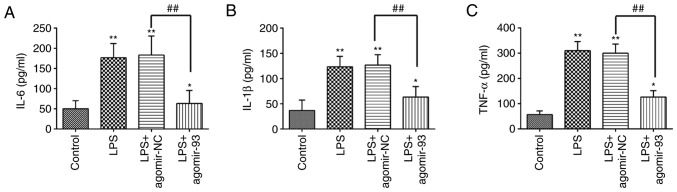
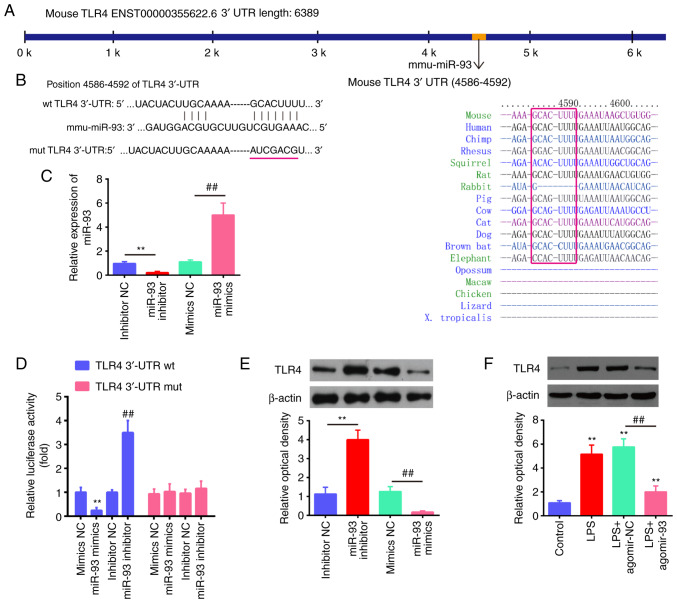
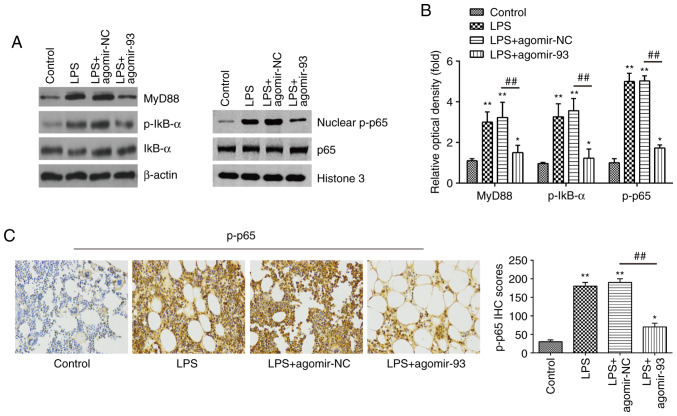
Acute lung injury (ALI) is a severe inflammatory lung disease with a rapid onset. The anti‑inflammatory functions of microRNA‑93 (miRNA/miR‑93) have been described in various types of tissue injury and disease. However, the biological role of miR‑93 and its molecular mechanisms underlying the initiation and progression of ALI have not yet been reported, at least to the best of our knowledge. The present study aimed to investigate the regulatory effects exerted by miR‑93 in ALI. Using an in vivo murine model of ALI induced by lipopolysaccharide (LPS), miR‑93 expression was found to be downregulated in the lung tissues and bronchoalveolar lavage fluid (BALF) compared with the control group. Following agomiR‑93 injection, it was observed that agomiR‑93 attenuated lung injury, as evidenced by decreased lung permeability, a reduced lung wet/dry weight ratio and an increased survival rate of the mice. Concomitantly, agomiR‑93 significantly reduced LPS‑induced the interleukin (IL)‑6, IL‑1β, and tumor necrosis factor (TNF)‑α levels in BALF. Of note, Toll‑like receptor 4 (TLR4), an upstream regulator of the nuclear factor (NF)‑κB signaling pathway, was directly suppressed by miR‑93 in RAW 264.7 cells. Importantly, agomiR‑93 induced a significant suppression of the TLR4/myeloid differentiation primary response 88 (MyD88)/NF‑κB signaling pathway, as demonstrated by the downregulation of MyD88, and the phosphorylation of IκB‑α and p65 in the lung tissues of mice with ALI. Taken together, the findings of the present study indicate that miR‑93 attenutes LPS‑induced lung injury by regulating the TLR4/MyD88/NF‑κB signaling pathway, suggesting that miR‑93 may prove to be a potential therapeutic target for ALI.
急性肺损伤(ALI)是一种起病迅速的严重炎症性肺病。microRNA-93(miRNA/miR-93)的抗炎功能已在各种类型的组织损伤和疾病中得到描述。然而,miR-93 的生物学功能及其在 ALI 发生和发展中的分子机制尚未报道,至少据我们所知是这样。本研究旨在探讨 miR-93 在 ALI 中的调节作用。通过脂多糖(LPS)诱导的体内 ALI 小鼠模型,发现与对照组相比,肺组织和支气管肺泡灌洗液(BALF)中的 miR-93 表达下调。用 agomiR-93 注射后,观察到 agomiR-93 减轻了肺损伤,表现为肺通透性降低、肺湿/干重比降低和小鼠存活率提高。同时,agomiR-93 显著降低了 LPS 诱导的 BALF 中白细胞介素(IL)-6、IL-1β和肿瘤坏死因子(TNF)-α水平。值得注意的是,Toll 样受体 4(TLR4)是核因子(NF)-κB 信号通路的上游调节剂,在 RAW 264.7 细胞中被 miR-93 直接抑制。重要的是,agomiR-93 诱导 TLR4/髓样分化初级反应 88(MyD88)/NF-κB 信号通路显著抑制,表现为 MyD88 下调,以及 ALI 小鼠肺组织中 IκB-α和 p65 的磷酸化。综上所述,本研究结果表明,miR-93 通过调节 TLR4/MyD88/NF-κB 信号通路减轻 LPS 诱导的肺损伤,表明 miR-93 可能成为 ALI 的潜在治疗靶点。