Department of Rehabilitation, Graduate School of Health Science, Saitama Prefectural University, Saitama, Japan.
Department of Behavioral Medicine, Graduate School of Medicine, Tohoku University, Sendai, Japan.
PLoS One. 2020 May 29;15(5):e0234089. doi: 10.1371/journal.pone.0234089. eCollection 2020.
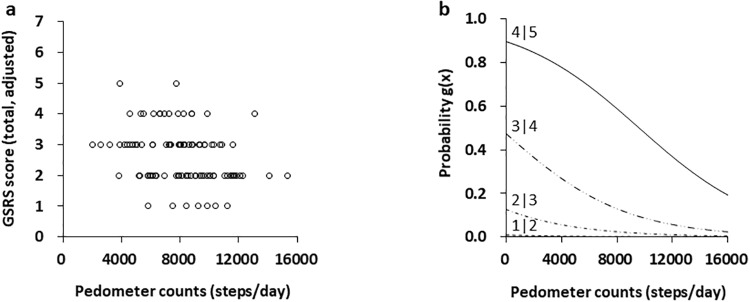
Irritable bowel syndrome (IBS) is a common bowel disorder that manifests as unexplained abdominal pain or discomfort and bowel habit changes in the form of diarrhea, constipation, or alternating patterns of the two. Some evidences demonstrate that increased physical activity improves IBS symptoms. Hence, daily exercise is recommended in these patients. In this study, we aimed to investigate the relationship between physical activity and gastrointestinal symptoms in 101 university students (female = 78) with IBS. Participants were examined by Gastrointestinal Symptoms Rating Scale (GSRS), and gait steps were measured for 1 week using a pedometer. The association between the GSRS score and pedometer counts was determined by ordinal logistic modeling analysis. The ordinal logistic regression model for GSRS and locomotor activity showed a significant stepwise fit (z = -3.05, p = 0.002). The logistic curve separated GSRS score of 5 points (moderately severe discomfort) from 2 points (minor discomfort) by locomotor activity. The probability for daily locomotor activity to discriminate between 5 and 4 points of GSRS (i.e., likely to have reverse symptoms) decreased in accordance with increment of steps per day: 78% probability for 4000 steps, 70% probability for 6000 steps, 59% probability for 8000 steps, and 48% probability for 10000 steps. This study demonstrated that the severity of GSRS is associated with the amount of walking in younger people with IBS. These results may be used as a measure to determine the daily step count to reduce the severity of gastrointestinal symptoms in individuals with IBS.
肠易激综合征(IBS)是一种常见的肠道疾病,表现为不明原因的腹痛或不适,以及腹泻、便秘或两者交替的肠道习惯改变。一些证据表明,增加身体活动可以改善 IBS 症状。因此,建议这些患者进行日常锻炼。在这项研究中,我们旨在调查 101 名大学生(女性=78 名)中身体活动与胃肠道症状之间的关系。通过胃肠道症状评分量表(GSRS)对参与者进行检查,并使用计步器测量一周的步行步数。通过有序逻辑模型分析确定 GSRS 评分与计步器计数之间的关联。GSRS 和运动活动的有序逻辑回归模型显示出显著的逐步拟合(z=-3.05,p=0.002)。运动活动将 GSRS 评分 5 分(中度不适)与 2 分(轻度不适)分开。每天的运动活动区分 GSRS 评分 5 分和 4 分(即可能出现相反症状)的概率随着每天步数的增加而降低:4000 步的概率为 78%,6000 步的概率为 70%,8000 步的概率为 59%,10000 步的概率为 48%。本研究表明,GSRS 的严重程度与年轻 IBS 患者的步行量有关。这些结果可用于确定每日步数,以减轻 IBS 患者胃肠道症状的严重程度。