Cardiology Department, Centro de Investigación Biomédica en Red Enfermedades Cardiovaculares (CIBERCV), Hospital Clínico Universitario, Valladolid, Spain.
Cardiology Department, Centro de Investigación Biomédica en Red Enfermedades Cardiovaculares (CIBERCV), Hospital Clínico Universitario, Valladolid, Spain.
J Am Coll Cardiol. 2020 Jul 21;76(3):268-276. doi: 10.1016/j.jacc.2020.05.040. Epub 2020 May 26.
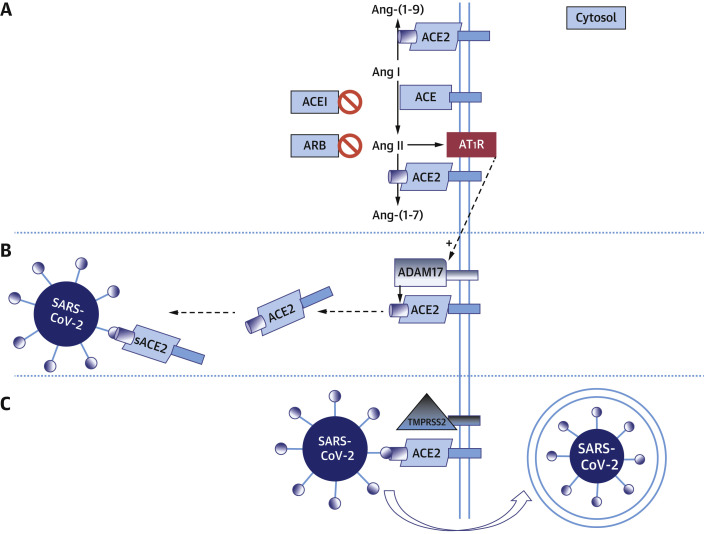
Coronavirus disease-2019 (COVID-19) is caused by severe acute respiratory-syndrome coronavirus-2 that interfaces with the renin-angiotensin-aldosterone system (RAAS) through angiotensin-converting enzyme 2. This interaction has been proposed as a potential risk factor in patients treated with RAAS inhibitors.
This study analyzed whether RAAS inhibitors modify the risk for COVID-19.
The RASTAVI (Renin-Angiotensin System Blockade Benefits in Clinical Evolution and Ventricular Remodeling After Transcatheter Aortic Valve Implantation) trial is an ongoing randomized clinical trial randomly allocating subjects to ramipril or control groups after successful transcatheter aortic valve replacement at 14 centers in Spain. A non-pre-specified interim analysis was performed to evaluate ramipril's impact on COVID-19 risk in this vulnerable population.
As of April 1, 2020, 102 patients (50 in the ramipril group and 52 in the control group) were included in the trial. Mean age was 82.3 ± 6.1 years, 56.9% of the participants were male. Median time of ramipril treatment was 6 months (interquartile range: 2.9 to 11.4 months). Eleven patients (10.8%) have been diagnosed with COVID-19 (6 in control group and 5 receiving ramipril; hazard ratio: 1.150; 95% confidence interval: 0.351 to 3.768). The risk of COVID-19 was increased in older patients (p = 0.019) and those with atrial fibrillation (p = 0.066), lower hematocrit (p = 0.084), and more comorbidities according to Society of Thoracic Surgeons score (p = 0.065). Admission and oxygen supply was required in 4.9% of patients (2 in the ramipril group and 3 in the control group), and 4 of them died (2 in each randomized group). A higher body mass index was the only factor increasing the mortality rate (p = 0.039).
In a high-risk population of older patients with cardiovascular disease, randomization to ramipril had no impact on the incidence or severity of COVID-19. This analysis supports the maintenance of RAAS inhibitor treatment during the COVID-19 crisis. (Renin-Angiotensin System Blockade Benefits in Clinical Evolution and Ventricular Remodeling After Transcatheter Aortic Valve Implantation [RASTAVI]; NCT03201185).
由严重急性呼吸综合征冠状病毒 2 引起的 2019 年冠状病毒病(COVID-19)通过血管紧张素转换酶 2 与肾素-血管紧张素-醛固酮系统(RAAS)相互作用。这种相互作用已被提议作为接受 RAAS 抑制剂治疗的患者的潜在风险因素。
本研究分析 RAAS 抑制剂是否会改变 COVID-19 的风险。
RASTAVI(经导管主动脉瓣置换术后肾素-血管紧张素系统阻断对临床演变和心室重构的益处)试验是一项正在进行的随机临床试验,在西班牙的 14 个中心,将受试者随机分配至雷米普利组或对照组,在成功进行经导管主动脉瓣置换术后。进行了非预先指定的中期分析,以评估雷米普利对该脆弱人群 COVID-19 风险的影响。
截至 2020 年 4 月 1 日,试验纳入了 102 例患者(雷米普利组 50 例,对照组 52 例)。平均年龄为 82.3±6.1 岁,56.9%的参与者为男性。雷米普利治疗的中位时间为 6 个月(四分位距:2.9 至 11.4 个月)。11 例(10.8%)患者被诊断为 COVID-19(对照组 6 例,雷米普利组 5 例;风险比:1.150;95%置信区间:0.351 至 3.768)。COVID-19 的风险在年龄较大的患者中增加(p=0.019)和那些患有心房颤动的患者中增加(p=0.066),较低的血细胞比容(p=0.084)和根据胸外科医生协会评分的更多合并症(p=0.065)。4.9%的患者(雷米普利组 2 例,对照组 3 例)需要住院和供氧,其中 4 例死亡(随机分组各 2 例)。较高的体重指数是唯一增加死亡率的因素(p=0.039)。
在心血管疾病高危老年患者人群中,随机分配至雷米普利对 COVID-19 的发生率或严重程度没有影响。该分析支持在 COVID-19 危机期间维持 RAAS 抑制剂治疗。(经导管主动脉瓣置换术后肾素-血管紧张素系统阻断对临床演变和心室重构的益处[RASTAVI];NCT03201185)。