Hong Mihee, Kyung Hee-Moon, Park Hyo-Sang, Yu Won-Jae, Baek Seung-Hak
Department of Orthodontics, School of Dentistry, Kyungpook National University, Daegu, Korea.
Department of Orthodontics and Dental Research Institute, School of Dentistry, Seoul National University, Seoul, Korea.
Korean J Orthod. 2020 May 25;50(3):197-205. doi: 10.4041/kjod.2020.50.3.197.
To investigate the prevalence of malocclusion with respect to grade, sex, and year among Korean pre-adolescent and adolescent students during 2012-2017.
A total of 165,996 students (first grade [E1, 6-7 years of age], fourth grade [E4, 9-10 years], seventh grade [M1, 12-13 years], and tenth grade [H1, 15-16 years]) were selected by stratified sampling method and underwent the nationwide oral health examination performed by the Ministry of Education, Republic of Korea. The malocclusion assessments based on dentists' judgments were "no malocclusion," "needs orthodontic treatment (N-OTx)," and "under orthodontic treatment (U-OTx)." The sum of N-OTx and U-OTx cases was determined as the number of students with malocclusion. After analyzing the prevalence of malocclusion according to grade, sex, and year-by-year differences, Pearson correlation analyses and two-way analyses of variance were performed.
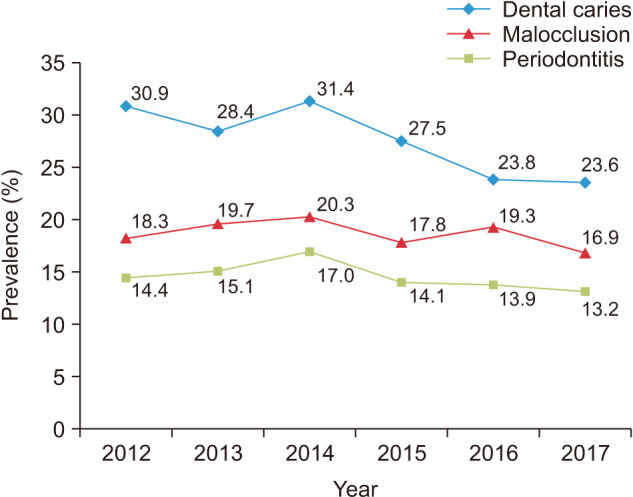
The prevalence of malocclusion was 18.7%, which increased with the grades (E1 [8.3%] < E4 [15.8%] < M1 [22.9%] < H1 [25.3%], < 0.001). However, there was no significant difference in the prevalence of malocclusion in each grade group for the period ( > 0.05) without significant correlation (E1, ρ = 0.129; E4, ρ = -0.495; M1, ρ = 0.406; H1, ρ = -0.383; all > 0.05). The prevalence of malocclusion within each grade group over the six-year period was more prominent in the female ( < 0.0001).
Further studies are necessary to modify the malocclusion assessment method to account for specific types of malocclusion in pre-adolescent and adolescent students.
调查2012 - 2017年韩国青春期前及青春期学生错牙合畸形在年级、性别和年份方面的患病率。
采用分层抽样方法选取了165996名学生(一年级[E1,6 - 7岁]、四年级[E4,9 - 10岁]、七年级[M1,12 - 13岁]和十年级[H1,15 - 16岁]),并接受了韩国教育部进行的全国口腔健康检查。基于牙医判断的错牙合畸形评估为“无错牙合畸形”、“需要正畸治疗(N - OTx)”和“正在接受正畸治疗(U - OTx)”。将N - OTx和U - OTx病例的总和确定为错牙合畸形学生的数量。在分析错牙合畸形患病率根据年级、性别和逐年差异后,进行了Pearson相关分析和双向方差分析。
错牙合畸形的患病率为18.7%,随年级升高而增加(E1[8.3%]<E4[15.8%]<M1[22.9%]<H1[25.3%],P<0.001)。然而,在此期间各年级组错牙合畸形患病率无显著差异(P>0.05),且无显著相关性(E1,ρ = 0.129;E4,ρ = -0.495;M1,ρ = 0.406;H1,ρ = -0.383;均P>0.05)。在六年期间,各年级组内错牙合畸形患病率在女性中更为突出(P<0.0001)。
有必要进一步研究修改错牙合畸形评估方法,以考虑青春期前及青春期学生特定类型的错牙合畸形。