Diabetes Centre, Department of Internal Medicine, Amsterdam University Medical Centers, location VUmc, Amsterdam, The Netherlands.
German Diabetes Center (DDZ), Leibniz Center for Diabetes Research, Heinrich Heine University, Medical Faculty, Düsseldorf, Germany.
Diabetes Obes Metab. 2020 Oct;22(10):1847-1856. doi: 10.1111/dom.14107. Epub 2020 Jun 22.
To determine the glucose-independent effect of the dipeptidyl peptidase-4 (DPP-4) inhibitor linagliptin versus the sulphonylurea glimepiride on systemic haemodynamics in the fasting and postprandial state in patients with type 2 diabetes (T2D).
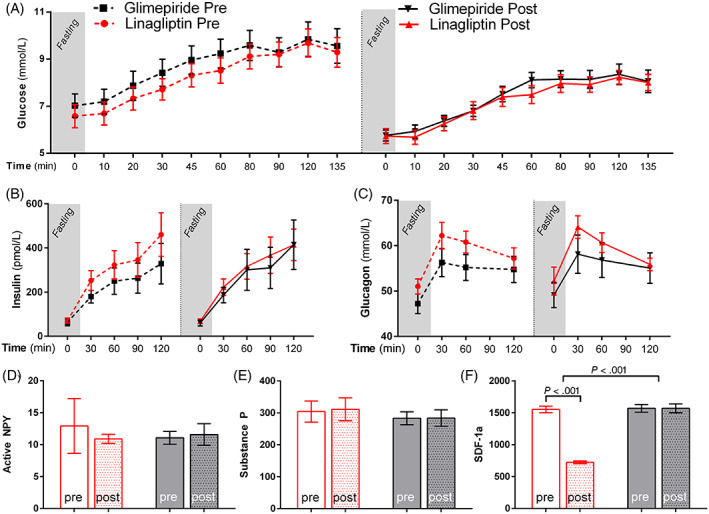
In this prespecified secondary analysis of a phase IV, double-blind trial, 46 metformin-treated, overweight patients with T2D were included and randomly assigned (1:1) to once-daily linagliptin (5 mg) or glimepiride (1 mg) for 8 weeks. In a sub-study involving 26 patients, systemic haemodynamics were also assessed following a standardized liquid meal (Nutridrink Yoghurt style). Systemic haemodynamics (oscillometric device and finger photoplethysmography), arterial stiffness (applanation tonometry) and cardiac sympathovagal balance (heart rate variability [HRV]) were measured in the fasting state and repetitively following the meal. Ewing tests were performed in the fasting state.
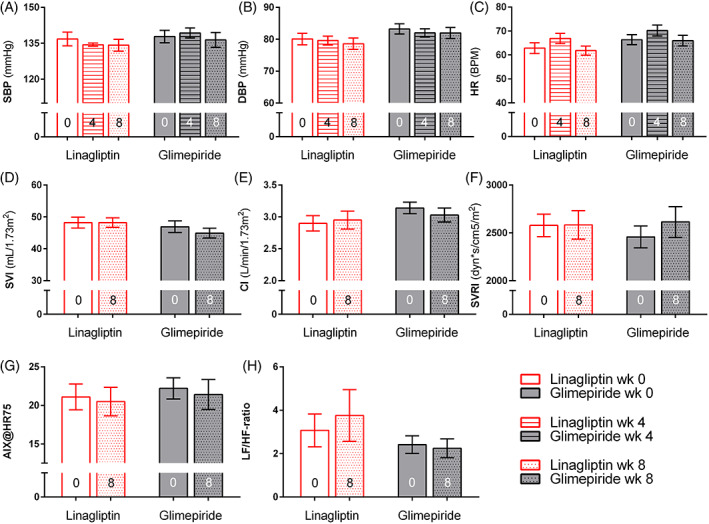
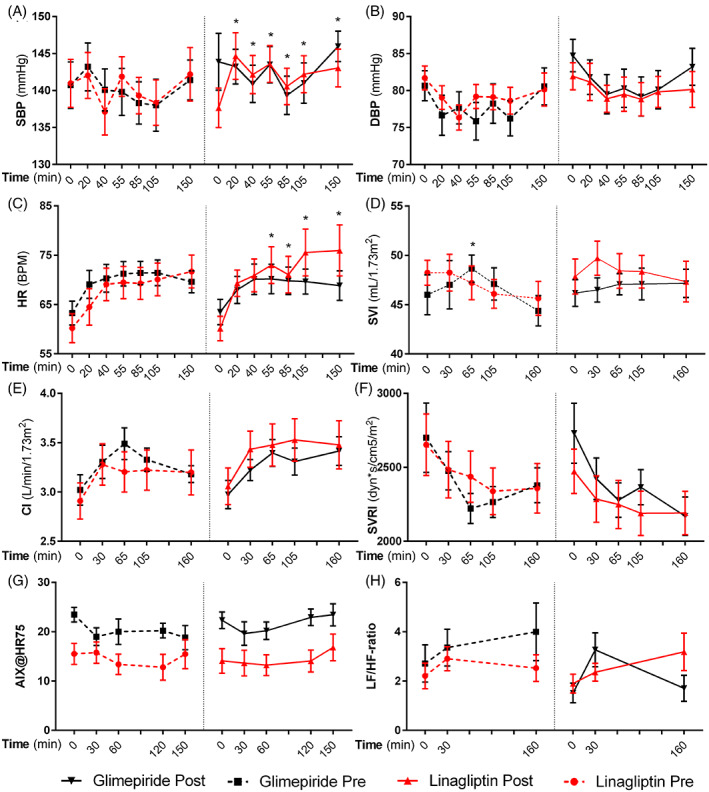
From baseline to week 8, linagliptin compared with glimepiride did not affect systemic haemodynamics, arterial stiffness or HRV in the fasting state. Linagliptin increased parasympathetic nervous activity, as measured by the Valsalva manoeuvre (P = .021) and deep breathing test (P = .027) compared with glimepiride. Postprandially, systolic blood pressure (SBP) dropped an average of 7.6 ± 1.6 mmHg. Linagliptin reduced this decrease to 0.7 ± 2.3 mmHg, which was significant to glimepiride (P = .010).
When compared with glimepiride, linagliptin does not affect fasting blood pressure. However, linagliptin blunted the postprandial drop in SBP, which could benefit patients with postprandial hypotension.
在 2 型糖尿病(T2D)患者空腹和餐后状态下,确定二肽基肽酶-4(DPP-4)抑制剂利拉利汀与磺酰脲类药物格列美脲的葡萄糖非依赖性作用对全身血液动力学的影响。
在一项 4 期、双盲试验的预设二次分析中,纳入了 46 名接受二甲双胍治疗的超重 T2D 患者,并按 1:1 比例随机分配(每天一次)接受利拉利汀(5 mg)或格列美脲(1 mg)治疗 8 周。在涉及 26 名患者的子研究中,还在标准化液体餐后评估了全身血液动力学(振荡测量装置和手指光体积描记法)、动脉僵硬(平板眼压测量)和心脏交感神经迷走神经平衡(心率变异性[HRV])。在空腹状态下和餐后重复测量。在空腹状态下进行尤因试验。
从基线到第 8 周,与格列美脲相比,利拉利汀在空腹状态下不影响全身血液动力学、动脉僵硬或 HRV。与格列美脲相比,利拉利汀增加了迷走神经活动,通过瓦尔萨尔瓦动作(P=.021)和深呼吸测试(P=.027)测量。餐后,收缩压(SBP)平均下降 7.6±1.6mmHg。与格列美脲相比,利拉利汀将这种下降降低至 0.7±2.3mmHg,这具有显著差异(P=.010)。
与格列美脲相比,利拉利汀不影响空腹血压。然而,利拉利汀减轻了餐后 SBP 的下降,这可能使餐后低血压患者受益。