Stary Victoria, Stary Georg
Department of Surgery, Medical University of Vienna, Vienna, Austria.
Department of Dermatology, Medical University of Vienna, Vienna, Austria.
Front Cell Infect Microbiol. 2020 May 14;10:208. doi: 10.3389/fcimb.2020.00208. eCollection 2020.
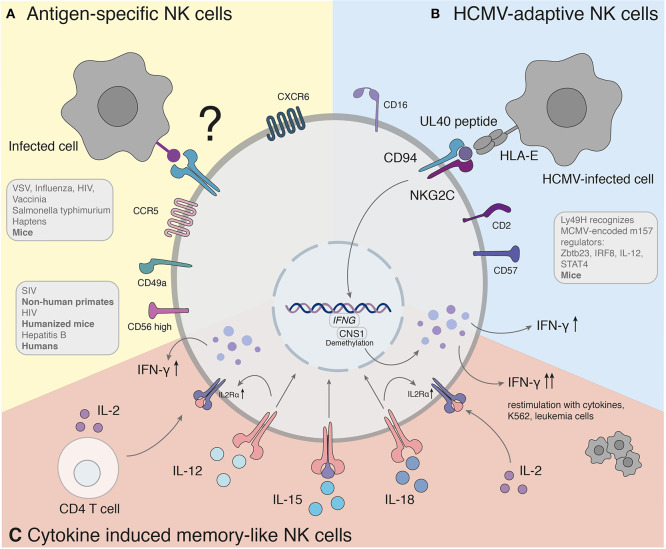
Mounting experimental evidence hints to an import role for natural killer (NK) cells in adaptive immune responses to pathogens. NK cells with adaptive features are heterogeneous and belong to different subsets according to their phenotype as well as the nature of their adaptive recall reactions. Three types of adaptive NK cell responses have been described: (i) NK cells with long-lived memory of multiple different haptens and viral antigens were described in murine liver tissue with a possible human counterpart; (ii) infection of human and mouse cytomegalovirus is associated with an expansion of NKG2C and Ly49H NK cells, respectively, that selectively recognize CMV-encoded peptides thereby facilitating recall responses; (iii) cytokine-stimulated NK cells respond to different stimuli with enhanced production of IFN-γ after re-stimulation. These exciting findings not only support the idea of NK cells with adaptive features, but define a novel field of harnessing memory NK cell subsets for therapeutic strategies.
越来越多的实验证据表明,自然杀伤(NK)细胞在针对病原体的适应性免疫反应中起着重要作用。具有适应性特征的NK细胞具有异质性,根据其表型以及适应性回忆反应的性质可分为不同的亚群。已描述了三种类型的适应性NK细胞反应:(i)在小鼠肝脏组织中发现了对多种不同半抗原和病毒抗原有长期记忆的NK细胞,可能存在人类对应物;(ii)人类和小鼠巨细胞病毒感染分别与NKG2C和Ly49H NK细胞的扩增有关,这些细胞选择性识别巨细胞病毒编码的肽,从而促进回忆反应;(iii)细胞因子刺激的NK细胞在再次刺激后对不同刺激产生增强的IFN-γ分泌反应。这些令人兴奋的发现不仅支持了具有适应性特征的NK细胞的观点,而且为利用记忆NK细胞亚群制定治疗策略定义了一个新领域。