Kidney Research Center, Department of Nephrology, Linkou Chang Gung Memorial Hospital, Taoyuan, Taiwan.
Clinical Poison Center, Chang Gung Memorial Hospital, Linkou Medical Center, Taoyuan, Taiwan.
Sci Rep. 2020 Jun 1;10(1):8827. doi: 10.1038/s41598-020-65756-w.
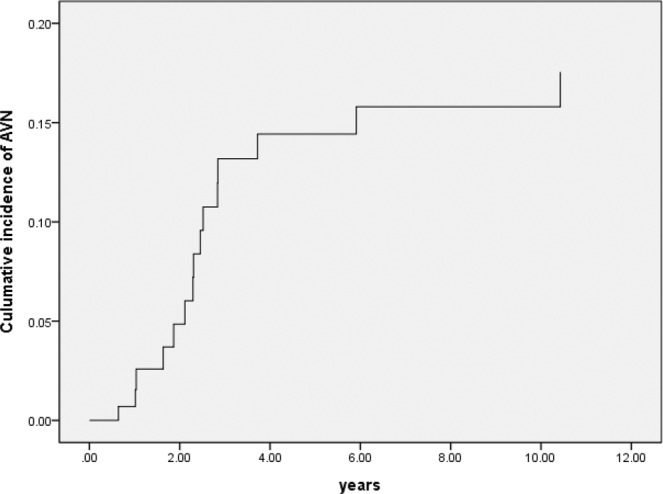
With increasing numbers of patients surviving acute intoxication phase, long-term complication after paraquat intoxication is a topic worth exploring, such as osteonecrosis (ON) of femoral head. We reviewed 86 paraquat-intoxicated survivors between 2000 and 2012 in Chang Gung Memorial Hospital, a 3700-bed tertiary hospital in Taiwan. With all the patients underwent same detoxification protocol in the acute stage, 17.4% of paraquat poisoning survivors developed ON of femoral head requiring surgery during follow up. Most of ON episodes occurred within 2 to 4 years after paraquat intoxication and then plateau after 6 years. ON patients exhibited higher SOFA scores than non-ON patients (2.80 ± 2.14 vs. 1.76 ± 1.52, p = 0.028). Furthermore, AKIN scores are also higher in the ON patients than non-ON patients (0.87 ± 1.13 vs. 0.38 ± 0.74, p = 0.040). Multivariate logistic regression showed higher AKIN score and higher partial pressure of carbon dioxide in the blood 48 hours after admission significantly predicted ON of femoral head after paraquat intoxication (p = 0.002 and p = 0.006 respectively). Larger studies with longer follow-up durations are warranted to confirm our finding.
随着越来越多的急性中毒患者存活下来,百草枯中毒后的长期并发症是一个值得探讨的问题,例如股骨头坏死(ON)。我们回顾了 2000 年至 2012 年间在台湾长庚纪念医院(一家拥有 3700 张床位的三级医院)接受治疗的 86 名百草枯中毒幸存者。所有患者在急性期均接受相同的解毒方案治疗,其中 17.4%的百草枯中毒幸存者在随访期间需要手术治疗股骨头坏死。大多数股骨头坏死发作发生在百草枯中毒后 2 至 4 年内,然后在 6 年后趋于稳定。股骨头坏死患者的 SOFA 评分高于非股骨头坏死患者(2.80±2.14 vs. 1.76±1.52,p=0.028)。此外,股骨头坏死患者的 AKIN 评分也高于非股骨头坏死患者(0.87±1.13 vs. 0.38±0.74,p=0.040)。多变量逻辑回归显示,入院后 48 小时 AKIN 评分较高和血二氧化碳分压较高显著预测了百草枯中毒后股骨头坏死(p=0.002 和 p=0.006)。需要进行更大规模的研究并延长随访时间,以证实我们的发现。