Molecular Diagnostics Division, Molecular Genetics Laboratory, London Health Sciences Centre, London, ON, Canada.
Department of Obstetrics and Gynaecology, Western University, London, ON, Canada.
J Hum Genet. 2020 Oct;65(10):865-873. doi: 10.1038/s10038-020-0780-4. Epub 2020 Jun 1.
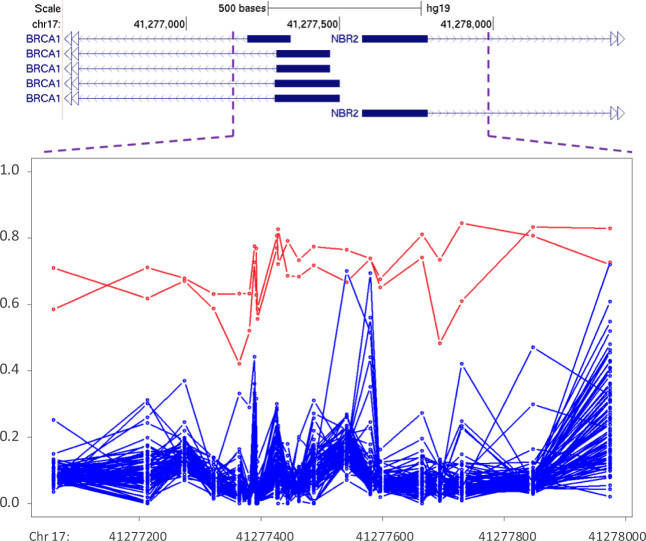
Poly-ADP-ribose-polymerase inhibitor (PARPi) treatment is indicated for advanced-stage ovarian tumors with BRCA1/2 deficiency. The "BRCAness" status is thought to be attributed to a tumor phenotype associated with a specific epigenomic DNA methylation profile. Here, we examined the diagnostic impact of combined BRCA1/2 sequence, copy number, and promoter DNA methylation analysis, and evaluated whether genomic DNA methylation patterns can predict the BRCAness in ovarian tumors. DNA sequencing of 172 human tissue samples of advanced-stage ovarian adenocarcinoma identified 36 samples with a clinically significant tier 1/2 sequence variants (point mutations and in/dels) and 9 samples with a CNV causing a loss of function in BRCA1/2. DNA methylation analysis of the promoter of BRCA1/2 identified promoter hypermethylation of BRCA1 in two mutation-negative samples. Computational modeling of genome-wide methylation markers, measured using Infinium EPIC arrays, resulted in a total accuracy of 0.75, sensitivity: 0.83, specificity: 0.64, positive predictive value: 0.76, negative predictive value: 0.74, and area under the receiver's operating curve (AUC): 0.77, in classifying tumors harboring a BRCA1/2 defect from the rest. These findings indicate that the assessment of CNV and promoter DNA methylation in BRCA1/2 increases the cumulative diagnostic yield by 10%, compared with the 20% yield achieved by sequence variant analysis alone. Genomic DNA methylation data can partially predict BRCAness in ovarian tumors; however, further investigation in expanded BRCA1/2 cohorts is needed, and the effect of other double strand DNA repair gene defects in these tumors warrants further investigations.
聚 ADP 核糖聚合酶抑制剂 (PARPi) 治疗用于 BRCA1/2 缺陷的晚期卵巢肿瘤。“BRCAness”状态被认为归因于与特定表观基因组 DNA 甲基化谱相关的肿瘤表型。在这里,我们检查了联合 BRCA1/2 序列、拷贝数和启动子 DNA 甲基化分析的诊断影响,并评估了基因组 DNA 甲基化模式是否可以预测卵巢肿瘤中的 BRCAness。对 172 个人类晚期卵巢腺癌组织样本进行的 BRCA1/2 序列分析,确定了 36 个具有临床显著 1/2 级序列变异(点突变和插入/缺失)的样本和 9 个导致 BRCA1/2 功能丧失的 CNV 样本。BRCA1/2 启动子的 DNA 甲基化分析确定了两个突变阴性样本中 BRCA1 启动子的超甲基化。使用 Infinium EPIC 阵列测量的全基因组甲基化标记的计算建模导致分类具有 BRCA1/2 缺陷的肿瘤与其余肿瘤的总准确率为 0.75、灵敏度为 0.83、特异性为 0.64、阳性预测值为 0.76、阴性预测值为 0.74 和接收器操作曲线下的面积 (AUC):0.77。这些发现表明,与仅通过序列变异分析获得的 20%的产量相比,评估 BRCA1/2 中的 CNV 和启动子 DNA 甲基化可将累积诊断产量提高 10%。基因组 DNA 甲基化数据可以部分预测卵巢肿瘤中的 BRCAness;然而,需要在更大的 BRCA1/2 队列中进行进一步研究,并且这些肿瘤中其他双链 DNA 修复基因缺陷的影响需要进一步研究。