Center for Exosome & Bioparticulate Research, Hanyang University, Gyeonggi-do, Korea.
HY Indang Center of Regenerative Medicine and Stem Cell Research, Hanyang University, Seoul, Korea.
Biotechnol Bioeng. 2020 Sep;117(9):2658-2667. doi: 10.1002/bit.27447. Epub 2020 Jun 30.
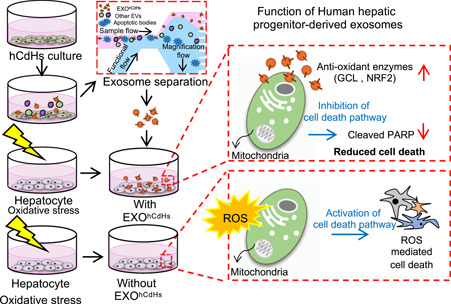
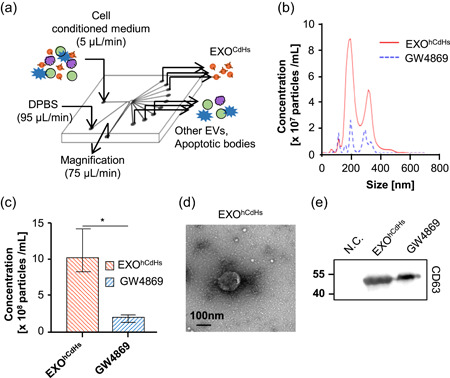
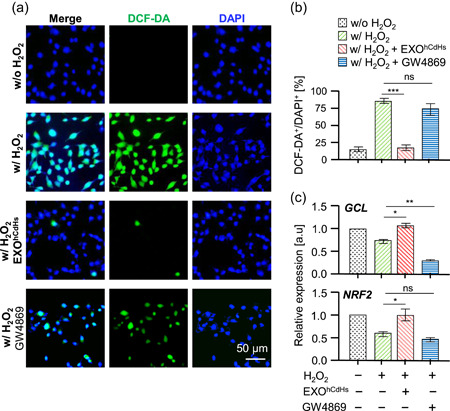
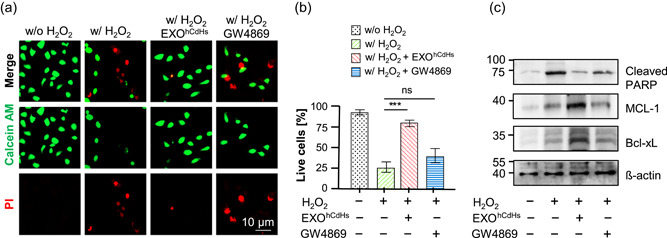
The emerging field of regenerative medicine has revealed that the exosome contributes to many aspects of development and disease through intercellular communication between donor and recipient cells. However, the biological functions of exosomes secreted from cells have remained largely unexplored. Here, we report that the human hepatic progenitor cells (CdHs)-derived exosome (EXO ) plays a crucial role in maintaining cell viability. The inhibition of exosome secretion treatment with GW4869 results in the acceleration of reactive oxygen species (ROS) production, thereby causing a decrease of cell viability. This event provokes inhibition of caspase dependent cell death signaling, leading to a ROS-dependent cell damage response and thus induces promotion of antioxidant gene expression or repair of cell death of hypoxia-exposed cells. Together, these findings show the effect of exosomes in regeneration of liver cells, and offer valuable new insights into liver regeneration.
再生医学领域的新发现表明,外泌体通过供体细胞与受体细胞之间的细胞间通讯,在许多方面发挥作用,参与到发育和疾病过程中。然而,细胞分泌的外泌体的生物学功能在很大程度上仍未得到探索。在这里,我们报告称,人肝祖细胞(CdHs)来源的外泌体(EXO)在维持细胞活力方面起着关键作用。用 GW4869 抑制外泌体分泌处理会加速活性氧(ROS)的产生,从而导致细胞活力下降。这一事件引发了半胱天冬酶依赖性细胞死亡信号的抑制,导致 ROS 依赖性细胞损伤反应,从而诱导抗氧化基因表达的促进或缺氧暴露细胞死亡的修复。总之,这些发现表明了外泌体在肝细胞再生中的作用,并为肝脏再生提供了有价值的新见解。