Shin Dongyoon, Park Joonho, Han Dohyun, Moon Ji Hye, Ryu Han Suk, Kim Youngsoo
Department of Biomedical Sciences, Seoul National University College of Medicine, 103 Daehakro, Seoul, 30380 Korea.
Interdisciplinary Program for Bioengineering, Seoul National University College of Engineering, Seoul, Korea.
Clin Proteomics. 2020 May 24;17:16. doi: 10.1186/s12014-020-09280-z. eCollection 2020.
Metastasis of breast cancer to distal organs is fatal. However, few studies have identified biomarkers that are associated with distant metastatic breast cancer. Furthermore, the inability of current biomarkers, such as HER2, ER, and PR, to differentiate between distant and nondistant metastatic breast cancers accurately has necessitated the development of novel biomarker candidates.
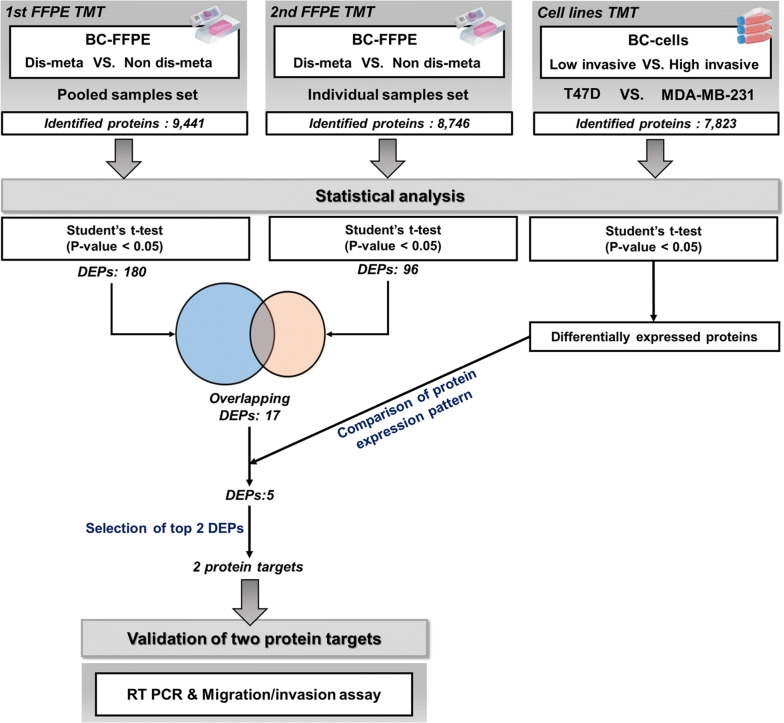
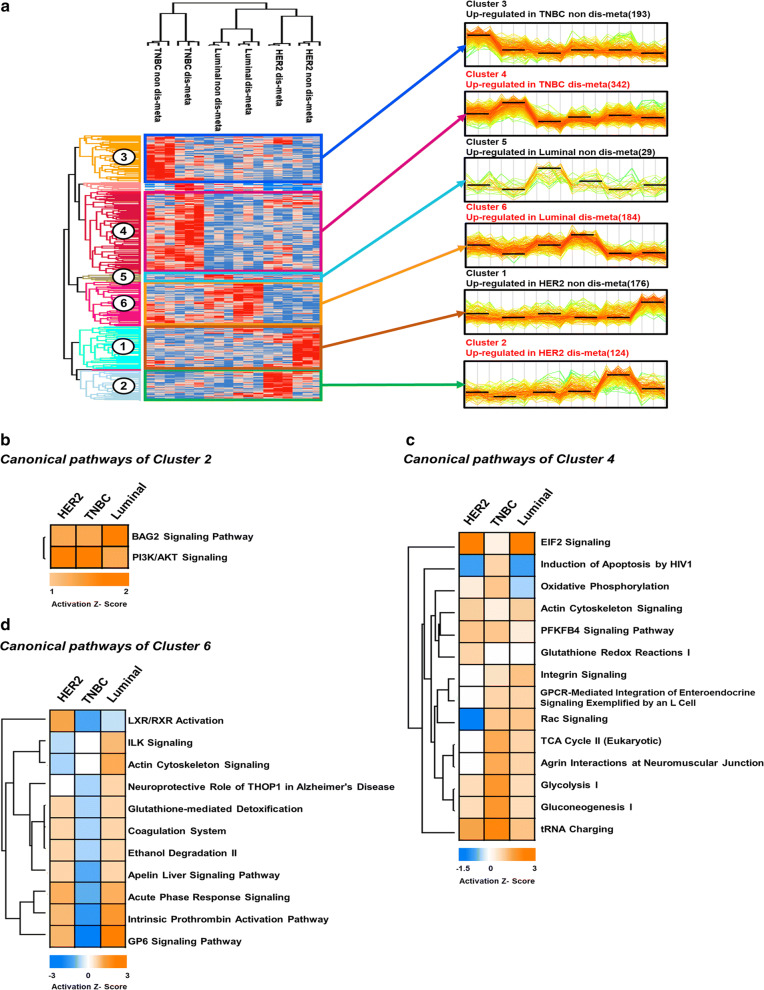
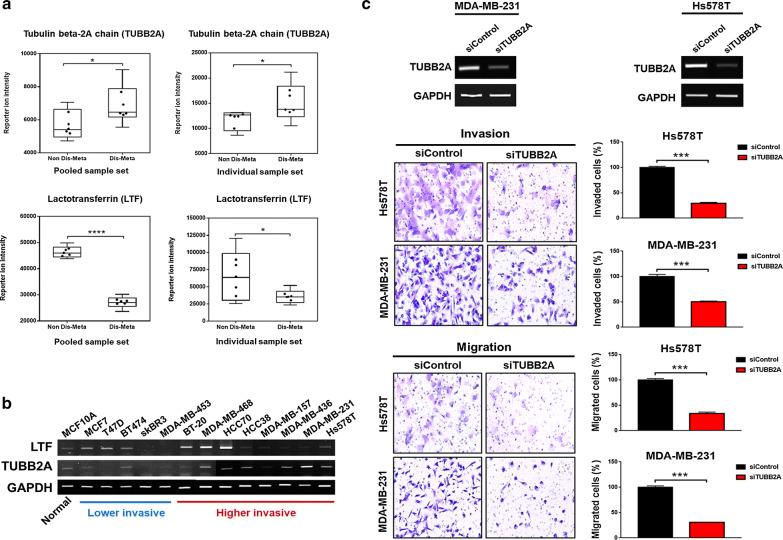
An integrated proteomics approach that combined filter-aided sample preparation, tandem mass tag labeling (TMT), high pH fractionation, and high-resolution MS was applied to acquire in-depth proteomic data from FFPE distant metastatic breast cancer tissues. A bioinformatics analysis was performed with regard to gene ontology and signaling pathways using differentially expressed proteins (DEPs) to examine the molecular characteristics of distant metastatic breast cancer. In addition, real-time polymerase chain reaction (RT-PCR) and invasion/migration assays were performed to validate the differential regulation and function of our protein targets.
A total of 9441 and 8746 proteins were identified from the pooled and individual sample sets, respectively. Based on our criteria, TUBB2A was selected as a novel biomarker candidate. The metastatic activities of TUBB2A were subsequently validated. In our bioinformatics analysis using DEPs, we characterized the overall molecular features of distant metastasis and measured differences in the molecular functions of distant metastatic breast cancer between breast cancer subtypes.
Our report is the first study to examine the distant metastatic breast cancer proteome using FFPE tissues. The depth of our dataset allowed us to discover a novel biomarker candidate and a proteomic characteristics of distant metastatic breast cancer. Distinct molecular features of various breast cancer subtypes were also established. Our proteomic data constitute a valuable resource for research on distant metastatic breast cancer.
乳腺癌转移至远端器官是致命的。然而,很少有研究确定与远处转移性乳腺癌相关的生物标志物。此外,目前的生物标志物,如HER2、ER和PR,无法准确区分远处和非远处转移性乳腺癌,因此有必要开发新的生物标志物候选物。
采用一种综合蛋白质组学方法,结合过滤辅助样品制备、串联质量标签标记(TMT)、高pH分级分离和高分辨率质谱,从福尔马林固定石蜡包埋(FFPE)的远处转移性乳腺癌组织中获取深度蛋白质组学数据。使用差异表达蛋白(DEP)对基因本体和信号通路进行生物信息学分析,以研究远处转移性乳腺癌的分子特征。此外,进行实时聚合酶链反应(RT-PCR)和侵袭/迁移试验,以验证我们蛋白质靶点的差异调节和功能。
分别从混合样本集和单个样本集中鉴定出总共9441种和8746种蛋白质。根据我们的标准,选择TUBB2A作为一种新的生物标志物候选物。随后验证了TUBB2A的转移活性。在我们使用DEP的生物信息学分析中,我们表征了远处转移的整体分子特征,并测量了乳腺癌亚型之间远处转移性乳腺癌分子功能的差异。
我们的报告是第一项使用FFPE组织研究远处转移性乳腺癌蛋白质组的研究。我们数据集的深度使我们能够发现一种新的生物标志物候选物和远处转移性乳腺癌的蛋白质组特征。还确定了各种乳腺癌亚型的独特分子特征。我们的蛋白质组学数据构成了远处转移性乳腺癌研究的宝贵资源。