Moroz-Omori Elena V, Satyapertiwi Dwiantari, Ramel Marie-Christine, Høgset Håkon, Sunyovszki Ilona K, Liu Ziqian, Wojciechowski Jonathan P, Zhang Yueyun, Grigsby Christopher L, Brito Liliana, Bugeon Laurence, Dallman Margaret J, Stevens Molly M
Department of Materials, Department of Bioengineering and Institute of Biomedical Engineering, Imperial College London, London SW7 2AZ, United Kingdom.
Department of Medical Biochemistry and Biophysics, Karolinska Institutet, Stockholm 171 65, Sweden.
ACS Cent Sci. 2020 May 27;6(5):695-703. doi: 10.1021/acscentsci.9b01093. Epub 2020 Apr 1.
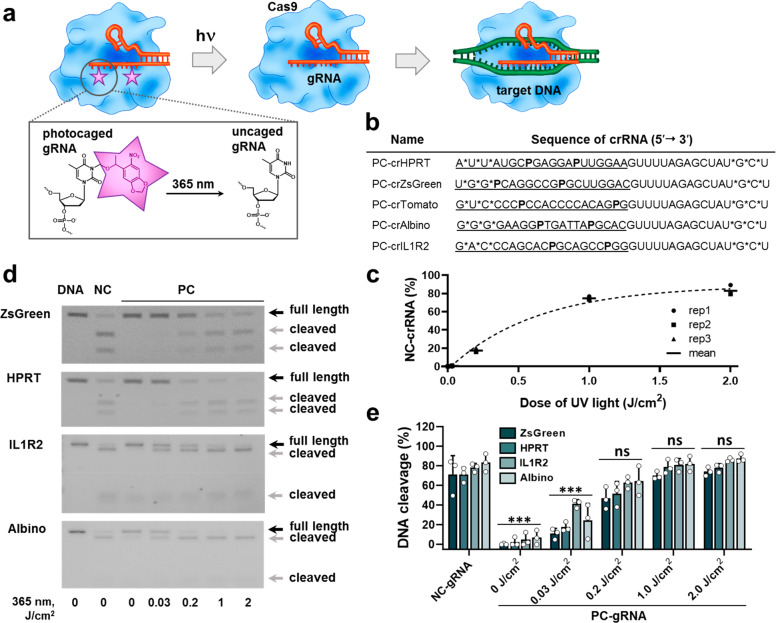
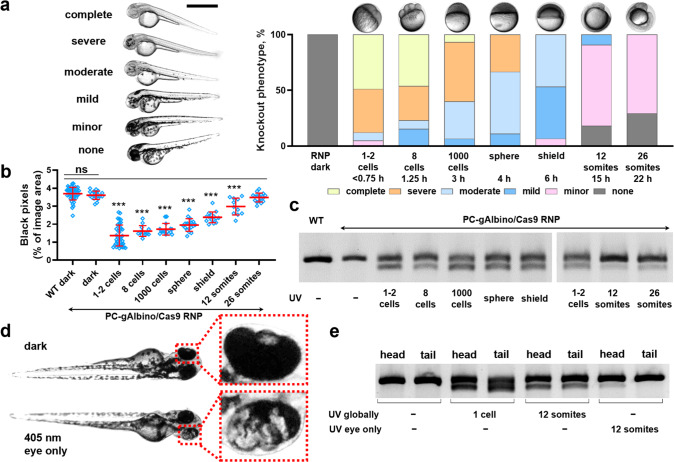
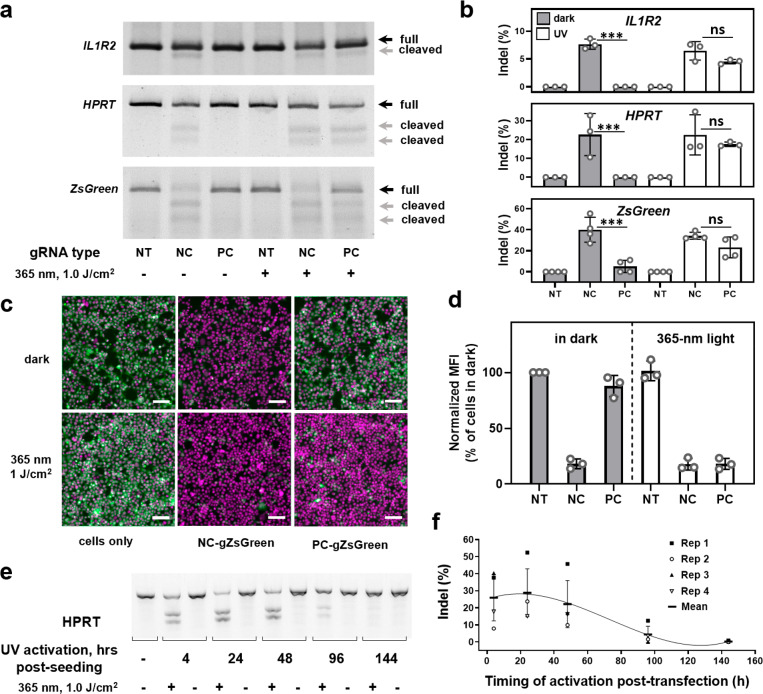
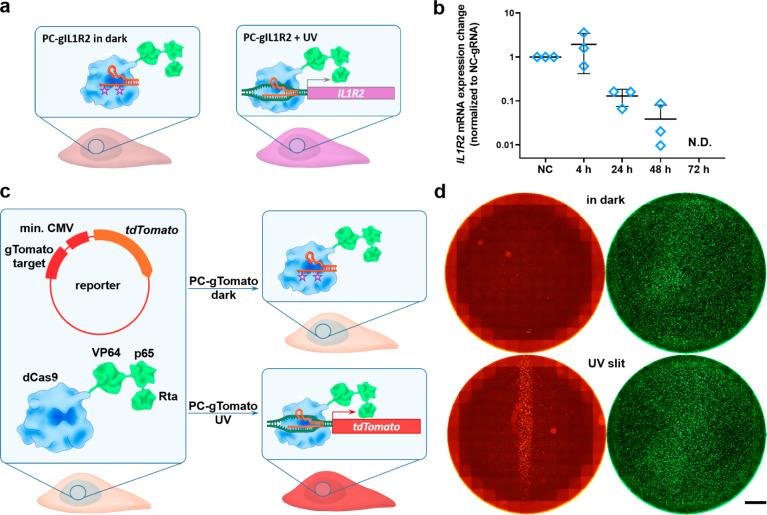
The recently discovered CRISPR-Cas gene editing system and its derivatives have found numerous applications in fundamental biology research and pharmaceutical sciences. The need for precise external control over the gene editing and regulatory events has driven the development of inducible CRISPR-Cas systems. While most of the light-controllable CRISPR-Cas systems are based on protein engineering, we developed an alternative synthetic approach based on modification of crRNA/tracrRNA duplex (guide RNA or gRNA) with photocaging groups, preventing the gRNA from recognizing its genome target sequence until its deprotection is induced within seconds of illumination. This approach relies on a straightforward solid-phase synthesis of the photocaged gRNAs, with simpler purification and characterization processes in comparison to engineering a light-responsive protein. We have demonstrated the feasibility of photocaging of gRNAs and light-mediated DNA cleavage upon brief exposure to light . We have achieved light-mediated spatiotemporally resolved gene editing as well as gene activation in cells, whereas photocaged gRNAs showed virtually no detectable gene editing or activation in the absence of light irradiation. Finally, we have applied this system to spatiotemporally control gene editing in zebrafish embryos , enabling the use of this strategy for developmental biology and tissue engineering applications.
最近发现的CRISPR-Cas基因编辑系统及其衍生物在基础生物学研究和制药科学领域有诸多应用。对基因编辑和调控事件进行精确外部控制的需求推动了可诱导CRISPR-Cas系统的发展。虽然大多数光控CRISPR-Cas系统基于蛋白质工程,但我们开发了一种基于用光笼蔽基团修饰crRNA/tracrRNA双链体(引导RNA或gRNA)的替代合成方法,该方法可防止gRNA识别其基因组靶序列,直至在光照后数秒内诱导其脱保护。这种方法依赖于光笼蔽gRNA的直接固相合成,与工程化光响应蛋白相比,其纯化和表征过程更简单。我们已经证明了gRNA光笼蔽以及短暂光照后光介导的DNA切割的可行性。我们在细胞中实现了光介导的时空分辨基因编辑以及基因激活,而在无光照射的情况下,光笼蔽gRNA几乎没有可检测到的基因编辑或激活。最后,我们将该系统应用于斑马鱼胚胎中的时空控制基因编辑,从而使该策略可用于发育生物学和组织工程应用。