Yu Weiwei, Jin Haiqiang, Deng Jianwen, Nan Ding, Huang Yining
Department of Neurology, Peking University First Hospital, 8 Xishiku Street Xicheng District, Beijing, 100034, China.
BMC Med Genet. 2020 Jun 3;21(1):123. doi: 10.1186/s12881-020-01053-7.
Hereditary spastic paraplegia is a heterogeneous group of clinically and genetically neurodegenerative diseases characterized by progressive gait disorder. Hereditary spastic paraplegia can be inherited in various ways, and all modes of inheritance are associated with multiple genes or loci. At present, more than 76 disease-causing loci have been identified in hereditary spastic paraplegia patients. Here, we report a novel mutation in SPAST gene associated with hereditary spastic paraplegia in a Chinese family, further enriching the hereditary spastic paraplegia spectrum.
Whole genomic DNA was extracted from peripheral blood of the 15 subjects from a Chinese family using DNA Isolation Kit. The Whole Exome Sequencing of the proband was analyzed and the result was identified in the rest individuals. RaptorX prediction tool and Protein Variation Effect Analyzer were used to predict the effects of the mutation on protein tertiary structure and function.
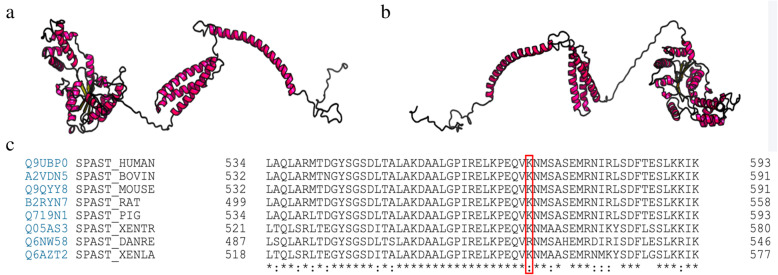
Spastic paraplegia has been inherited across at least four generations in this family, during which only four HSP patients were alive. The results obtained by analyzing the Whole Exome Sequencing of the proband exhibited a novel disease-associated in-frame deletion in the SPAST gene, and this mutation also existed in the rest three HSP patients in this family. This in-frame deletion consists of three nucleotides deletion (c.1710_1712delGAA) within the exon 16, resulting in lysine deficiency at the position 570 of the protein (p.K570del). This novel mutation was also predicted to result in the synthesis of misfolded SPAST protein and have the deleterious effect on the function of SPAST protein.
In this case, we reported a novel mutation in the known SPAST gene that segregated with HSP disease, which can be inherited in each generation. Simultaneously, this novel discovery significantly enriches the mutation spectrum, which provides an opportunity for further investigation of genetic pathogenesis of HSP.
遗传性痉挛性截瘫是一组临床和遗传异质性的神经退行性疾病,其特征为进行性步态障碍。遗传性痉挛性截瘫可通过多种方式遗传,所有遗传模式均与多个基因或基因座相关。目前,在遗传性痉挛性截瘫患者中已鉴定出超过76个致病基因座。在此,我们报道了一个中国家系中与遗传性痉挛性截瘫相关的SPAST基因新突变,进一步丰富了遗传性痉挛性截瘫的谱图。
使用DNA提取试剂盒从一个中国家系的15名受试者的外周血中提取全基因组DNA。对先证者进行全外显子组测序分析,并在其余个体中进行验证。使用RaptorX预测工具和蛋白质变异效应分析仪预测该突变对蛋白质三级结构和功能的影响。
痉挛性截瘫在这个家系中至少遗传了四代,在此期间只有四名遗传性痉挛性截瘫患者存活。通过对先证者的全外显子组测序分析结果显示,SPAST基因存在一个新的与疾病相关的框内缺失,该突变也存在于这个家系的其余三名遗传性痉挛性截瘫患者中。这个框内缺失由外显子16内的三个核苷酸缺失(c.1710_1712delGAA)组成,导致蛋白质第570位赖氨酸缺失(p.K570del)。这个新突变还被预测会导致错误折叠的SPAST蛋白的合成,并对SPAST蛋白的功能产生有害影响。
在本病例中,我们报道了一个已知的SPAST基因中的新突变,该突变与遗传性痉挛性截瘫疾病共分离,可在每一代中遗传。同时,这一新发现显著丰富了突变谱图,为进一步研究遗传性痉挛性截瘫的遗传发病机制提供了机会。