Université Côte d'Azur, CNRS, Inserm, iBV, Nice, France.
Université Paris-Saclay, INRAE, ENVA, BREED, 78350, Jouy-en-Josas, France.
Sci Adv. 2020 May 22;6(21):eaaz1261. doi: 10.1126/sciadv.aaz1261. eCollection 2020 May.
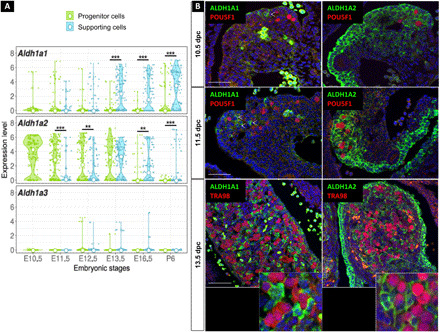
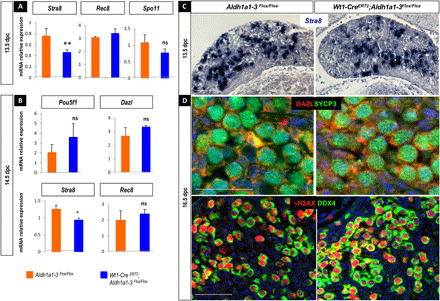
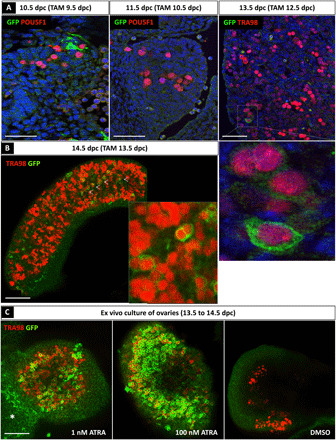
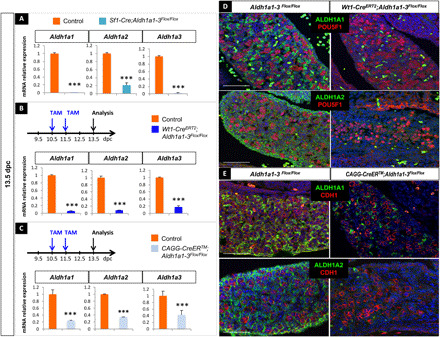
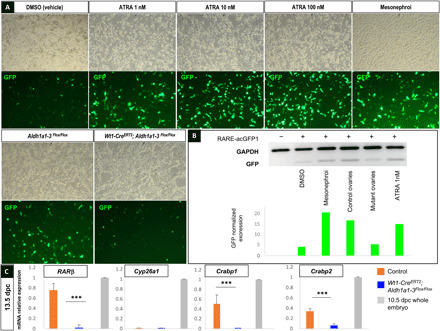
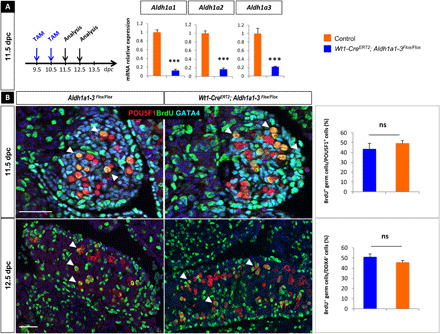
In mammals, the timing of meiosis entry is regulated by signals from the gonadal environment. All- retinoic acid (ATRA) signaling is considered the key pathway that promotes () expression and, in turn, meiosis entry. This model, however, is debated because it is based on analyzing the effects of exogenous ATRA on ex vivo gonadal cultures, which not accurately reflects the role of endogenous ATRA. and two retinaldehyde dehydrogenases synthesizing ATRA, are expressed in the mouse ovaries when meiosis initiates. Contrary to the present view, here, we demonstrate that ATRA-responsive cells are scarce in the ovary. Using three distinct gene deletion models for , we show that expression is independent of ATRA production by ALDH1A proteins and that germ cells progress through meiosis. Together, these data demonstrate that ATRA signaling is dispensable for instructing meiosis initiation in female germ cells.
在哺乳动物中,减数分裂进入的时间由性腺环境的信号调节。全反式视黄酸 (ATRA) 信号被认为是促进 () 表达的关键途径,进而促进减数分裂进入。然而,由于该模型是基于分析外源性 ATRA 对离体性腺培养物的影响,而不能准确反映内源性 ATRA 的作用,因此该模型存在争议。 和 是两种合成 ATRA 的视黄醛脱氢酶,在减数分裂开始时在小鼠卵巢中表达。与目前的观点相反,在这里,我们证明 ATRA 反应细胞在卵巢中很少。使用三种不同的 基因缺失模型,我们表明 表达不依赖于 ALDH1A 蛋白产生的 ATRA,并且生殖细胞通过减数分裂进行。这些数据表明 ATRA 信号对于指导雌性生殖细胞减数分裂的起始是可有可无的。