UCLA Center for Clinical AIDS Research and Education, Division of Infectious Diseases, David Geffen School of Medicine at UCLA, Los Angeles, CA, USA.
Statistical Center for HIV/AIDS Research and Prevention, Fred Hutchinson Cancer Research Center, Seattle, WA, USA.
Lancet HIV. 2020 Jul;7(7):e472-e481. doi: 10.1016/S2352-3018(20)30106-5. Epub 2020 Jun 1.
Long-acting injectable cabotegravir is a novel integrase inhibitor currently in advanced clinical development for HIV prevention and treatment. We aimed to assess the terminal phase pharmacokinetics and safety of long-acting injectable cabotegravir in participants included in the HPTN 077 trial.
HPTN 077 was a multicentre, double-blind, randomised, placebo-controlled phase 2a trial done at eight sites in Brazil, Malawi, South Africa, and the USA. Participants (aged 18-65 years), who were HIV-uninfected and at low-risk for HIV, were randomly assigned (3:1) to long-acting injectable cabotegravir (800 mg given three times at 12 week intervals or 600 mg given five times, administered at one 4 week interval, and every 8 weeks thereafter) or placebo. Participants were followed up to 76 weeks after final injection. In a prespecified analysis of secondary and exploratory outcomes, we assessed the safety, measured by the proportion of participants with grade 2 or worse adverse events, and pharmacokinetics, measured by apparent terminal phase half-life (t) and estimated time to lower limit of quantification (LLOQ) of long-acting injectable cabotegravir during the injection phase (defined as the time between first injection and 12 weeks or 8 weeks after the last injection in cohort 1 or cohort 2 respectively) and tail phase (defined as the time between final injection and 52-76 weeks post-final injection). Safety was analysed in all participants who received at least one injection. Pharmacokinetic analyses included all participants who had received at least one injection and had at least three cabotegravir measurements higher than the LLOQ after the final injection. Pharmacokinetic outcomes were estimated using non-compartmental methods. The trial is completed, and was registered with ClinicalTrials.gov, NCT02178800.
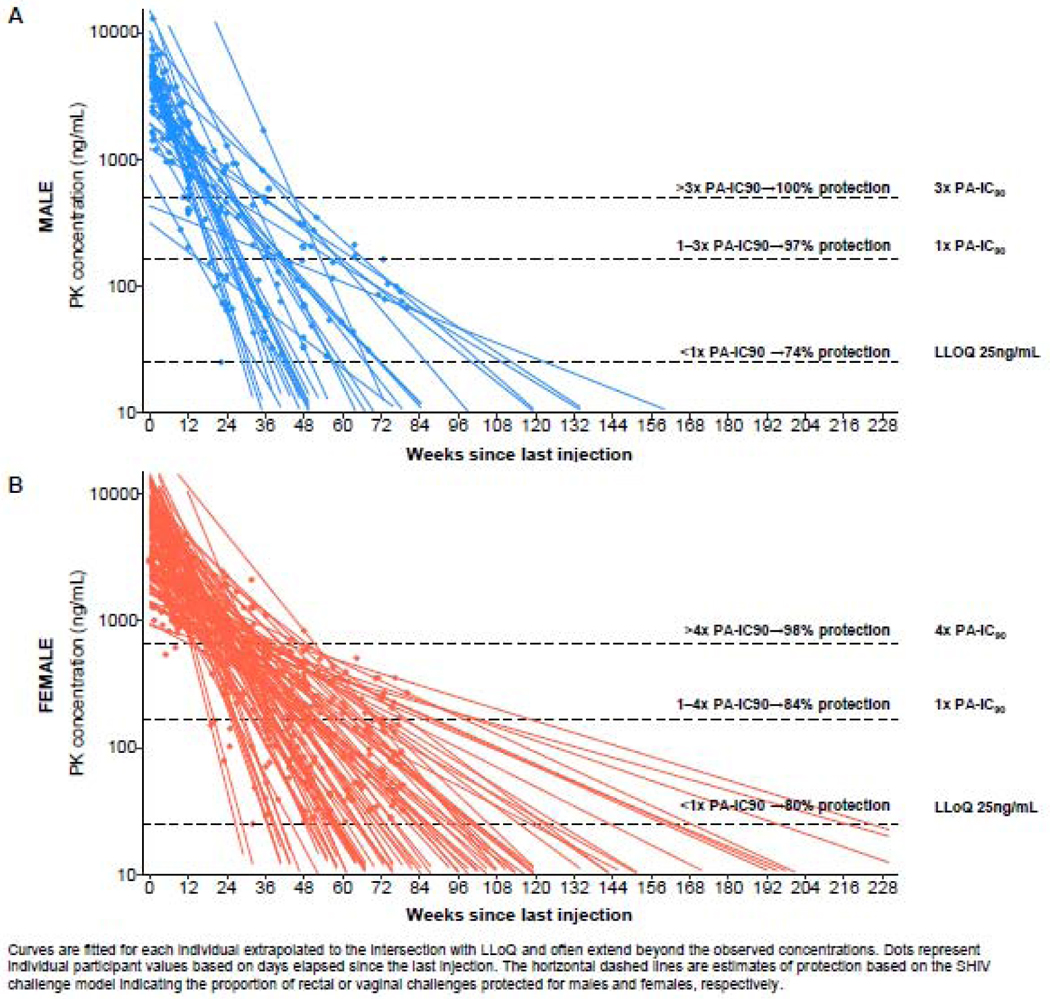
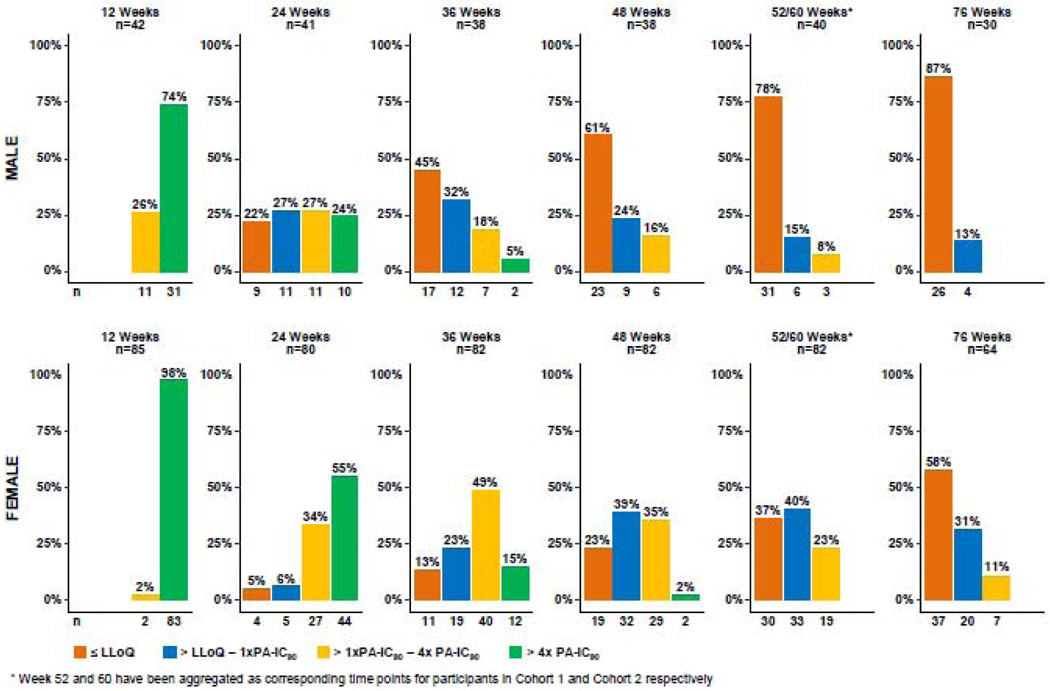
Between Feb 9, 2015, and May 27, 2016, 177 participants (134 participants in the cabotegravir group [74 participants in cohort 1; 60 participants in cohort 2] and 43 participants in the placebo group [25 participants in cohort 1; 18 participants in cohort 2) were enrolled and received at least one injection and thus were included in the safety analysis. The incidence of grade 2 or worse adverse events was significantly lower during the tail phase than the injection phase (p<0·0001). At 52-60 weeks after final injection, nine (23%) of 40 male participants had detectable cabotegravir concentrations and at week 76, four (13%) of 30 male participants had detectable cabotegravir concentrations compared with 52 (63%) of 82 female participants and 27 (42%) of 64 female participants at the same timepoints. The median time from the last injection to the time when cabotegravir concentration decreased below the LLOQ was 43·7 weeks (IQR 31·1-66·6; range 20·4-152·5) for male participants and 67·3 weeks (29·1-89·6; 17·7-225·5) for female participants (p=0·0003). t was longer for female participants than male participants (geometric mean fold-change 1·33, 95% CI 1·06-1·68; p=0·014), and longer for participants with a high body-mass index (BMI) than those with a low BMI (1·31, 1·06-1·63; p=0·015).
The clinical significance of the long pharmacokinetic tail of cabotegravir observed in female participants compared with male participants, and those with higher BMI compared with a lower BMI, need to be addressed in future trials.
National Institute of Allergy and Infectious Diseases.
长效注射用卡替拉韦是一种新型整合酶抑制剂,目前正处于艾滋病预防和治疗的临床研究后期。我们旨在评估 HPTN 077 试验中纳入的参与者长效注射用卡替拉韦的终末相药代动力学和安全性。
HPTN 077 是一项多中心、双盲、随机、安慰剂对照的 2a 期试验,在巴西、马拉维、南非和美国的 8 个地点进行。参与者(年龄 18-65 岁)为 HIV 未感染且 HIV 感染风险较低的人群,按 3:1 随机分配至长效注射用卡替拉韦(800mg 每 12 周 3 次给药或 600mg 第 1 次 4 周 1 次,此后每 8 周 1 次,之后每 8 周 1 次)或安慰剂。最后一次注射后随访 76 周。在预先设定的次要和探索性结局的分析中,我们评估了安全性,通过发生 2 级或更高级别的不良事件的参与者比例来衡量,以及药代动力学,通过长效注射用卡替拉韦在注射阶段(定义为第一次注射至第 12 周或第 1 组或第 2 组最后一次注射后 8 周)和尾期(定义为最后一次注射至最后一次注射后 52-76 周)的表观终末相半衰期(t)和估计定量下限(LLOQ)来衡量。在至少接受一次注射的所有参与者中进行安全性分析。药代动力学分析包括至少接受一次注射且最后一次注射后至少有三次卡替拉韦测量值高于 LLOQ 的所有参与者。药代动力学结果采用非房室模型方法进行估算。该试验已经完成,并在 ClinicalTrials.gov 上注册,NCT02178800。
在 2015 年 2 月 9 日至 2016 年 5 月 27 日期间,共有 177 名参与者(卡替拉韦组 134 名参与者[第 1 组 74 名;第 2 组 60 名]和安慰剂组 43 名参与者[第 1 组 25 名;第 2 组 18 名])被招募并接受了至少一次注射,因此被纳入安全性分析。尾期不良事件发生率明显低于注射期(p<0·0001)。最后一次注射后 52-60 周,40 名男性参与者中有 9 名(23%)可检测到卡替拉韦浓度,而在第 76 周时,30 名男性参与者中有 4 名(13%)可检测到卡替拉韦浓度,而在同一时间点,82 名女性参与者中有 52 名(63%)和 64 名女性参与者中有 27 名(42%)可检测到卡替拉韦浓度。从最后一次注射到卡替拉韦浓度降至 LLOQ 以下的时间中位数为男性参与者 43.7 周(IQR 31.1-66.6;范围 20.4-152.5),女性参与者 67.3 周(29.1-89.6;17.7-225.5)(p=0·0003)。女性参与者的 t 值长于男性参与者(几何平均 fold-change 1·33,95%CI 1·06-1·68;p=0·014),而体重指数(BMI)较高的参与者长于 BMI 较低的参与者(1·31,1·06-1·63;p=0·015)。
在女性参与者中观察到的长效卡替拉韦的长药代动力学尾期与男性参与者相比,以及与 BMI 较高的参与者相比,与 BMI 较低的参与者相比,需要在未来的试验中解决。
国家过敏和传染病研究所。