Chemical Engineering Department, Universidad Católica del Norte, Antofagasta CP 1270709, Chile.
Mining Business School, ENM, Universidad Católica del Norte, Antofagasta CP 1270709, Chile.
Int J Environ Res Public Health. 2020 Jun 2;17(11):3948. doi: 10.3390/ijerph17113948.
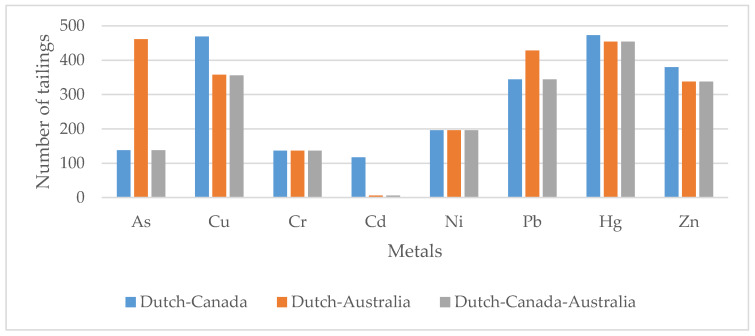
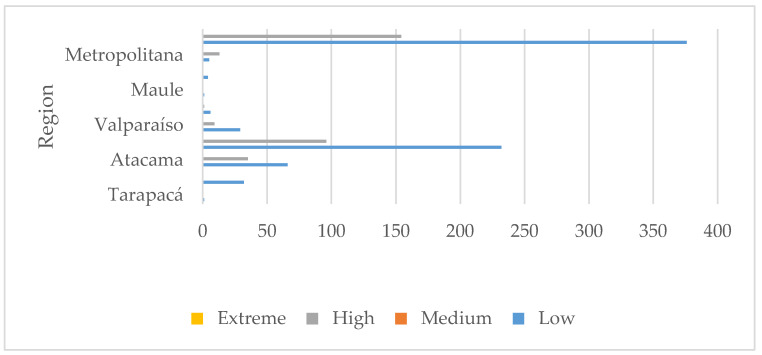
For centuries, Chile has been a territory with significant mining activity, resulting in associated social benefits and impacts. One of the main challenges the country faces today is the presence of a great number of mine tailings containing heavy metals, such as Cu, Cr, Ni, Zn, Pb, As, Cd, and Fe, which make up a potential risk for the population. This study is intended to develop a methodology for determining tailings requiring urgent treatment in Chile, based on risks associated with heavy metals. Geochemical data from 530 Chilean tailings were compared to the Dutch norm and the Canadian and Australian soil quality guidelines for residential use. Additionally, criteria about residents and water bodies were used, considering a 2-km area of influence around tailings. To do this, QGIS (Böschacherstrasse 10a CH-8624 Grüt (Gossau ZH),Zurich, Switzerland), a geospatial tool, was used to geolocate each deposit, considering regions, communes, rivers, lakes, and populated areas. To evaluate potential ecological contamination risks, Hakanson's methodology was used. Results revealed the presence of 12 critical tailings in Chile that require urgent treatment. From the 530 tailings evaluated, 195 are located at less than 2 km from a populated area and 154 at less than 2 km from a water body. In addition, 347 deposits require intervention: 30 on Cu, 30 on Cr, 13 on Zn, 69 on Pb, 138 on As, 1 on Cd, and 5 on Hg.
几个世纪以来,智利一直是一个矿业活动频繁的地区,这带来了相应的社会效益和影响。如今,该国面临的主要挑战之一是存在大量含有重金属的尾矿,如 Cu、Cr、Ni、Zn、Pb、As、Cd 和 Fe,这对人口构成了潜在的风险。本研究旨在制定一种方法,以确定智利需要紧急处理的尾矿,方法是基于与重金属相关的风险。对 530 个智利尾矿的地球化学数据与荷兰标准以及加拿大和澳大利亚的住宅土壤质量指南进行了比较。此外,还考虑到尾矿周围 2 公里的影响区域,使用了关于居民和水体的标准。为此,使用了地理空间工具 QGIS(瑞士苏黎世 Böschacherstrasse 10a CH-8624 Grüt (Gossau ZH))来对每个矿床进行地理定位,考虑到地区、公社、河流、湖泊和人口稠密地区。为了评估潜在的生态污染风险,采用了 Hakanson 方法。结果显示,智利有 12 个关键尾矿需要紧急处理。在所评估的 530 个尾矿中,有 195 个位于距人口稠密区不到 2 公里的地方,有 154 个位于距水体不到 2 公里的地方。此外,有 347 个矿床需要干预:30 个涉及 Cu,30 个涉及 Cr,13 个涉及 Zn,69 个涉及 Pb,138 个涉及 As,1 个涉及 Cd,5 个涉及 Hg。