Laboratory of Transplantation Immunobiology, Department of Immunology, Institute of Biomedical Sciences, University of São Paulo, São Paulo, Brazil.
Laboratory of Immunology, Heart Institute (INCOR), University of São Paulo, São Paulo, Brazil.
Br J Cancer. 2020 Aug;123(4):534-541. doi: 10.1038/s41416-020-0915-6. Epub 2020 Jun 5.
Host-microbiota interactions shape T-cell differentiation and promote tumour immunity. Although IL-9-producing T cells have been described as potent antitumour effectors, their role in microbiota-mediated tumour control remains unclear.
We analysed the impact of the intestinal microbiota on the differentiation of colonic lamina propria IL-9-producing T cells in germ-free and dysbiotic mice. Systemic effects of the intestinal microbiota on IL-9-producing T cells and the antitumour role of IL-9 were analysed in a model of melanoma-challenged dysbiotic mice.
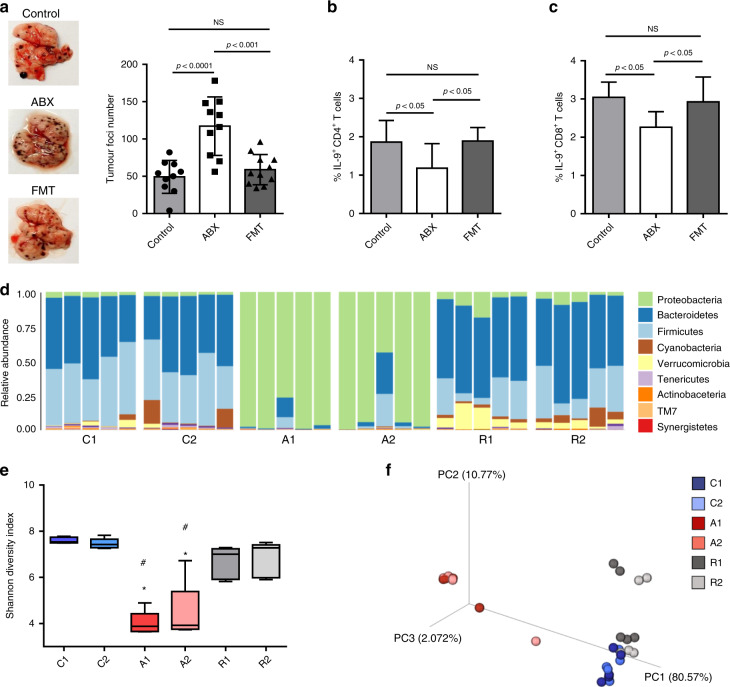
We show that germ-free mice have lower frequency of colonic lamina propria IL-9-producing T cells when compared with conventional mice, and that intestinal microbiota reconstitution restores cell frequencies. Long-term antibiotic treatment promotes host dysbiosis, diminishes intestinal IL-4 and TGF-β gene expression, decreases the frequency of colonic lamina propria IL-9-producing T cells, increases the susceptibility to tumour development and reduces the frequency of IL-9-producing T cells in the tumour microenvironment. Faecal transplant restores intestinal microbiota diversity, and the frequency of IL-9-producing T cells in the lungs of dysbiotic animals, restraining tumour burden. Finally, recombinant IL-9 injection enhances tumour control in dysbiotic mice.
Host-microbiota interactions are required for adequate differentiation and antitumour function of IL-9-producing T cells.
宿主-微生物群相互作用塑造 T 细胞分化并促进肿瘤免疫。虽然产生 IL-9 的 T 细胞已被描述为有效的抗肿瘤效应物,但它们在微生物群介导的肿瘤控制中的作用尚不清楚。
我们分析了肠道微生物群对无菌和失调小鼠结肠固有层产生 IL-9 的 T 细胞分化的影响。在失调小鼠黑色素瘤挑战模型中分析了肠道微生物群对产生 IL-9 的 T 细胞的全身影响和 IL-9 的抗肿瘤作用。
我们表明,与常规小鼠相比,无菌小鼠结肠固有层产生 IL-9 的 T 细胞频率较低,而肠道微生物群的重建恢复了细胞频率。长期抗生素治疗会促进宿主菌群失调,减少肠道 IL-4 和 TGF-β 基因表达,降低结肠固有层产生 IL-9 的 T 细胞频率,增加肿瘤发展的易感性,并减少肿瘤微环境中产生 IL-9 的 T 细胞频率。粪便移植恢复了肠道微生物群的多样性,并恢复了失调动物肺部产生 IL-9 的 T 细胞的频率,从而抑制了肿瘤负担。最后,重组 IL-9 注射增强了失调小鼠的肿瘤控制。
宿主-微生物群相互作用是产生 IL-9 的 T 细胞适当分化和抗肿瘤功能所必需的。