Department of Head and Neck Surgical Oncology, UMC Utrecht Cancer Center, University Medical Center Utrecht, Heidelberglaan 100, P.O. Box 85500, Utrecht, 3508, GA, The Netherlands.
Department of Oral and Maxillofacial Surgery, University Medical Center Utrecht, Utrecht, The Netherlands.
BMC Cancer. 2020 Jun 5;20(1):519. doi: 10.1186/s12885-020-06847-9.
Treatment options for advanced head and neck adenoid cystic carcinoma (AdCC) are limited. Prostate-Specific Membrane Antigen (PSMA), a transmembrane protein that is known for its use in diagnostics and targeted therapy in prostate cancer, is also expressed by AdCC. This study aimed to analyse PSMA expression in a large cohort of primary, recurrent and metastasized AdCC of the head and neck.
One hundred ten consecutive patients with histologically confirmed AdCC in the period 1990-2017 were included. An analysis was made of clinical details, revised pathology and semiquantitative immunohistochemical expression of PSMA on tissue microarray and whole slides. Associations of PSMA expression with clinicopathological parameters were explored and survival was analysed by multivariate Cox-proportional Hazard analysis.
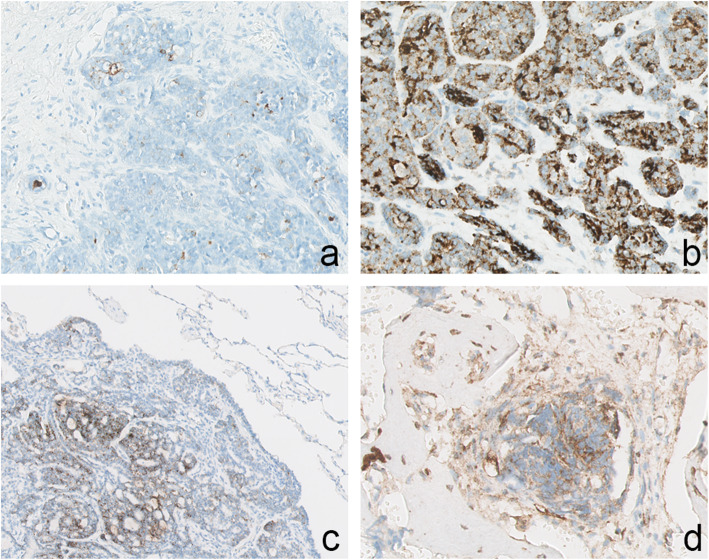
PSMA expression was present in 94% of the 110 primary tumours, with a median of 31% positive cells (IQR 15-60%). Primary tumours (n = 18) that recurred (n = 15) and/or had metastases (n = 10) demonstrated 40, 60 and 23% expression respectively. Expression was not independently related to increased pathological stage, tumour grade, and the occurrence of locoregional recurrence or metastasis. After dichotomization, only primary tumour PSMA expression ≤10% appeared to be associated with reduced 10-years recurrence-free survival (HR 3.0, 95% CI 1.1-8.5, p = .04).
PSMA is highly expressed in primary, recurrent and metastatic AdCC of the salivary and seromucous glands. PSMA expression has no value in predicting clinical behaviour of AdCC although low expression may indicate a reduced recurrence-free survival. This study provides supporting results to consider using PSMA as target for imaging and therapy when other diagnostic and palliative treatment options fail.
晚期头颈部腺样囊性癌(AdCC)的治疗选择有限。前列腺特异性膜抗原(PSMA)是一种跨膜蛋白,已知在前列腺癌的诊断和靶向治疗中使用,也在 AdCC 中表达。本研究旨在分析大量原发性、复发性和转移性头颈部 AdCC 中 PSMA 的表达。
纳入 1990 年至 2017 年间经组织学证实的 110 例连续 AdCC 患者。对临床详细信息、修订后的病理学和组织微阵列及全切片的 PSMA 半定量免疫组织化学表达进行分析。探讨 PSMA 表达与临床病理参数的相关性,并通过多变量 Cox 比例风险分析分析生存情况。
110 例原发性肿瘤中有 94%表达 PSMA,阳性细胞中位数为 31%(IQR 15-60%)。复发(n=15)和/或转移(n=10)的原发性肿瘤(n=18)分别表达 40%、60%和 23%。表达与病理分期增加、肿瘤分级以及局部区域复发或转移的发生无独立相关性。经二分类化后,仅原发性肿瘤 PSMA 表达≤10%与 10 年无复发生存率降低相关(HR 3.0,95%CI 1.1-8.5,p=0.04)。
PSMA 在唾液腺和浆液黏液腺的原发性、复发性和转移性 AdCC 中高度表达。PSMA 表达不能预测 AdCC 的临床行为,尽管低表达可能预示着无复发生存率降低。本研究提供了支持结果,可考虑在其他诊断和姑息治疗选择失败时将 PSMA 作为成像和治疗的靶点。