Department of Medical Psychology, University Medical Center Hamburg-Eppendorf, Hamburg, Hamburg, Germany
Department of Health Economics and Health Services Research, University Medical Center Hamburg-Eppendorf, Hamburg, Hamburg, Germany.
BMJ Open. 2020 Jun 4;10(6):e032146. doi: 10.1136/bmjopen-2019-032146.
Peripheral artery disease (PAD) is the third most prevalent cardiovascular disease worldwide, with smoking and diabetes being the strongest risk factors. The most prominent symptom is leg pain while walking, known as intermittent claudication. To improve mobility, first-line treatment for intermittent claudication is supervised exercise programmes, but these remain largely unavailable and economically impractical, which has led to the development of structured home-based exercise programmes. This trial aims to determine the effectiveness and cost advantage of TeGeCoach, a 12-month long home-based exercise programme, compared with usual care of PAD. It is hypothesised that TeGeCoach improves walking impairment and lowers the need of health care resources that are spent on patients with PAD.
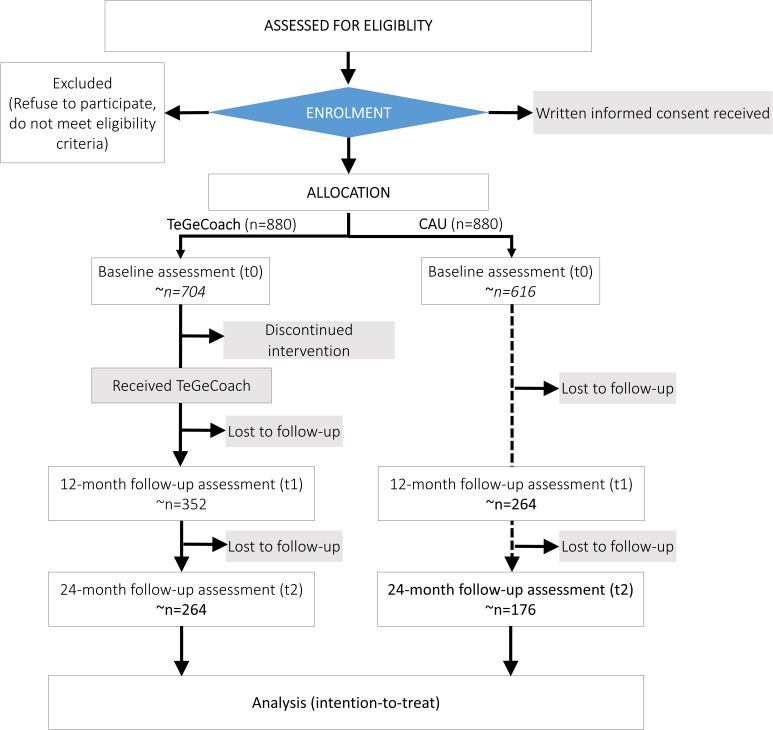
The investigators conduct a prospective, pragmatic randomised controlled clinical trial in a health insurance setting. 1760 patients diagnosed with PAD at Fontaine stage II are randomly assigned to either TeGeCoach or care-as-usual. TeGeCoach consists of telemonitored intermittent walking exercise with medical supervision by a physician and telephone health coaching. Participants allocated to the usual care group receive information leaflets and can access supervised exercise programmes, physical therapy and a variety of programmes for promoting a healthy lifestyle. The primary outcome is patient reported walking ability based on the Walking Impairment Questionnaire. Secondary outcome measures include quality of life, health literacy and health behaviour. Claims data are used to collect total health care costs, healthcare resource use and (severe) adverse events. Outcomes are measured at baseline, 12 and 24 months.
Ethical approval has been obtained from the Medical Association Hamburg. Findings are disseminated through peer-reviewed journals, reports to the funding body, conference presentations and media press releases. Data from this trial are made available to the public and researchers upon reasonable request.NCT03496948 (www.clinicaltrials.gov), Pre-results.
外周动脉疾病(PAD)是全球第三大常见心血管疾病,吸烟和糖尿病是最强的危险因素。最突出的症状是行走时腿部疼痛,即间歇性跛行。为了提高活动能力,间歇性跛行的一线治疗是监督下的运动方案,但这些方案在很大程度上无法获得且在经济上不切实际,这导致了结构化的家庭运动方案的发展。本试验旨在确定为期 12 个月的家庭运动方案 TeGeCoach 与 PAD 的常规护理相比的有效性和成本优势。研究假设 TeGeCoach 可改善步行障碍,并降低 PAD 患者所需的医疗资源的使用。
研究人员在医疗保险环境中进行了一项前瞻性、实用的随机对照临床试验。1760 名被诊断为 Fontaine Ⅱ期 PAD 的患者被随机分配到 TeGeCoach 或常规护理组。TeGeCoach 包括远程监测的间歇性步行运动,由医生进行医疗监督和电话健康指导。分配到常规护理组的参与者会收到信息传单,并可以获得监督运动方案、物理治疗以及促进健康生活方式的各种方案。主要结局是基于步行障碍问卷的患者报告的步行能力。次要结局指标包括生活质量、健康素养和健康行为。索赔数据用于收集总医疗保健费用、医疗资源使用和(严重)不良事件。在基线、12 个月和 24 个月时进行测量。
汉堡医学协会已批准该研究。研究结果通过同行评议的期刊、向资助机构的报告、会议演讲和媒体新闻稿进行传播。本试验的数据在合理要求的情况下向公众和研究人员开放。NCT03496948(www.clinicaltrials.gov),预结果。