Department of Pharmacy, The People's Hospital of Gaozhou, Gaozhou, 525200, China.
State Key Laboratory of Respiratory Disease, National Clinical Research Center of Respiratory Disease, Guangzhou Institute of Respiratory Health, the First Affiliated Hospital of Guangzhou Medical University, Guangzhou, 510120, China.
Acta Pharmacol Sin. 2020 Sep;41(9):1178-1196. doi: 10.1038/s41401-020-0403-9. Epub 2020 Jun 5.
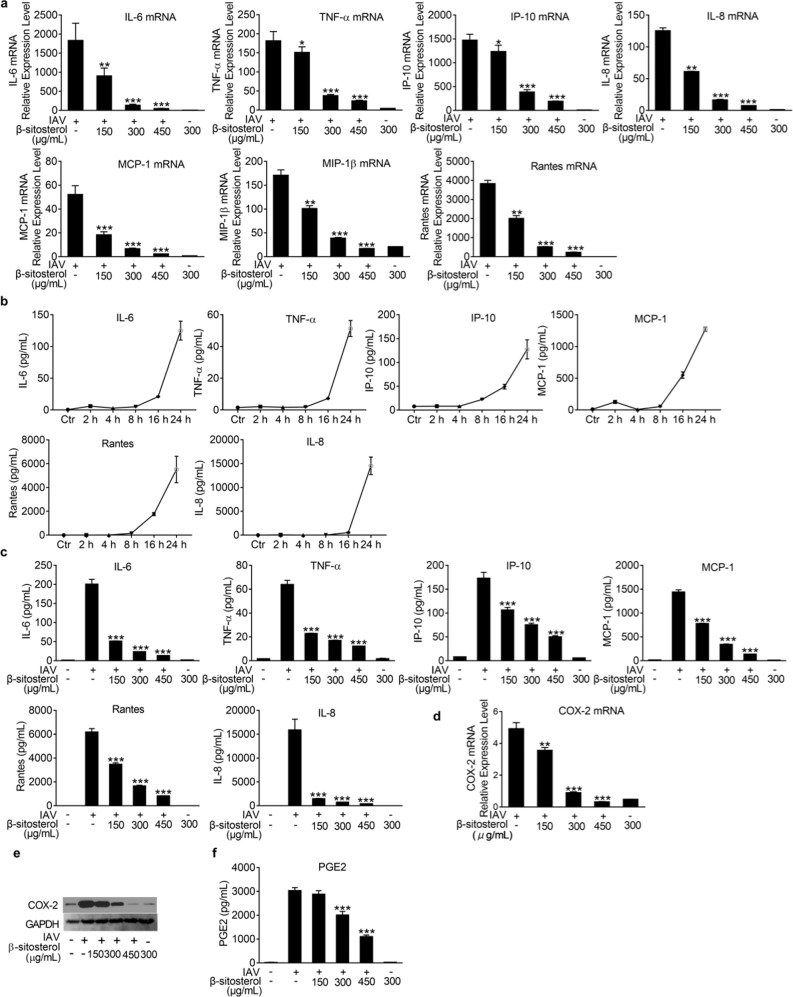
β-Sitosterol (24-ethyl-5-cholestene-3-ol) is a common phytosterol Chinese medical plants that has been shown to possess antioxidant and anti-inflammatory activity. In this study we investigated the effects of β-sitosterol on influenza virus-induced inflammation and acute lung injury and the molecular mechanisms. We demonstrate that β-sitosterol (150-450 μg/mL) dose-dependently suppresses inflammatory response through NF-κB and p38 mitogen-activated protein kinase (MAPK) signaling in influenza A virus (IAV)-infected cells, which was accompanied by decreased induction of interferons (IFNs) (including Type I and III IFN). Furthermore, we revealed that the anti-inflammatory effect of β-sitosterol resulted from its inhibitory effect on retinoic acid-inducible gene I (RIG-I) signaling, led to decreased STAT1 signaling, thus affecting the transcriptional activity of ISGF3 (interferon-stimulated gene factor 3) complexes and resulting in abrogation of the IAV-induced proinflammatory amplification effect in IFN-sensitized cells. Moreover, β-sitosterol treatment attenuated RIG-I-mediated apoptotic injury of alveolar epithelial cells (AEC) via downregulation of pro-apoptotic factors. In a mouse model of influenza, pre-administration of β-sitosterol (50, 200 mg·kg·d, i.g., for 2 days) dose-dependently ameliorated IAV-mediated recruitment of pathogenic cytotoxic T cells and immune dysregulation. In addition, pre-administration of β-sitosterol protected mice from lethal IAV infection. Our data suggest that β-sitosterol blocks the immune response mediated by RIG-I signaling and deleterious IFN production, providing a potential benefit for the treatment of influenza.
β-谷甾醇(24-乙基-5-胆甾烯-3-醇)是一种常见的植物固醇,已被证明具有抗氧化和抗炎活性。在这项研究中,我们研究了β-谷甾醇对流感病毒诱导的炎症和急性肺损伤的影响及其分子机制。我们证明β-谷甾醇(150-450μg/ml)通过核因子-κB 和 p38 丝裂原活化蛋白激酶(MAPK)信号通路在流感病毒(IAV)感染的细胞中呈剂量依赖性抑制炎症反应,同时伴随干扰素(IFNs)(包括 I 型和 III 型 IFN)诱导减少。此外,我们揭示了β-谷甾醇的抗炎作用源于其对视黄酸诱导基因 I(RIG-I)信号的抑制作用,导致 STAT1 信号减少,从而影响 ISGF3(干扰素刺激基因因子 3)复合物的转录活性,并导致 IFN 敏化细胞中 IAV 诱导的促炎放大效应被阻断。此外,β-谷甾醇通过下调促凋亡因子来减轻 RIG-I 介导的肺泡上皮细胞(AEC)凋亡损伤。在流感小鼠模型中,β-谷甾醇(50、200mg·kg·d,ig,连续 2 天)的预处理呈剂量依赖性改善了 IAV 介导的致病性细胞毒性 T 细胞募集和免疫失调。此外,β-谷甾醇预处理可保护小鼠免受致死性 IAV 感染。我们的数据表明,β-谷甾醇阻断了 RIG-I 信号介导的免疫反应和有害 IFN 的产生,为流感的治疗提供了一种潜在的益处。