Boehringer Ingelheim Pharma GmbH & Co. KG, Birkendorfer Str. 65, 88397, Biberach an der Riss, Germany.
UniversitätsKlinikum Heidelberg-Medizinische Klinik, Abteilung Klinische Pharmakologie and Pharmakoepidemiologie, Heidelberg, Germany.
Clin Pharmacokinet. 2020 Dec;59(12):1627-1639. doi: 10.1007/s40262-020-00907-w.
A novel cocktail containing four substrates of key drug transporters was previously optimized to eliminate mutual drug-drug interactions between the probes digoxin (P-glycoprotein substrate), furosemide (organic anion transporter 1/3), metformin (organic cation transporter 2, multidrug and toxin extrusion protein 1/2-K), and rosuvastatin (organic anion transporting polypeptide 1B1/3, breast cancer resistance protein). This clinical trial investigated the effects of four commonly employed drug transporter inhibitors on cocktail drug pharmacokinetics.
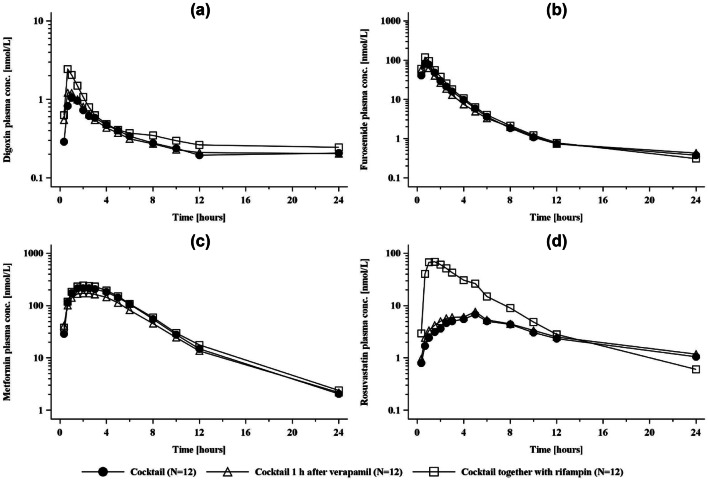
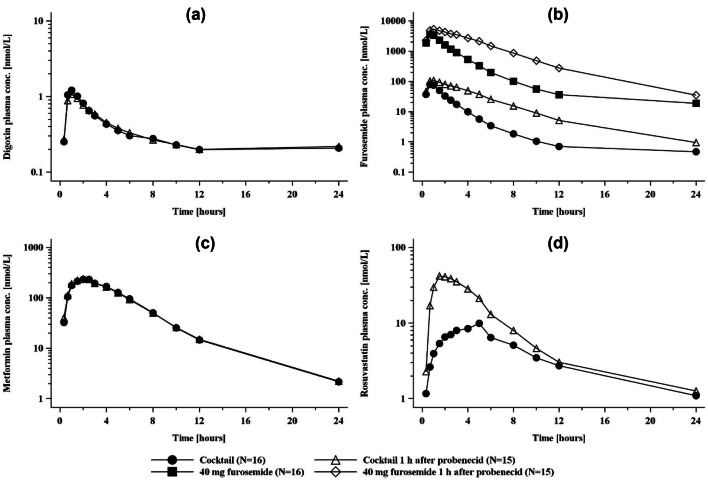
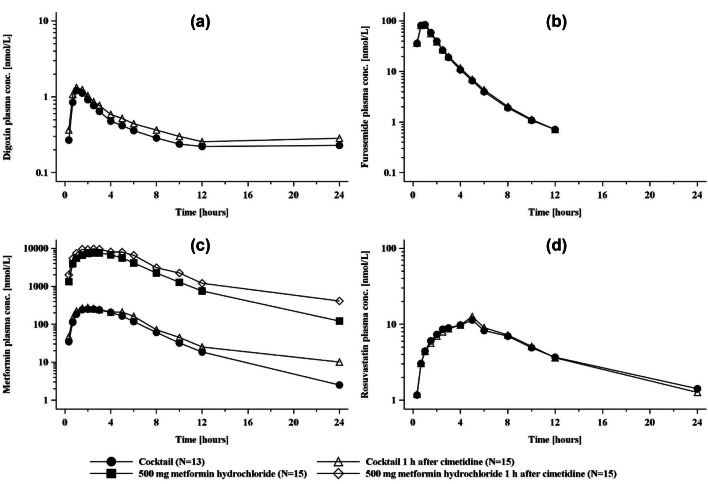
In a randomized open-label crossover trial in 45 healthy male subjects, treatment groups received the cocktail with or without single oral doses of rifampin, verapamil, cimetidine or probenecid. Concentrations of the probe drugs in serial plasma samples and urine fractions were measured by validated liquid chromatography-tandem mass spectrometry assays to assess systemic exposure.
The results were generally in accordance with known in vitro and/or clinical drug-drug interaction data. Single-dose rifampin increased rosuvastatin area under the plasma concentration-time curve up to the last quantifiable concentration (AUC) by 248% and maximum plasma concentration (C) by 1025%. Probenecid increased furosemide AUC by 172% and C by 23%. Cimetidine reduced metformin renal clearance by 26%. The effect of single-dose verapamil on digoxin systemic exposure was less than expected from multiple-dose studies (AUC unaltered, C + 22%).
Taking all the interaction results together, the transporter cocktail is considered to be validated as a sensitive and specific tool for evaluating transporter-mediated drug-drug interactions in drug development.
EudraCT number 2017-001549-29.
先前优化了一种含有四种关键药物转运体底物的新型鸡尾酒,以消除探针地高辛(P-糖蛋白底物)、呋塞米(有机阴离子转运体 1/3)、二甲双胍(有机阳离子转运体 2、多药和毒素外排蛋白 1/2-K)和瑞舒伐他汀(有机阴离子转运多肽 1B1/3、乳腺癌耐药蛋白)之间的相互药物-药物相互作用。这项临床试验研究了四种常用药物转运体抑制剂对鸡尾酒药物药代动力学的影响。
在 45 名健康男性受试者中进行了一项随机、开放标签的交叉试验,治疗组接受了鸡尾酒加或不加单剂量利福平、维拉帕米、西咪替丁或丙磺舒。通过验证的液相色谱-串联质谱测定法测量连续血浆样本和尿液级分中的探针药物浓度,以评估系统暴露量。
结果与已知的体外和/或临床药物-药物相互作用数据基本一致。单剂量利福平使瑞舒伐他汀的血浆浓度-时间曲线下面积(AUC)增加至最后可定量浓度(AUC)的 248%和最大血浆浓度(C)的 1025%。丙磺舒使呋塞米的 AUC 增加 172%,C 增加 23%。西咪替丁使二甲双胍的肾清除率降低 26%。单剂量维拉帕米对地高辛全身暴露的影响小于多次剂量研究的预期(AUC 不变,C+22%)。
综合所有相互作用的结果,该转运体鸡尾酒被认为是验证用于评估药物开发中转运体介导的药物-药物相互作用的敏感和特异工具。
EudraCT 编号 2017-001549-29。