Section on Endocrinology and Genetics & Inter-Institute Endocrinology Fellowship Program, Eunice Kennedy Shriver National Institute of Child Health & Human Development (NICHD), National Institutes of Health (NIH), Bethesda, MD, 20892, USA.
Section on Endocrinology and Genetics & Inter-Institute Endocrinology Fellowship Program, Eunice Kennedy Shriver National Institute of Child Health & Human Development (NICHD), National Institutes of Health (NIH), Bethesda, MD, 20892, USA.
Best Pract Res Clin Endocrinol Metab. 2020 May;34(3):101428. doi: 10.1016/j.beem.2020.101428. Epub 2020 May 23.
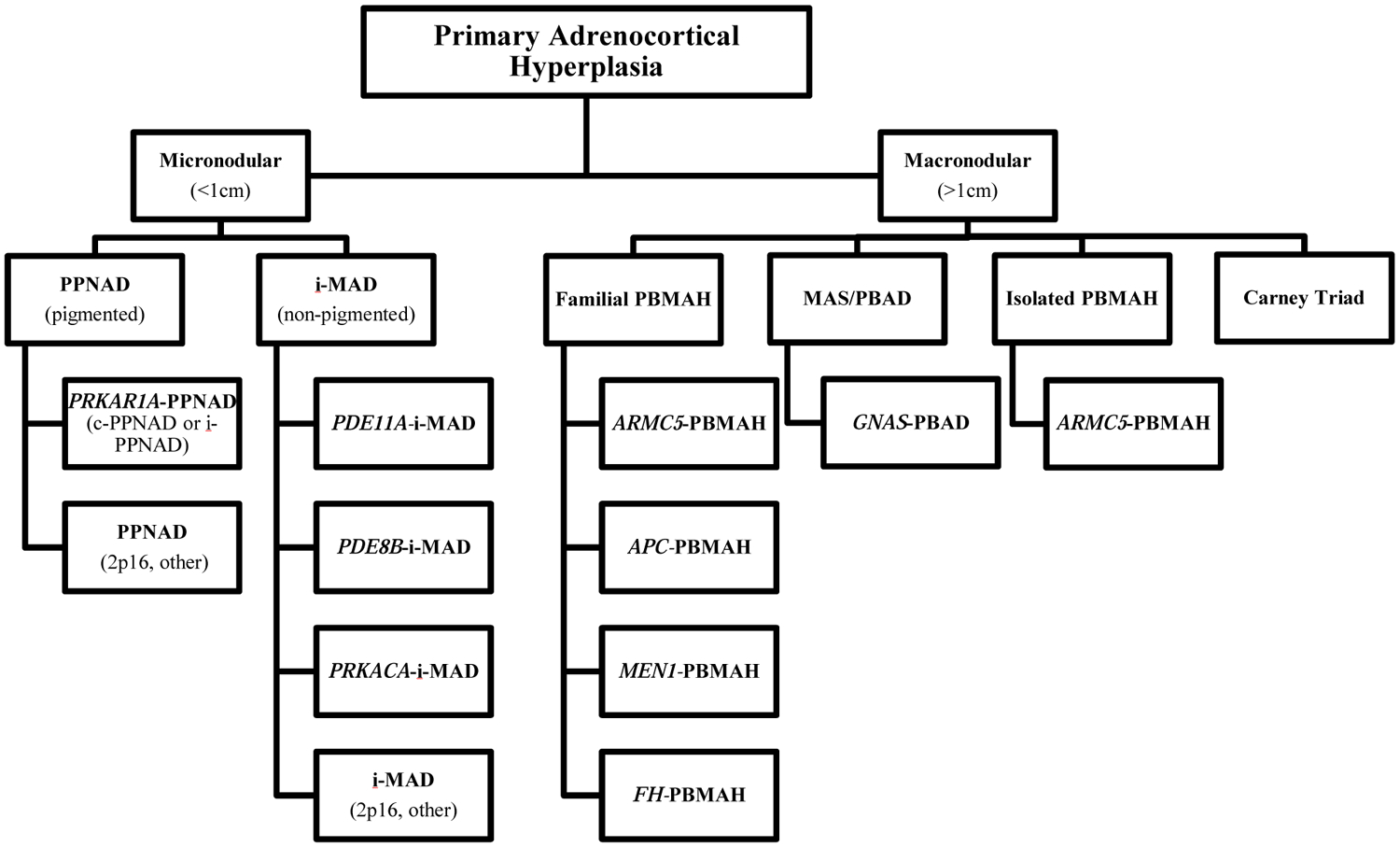
Advances in genomics over the past two decades have allowed for elucidation of the genetic alterations leading to the development of adrenocortical tumors and/or hyperplasias. These molecular changes were initially discovered through the study of rare familial tumor syndromes such as McCune-Albright Syndrome, Carney complex, Li-Fraumeni syndrome, and Beckwith-Wiedemann syndrome, with the identification of alterations in genes and molecular pathways that subsequently led to the discovery of aberrations in these or related genes and pathways in sporadic tumors. Genetic alterations in GNAS, PRKAR1A, PRKACA, PRKACB, PDE11A, and PDE8B, that lead to aberrant cyclic adenosine monophosphate-protein (cAMP) kinase A signaling, were found to play a major role in the development of benign cortisol-producing adrenocortical tumors and/or hyperplasias, whereas genetic defects in KCNJ5, ATP1A1, ATP2B3, CACNA1D, CACNA1H, and CLCN2 were implicated in the development of benign aldosterone-producing tumors and/or hyperplasias through modification of intracellular calcium signaling. Germline ARMC5 defects were found to cause the development of primary bilateral macronodular adrenocortical hyperplasia with glucocorticoid and/or mineralocorticoid oversecretion. Adrenocortical carcinoma was linked primarily to aberrant p53 signaling and/or Wnt-β-catenin signaling, as well as IGF2 overexpression, with frequent genetic alterations in TP53, ZNRF3, CTNNB1, and 11p15. This review focuses on the genetic underpinnings of benign cortisol- and aldosterone-producing adrenocortical tumors/hyperplasias and adrenocortical carcinoma.
在过去的二十年中,基因组学的进步使得阐明导致肾上腺皮质肿瘤和/或增生发展的遗传改变成为可能。这些分子变化最初是通过研究罕见的家族性肿瘤综合征(如 McCune-Albright 综合征、Carney 复合征、Li-Fraumeni 综合征和 Beckwith-Wiedemann 综合征)发现的,这些综合征改变了基因和分子途径,随后导致发现这些或相关基因和途径在散发性肿瘤中的异常。导致异常环磷酸腺苷蛋白激酶 A 信号转导的 GNAS、PRKAR1A、PRKACA、PRKACB、PDE11A 和 PDE8B 基因的遗传改变被发现与良性产生皮质醇的肾上腺皮质肿瘤和/或增生的发展密切相关,而 KCNJ5、ATP1A1、ATP2B3、CACNA1D、CACNA1H 和 CLCN2 中的遗传缺陷通过改变细胞内钙信号转导而与良性产生醛固酮的肿瘤和/或增生的发展有关。胚系 ARMC5 缺陷被发现可导致原发性双侧大结节性肾上腺皮质增生伴糖皮质激素和/或盐皮质激素分泌过多。肾上腺皮质癌主要与异常的 p53 信号转导和/或 Wnt-β-连环蛋白信号转导以及 IGF2 过表达有关,TP53、ZNRF3、CTNNB1 和 11p15 基因经常发生遗传改变。本文综述了良性产生皮质醇和醛固酮的肾上腺皮质肿瘤/增生和肾上腺皮质癌的遗传基础。