Wang Yucheng, Liu Xiaoxiao, Shi Hui, Yu Yong, Yu Ying, Li Minghui, Chen Ruizhen
Department of Cardiology, Zhongshan Hospital, Shanghai Institute of Cardiovascular Diseases, Shanghai Medical College of Fudan University, Shanghai, China.
Department of General Practice, Zhongshan Hospital, Shanghai Medical College of Fudan University, Shanghai, China.
Clin Transl Med. 2020 Jan;10(1):91-106. doi: 10.1002/ctm2.13. Epub 2020 Apr 9.
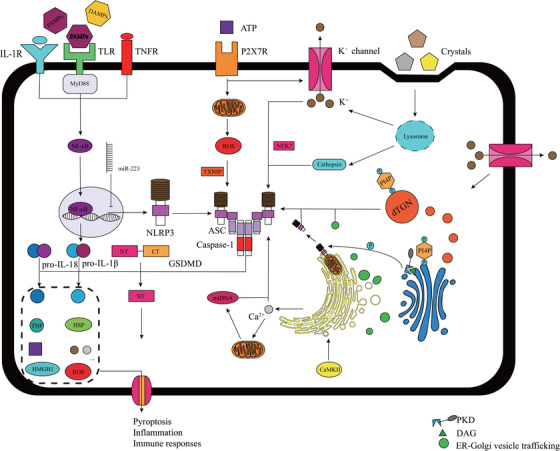
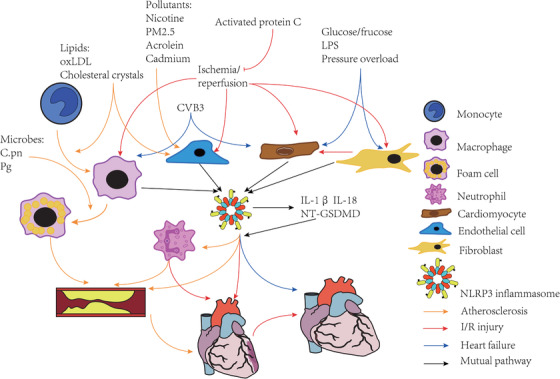
Inflammation is an important process involved in several cardiovascular diseases (CVDs), and nod-like receptor family pyrin domain containing 3 (NLRP3) inflammasome is a vital player in innate immunity and inflammation. In this review, we aim to provide a comprehensive summary of the current knowledge on the role and involvement of NLRP3 inflammasome in the pathogenesis and treatment of CVDs. NLRP3 inflammasome functions as a molecular platform, and triggers the activation of caspase-1 and cleavage of pro-IL-1β, pro-IL-18, and gasdermin D (GSDMD). Cleaved NT-GSDMD forms pores in the cell membrane and initiates pyroptosis, inducing cell death and release of many intracellular pro-inflammatory molecules. NLRP3 inflammasome activation is triggered via inter-related pathways downstream of K efflux, lysosomal disruption, and mitochondrial dysfunction. In addition, the Golgi apparatus and noncoding RNAs are gradually being recognized to play important roles in NLRP3 inflammasome activation. Many investigations have revealed the association between NLRP3 inflammasome and CVDs, including atherosclerosis, ischemia/reperfusion (I/R) injury and heart failure induced by pressure overload or cardiomyopathy. Some existing medications, including orthodox and natural medicines, used for CVD treatment have been newly discovered to act via NLRP3 inflammasome. In addition, NLRP3 inflammasome pathway components such as NLRP3, caspase-1, and IL-1β may be considered as novel therapeutic targets for CVDs. Thus, NLRP3 inflammasome is a key molecule involved in the pathogenesis of CVDs, and further research focused on development of NLRP3 inflammasome-based targeted therapies for CVDs and the clinical evaluation of these therapies is essential.
炎症是多种心血管疾病(CVD)所涉及的重要过程,而含NOD样受体家族吡咯结构域蛋白3(NLRP3)炎性小体是天然免疫和炎症中的关键参与者。在本综述中,我们旨在全面总结目前关于NLRP3炎性小体在CVD发病机制和治疗中的作用及参与情况的知识。NLRP3炎性小体作为一个分子平台,触发半胱天冬酶 -1的激活以及前白细胞介素 -1β、前白细胞介素 -18和gasdermin D(GSDMD)的切割。切割后的NT - GSDMD在细胞膜上形成孔道并引发细胞焦亡,诱导细胞死亡并释放许多细胞内促炎分子。NLRP3炎性小体的激活通过钾离子外流、溶酶体破坏和线粒体功能障碍下游的相互关联途径触发。此外,高尔基体和非编码RNA在NLRP3炎性小体激活中的重要作用也逐渐被认识到。许多研究揭示了NLRP3炎性小体与CVD之间的关联,包括动脉粥样硬化、缺血/再灌注(I/R)损伤以及压力过载或心肌病引起的心力衰竭。一些现有的用于CVD治疗的药物,包括传统药物和天然药物,新近被发现可通过NLRP3炎性小体发挥作用。此外,NLRP3炎性小体途径的组成成分如NLRP3、半胱天冬酶 -1和白细胞介素 -1β可被视为CVD的新型治疗靶点。因此,NLRP3炎性小体是参与CVD发病机制的关键分子,进一步聚焦于开发基于NLRP3炎性小体的CVD靶向治疗方法以及对这些治疗方法进行临床评估的研究至关重要。