Mansukoski Liina, Bogin Barry, Galvez-Sobral J Andres, Furlán Luis, Johnson William
Centre for Global Child Health, The Hospital for Sick Children, Toronto, Canada.
School of Sport, Exercise and Health Sciences, Loughborough University, Loughborough, UK.
Intelligence. 2020 May-Jun;80:101438. doi: 10.1016/j.intell.2020.101438.
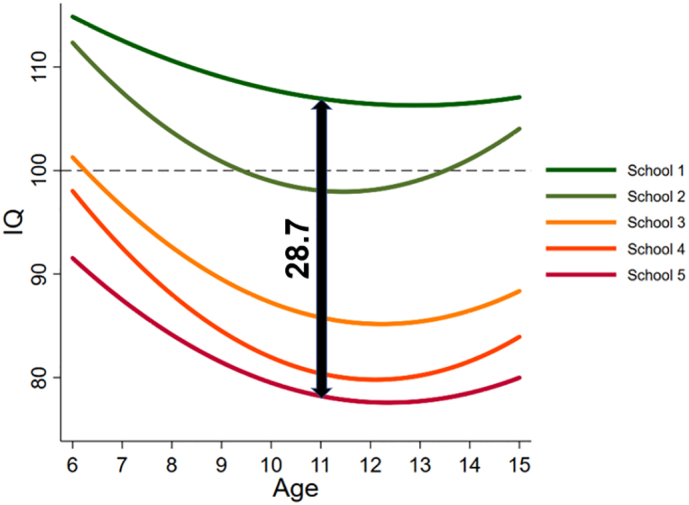
This study documents differences in childhood IQ trajectories of Guatemala City children, aged 6-15 years and born 1961-1993, according to school attended, height-for-age -scores (HAZ) and over time (Flynn effect). IQ data come from the Universidad del Valle de Guatemala Longitudinal Study of Child and Adolescent Development. IQ was measured using standardised tests from the Otis-Lennon Mental Ability Test-series. A multilevel model was developed to describe 60,986 IQ observations (level 1), in 22,724 children (level 2), in five schools representing students of different socioeconomic status (SES) (level 3). Average IQ trajectories differed by school. The difference in average IQ at age 11 years between the students of high and low SES schools was 28.7 points. A one-unit increase in HAZ was associated with a 1.42 (0.72, 2.11) unit higher IQ if HAZ was <0, this association was stronger in public compared to private schools. Conversely, one unit increase in HAZ was only associated with a 0.3 (0.001, 0.5) unit higher IQ if HAZ was ≥0. With each birth year increase, IQ at age 11 years increased by 0.14 (95% CI 0.12, 0.16) units, although this Flynn effect attenuated slightly across adolescence. We found no evidence of secular change in the inequality in IQ trajectories (according to school or HAZ). Shorter children from disadvantaged schools in Guatemala City have lower IQ than their taller and wealthier peers, possibly reflecting the damaging effects of poor early life environments both for linear growth and cognitive development.
本研究记录了1961年至1993年出生、6至15岁的危地马拉城儿童,根据所就读学校、年龄别身高得分(HAZ)以及时间推移(弗林效应),其童年智商轨迹的差异。智商数据来自危地马拉谷大学儿童与青少年发展纵向研究。智商通过奥蒂斯-列侬心理能力测试系列的标准化测试进行测量。开发了一个多层次模型来描述5所代表不同社会经济地位(SES)学生的学校中,22724名儿童(第2层)的60986次智商观测值(第1层)。平均智商轨迹因学校而异。高社会经济地位学校和低社会经济地位学校的学生在11岁时的平均智商差异为28.7分。如果HAZ<0,HAZ每增加一个单位,智商就会高出1.42(0.72,2.11)个单位,与私立学校相比,这种关联在公立学校中更强。相反,如果HAZ≥0,HAZ每增加一个单位,智商仅高出0.3(0.001,0.5)个单位。随着出生年份每增加一年,11岁时的智商增加0.14(95%CI 0.12,0.16)个单位,尽管这种弗林效应在整个青春期略有减弱。我们没有发现智商轨迹不平等方面长期变化的证据(根据学校或HAZ)。危地马拉城弱势学校中较矮的儿童智商低于身材较高且较富裕的同龄人,这可能反映了早期不良生活环境对线性生长和认知发展的有害影响。