Ilic Marija, Holy Marion, Jaentsch Kathrin, Liechti Matthias E, Lubec Gert, Baumann Michael H, Sitte Harald H, Luethi Dino
Institute of Pharmacology, Center for Physiology and Pharmacology, Medical University of Vienna, Vienna, Austria.
Department of Pharmaceutical Chemistry, Faculty of Life Sciences, University of Vienna, Vienna, Austria.
Front Pharmacol. 2020 May 19;11:673. doi: 10.3389/fphar.2020.00673. eCollection 2020.
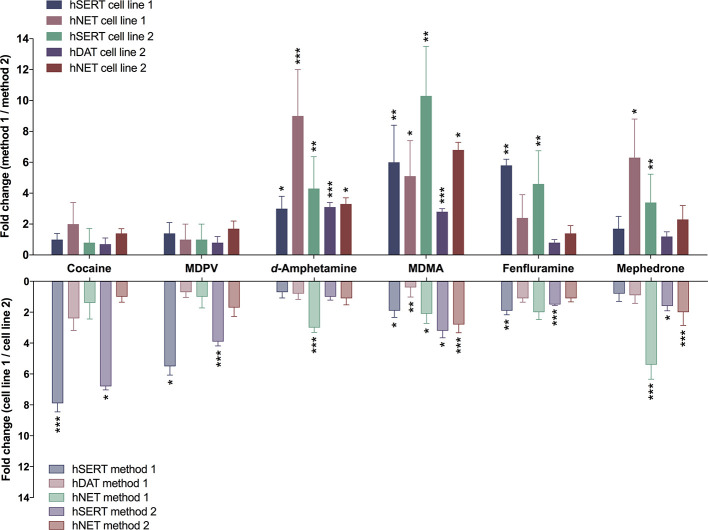
High-affinity monoamine transporters are targets for prescribed medications and stimulant drugs of abuse. Therefore, assessing monoamine transporter activity for candidate medications and newly-emerging drugs of abuse provides essential information for industry, academia, and public health. Radiotracer binding and uptake inhibition are the gold standard assays for determining drug-transporter interaction profiles. The combined results from such assays yield a unique biochemical fingerprint for each compound. Over time, different assay methods have been developed to assess transporter activity, and the comparability of data across various assay platforms remains largely unclear. Here, we compare the effects of six well-established stimulants in two different cell-based uptake inhibition assays, one method using adherent cells and the other using suspended cells. Furthermore, we compare the data from transfected cell lines derived from different laboratories and data reported from rat synaptosomes. For transporter inhibitors, IC values obtained by the two experimental methods were comparable, but using different transfected cell lines yielded disparate results. For transporter substrates, differences between the two cell lines were less pronounced but the drugs displayed different inhibition potencies when evaluated by the two methods. Our study illustrates the inherent limitations when comparing transporter inhibition data from different laboratories and stresses the importance of including appropriate control experiments with reference compounds when investigating new drugs of interest.
高亲和力单胺转运体是处方药和滥用兴奋剂药物的作用靶点。因此,评估候选药物和新出现的滥用药物的单胺转运体活性,可为制药行业、学术界和公共卫生提供重要信息。放射性示踪剂结合和摄取抑制是确定药物-转运体相互作用谱的金标准检测方法。这些检测方法的综合结果可为每种化合物生成独特的生化指纹图谱。随着时间的推移,已开发出不同的检测方法来评估转运体活性,而不同检测平台之间数据的可比性在很大程度上仍不明确。在此,我们在两种不同的基于细胞的摄取抑制检测方法中比较了六种成熟兴奋剂的作用效果,一种方法使用贴壁细胞,另一种方法使用悬浮细胞。此外,我们比较了来自不同实验室的转染细胞系的数据以及大鼠突触体报告的数据。对于转运体抑制剂,两种实验方法获得的IC值具有可比性,但使用不同的转染细胞系会产生不同的结果。对于转运体底物,两种细胞系之间的差异不太明显,但用两种方法评估时,药物显示出不同的抑制效力。我们的研究说明了比较不同实验室的转运体抑制数据时存在的固有局限性,并强调了在研究感兴趣的新药时纳入使用参考化合物的适当对照实验的重要性。