Department of Radiology, Zhongnan Hospital of Wuhan University, Wuhan 430071, China.
Biomed Res Int. 2020 May 15;2020:3872314. doi: 10.1155/2020/3872314. eCollection 2020.
To investigate the predictors of telomerase reverse transcriptase (TERT) promoter mutations in adults suffered from high-grade glioma (HGG) through radiomics analysis, develop a noninvasive approach to evaluate TERT promoter mutations.
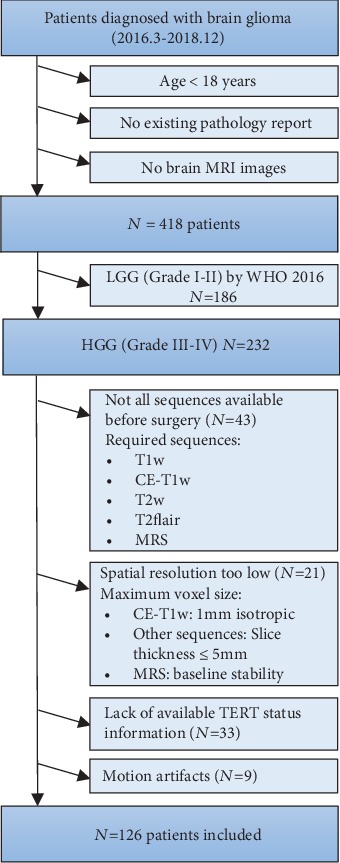
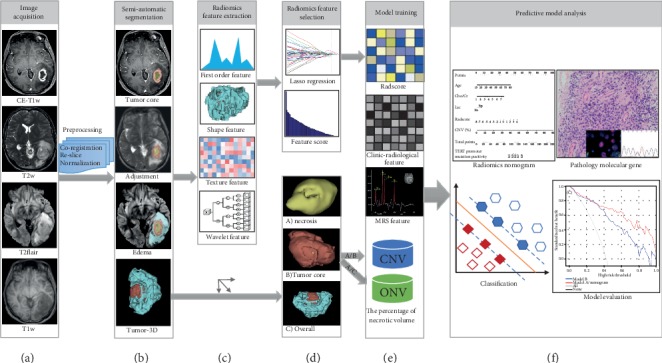
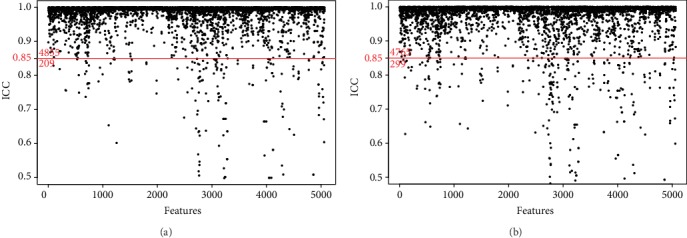
126 adult patients with HGG (88 in the training cohort and 38 in the validation cohort) were retrospectively enrolled. Totally 5064 radiomics features were, respectively, extracted from three VOIs (necrosis, enhanced, and edema) in MRI. Firstly, an optimal radiomics signature (Radscore) was established based on LASSO regression. Secondly, univariate and multivariate logistic regression analyses were performed to investigate important potential variables as predictors of TERT promoter mutations. Besides, multiparameter models were established and evaluated. Eventually, an optimal model was visualized as radiomics nomogram for clinical evaluations.
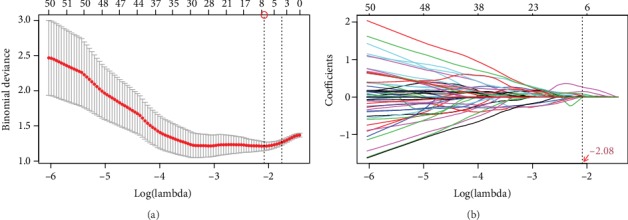
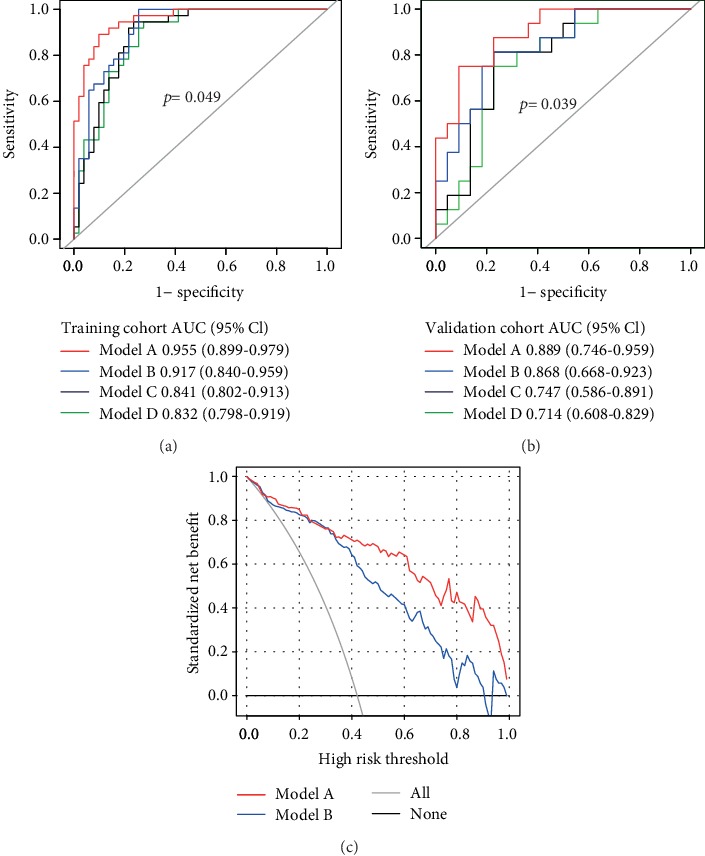
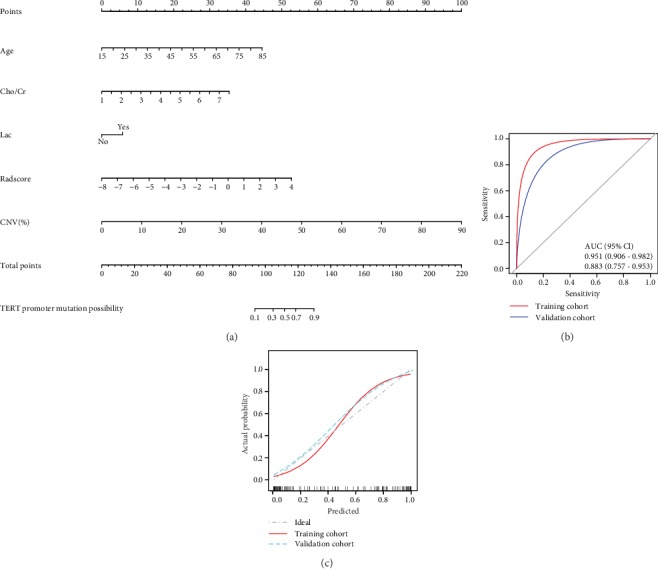
6 radiomics features were selected to build Radscore signature through LASSO regression. Among them, 5 were from necrotic VOIs and 1 was from enhanced ones. With univariate and multivariate analysis, necrotic volume percentages of core (CNV), Age, Cho/Cr, Lac, and Radscore were significantly higher in TERTm than in TERTw ( < 0.05). 4 models were built in our study. Compared with Model B (Age, Cho/Cr, Lac, and Radscore), Model A (Age, Cho/Cr, Lac, Radscore, and CNV) has a larger AUC in both training (0.955 vs. 0.917, = 0.049) and validation (0.889 vs. 0.868, = 0.039) cohorts. It also has higher performances in net reclassification improvement (NRI), integrated discrimination improvement (IDI), and decision curve analysis (DCA) evaluation. Conclusively, Model A was visualized as a radiomics nomogram. Calibration curve shows a good agreement between estimated and actual probabilities.
Age, Cho/Cr, Lac, CNV, and Radscore are important indicators for TERT promoter mutation predictions in HGG. Tumor necrosis seems to be closely related to TERT promoter mutations. Radiomics nomogram based on multiparameter MRI and CNV has higher prediction accuracies.
通过放射组学分析研究成人高级别胶质瘤(HGG)中端粒酶逆转录酶(TERT)启动子突变的预测因素,开发一种非侵入性方法来评估 TERT 启动子突变。
回顾性纳入 126 例成人 HGG 患者(训练队列 88 例,验证队列 38 例)。分别从 MRI 的 3 个感兴趣区(坏死、增强和水肿)中提取 5064 个放射组学特征。首先,基于 LASSO 回归建立最佳放射组学特征(Radscore)。其次,进行单因素和多因素逻辑回归分析,以研究作为 TERT 启动子突变预测因子的重要潜在变量。此外,还建立并评估了多参数模型。最后,将最佳模型可视化,作为临床评估的放射组学列线图。
通过 LASSO 回归选择 6 个放射组学特征来构建 Radscore 特征。其中,5 个来自坏死感兴趣区,1 个来自增强感兴趣区。通过单因素和多因素分析,TERTm 组的核心坏死体积百分比(CNV)、年龄、Cho/Cr、Lac 和 Radscore 显著高于 TERTw 组(<0.05)。本研究建立了 4 个模型。与模型 B(年龄、Cho/Cr、Lac 和 Radscore)相比,模型 A(年龄、Cho/Cr、Lac、Radscore 和 CNV)在训练(0.955 对 0.917,=0.049)和验证(0.889 对 0.868,=0.039)队列中具有更大的 AUC。在净重新分类改善(NRI)、综合判别改善(IDI)和决策曲线分析(DCA)评估中也具有更高的性能。总之,模型 A 被可视化作为放射组学列线图。校准曲线显示估计概率与实际概率之间具有良好的一致性。
年龄、Cho/Cr、Lac、CNV 和 Radscore 是 HGG 中 TERT 启动子突变预测的重要指标。肿瘤坏死似乎与 TERT 启动子突变密切相关。基于多参数 MRI 和 CNV 的放射组学列线图具有更高的预测准确性。